

Gold price heads for weekly loss as DXY surges above 100.00
- XAU/USD falls 0.7% to $5,032, set for weekly losses exceeding 2%.
- DXY climbs to 100.43 while US 10-year yield rises near 4.29%.
- US Q4 GDP revised down to 0.7% as Core PCE holds steady at 3.1% YoY.
Gold price loses some 0.70% on Friday. It seems poised to end the week with losses of more than 2% as the Greenback remains the choice for safety amid the Middle East conflict, which has increased investors' angst over a reacceleration of inflation. Also, a softer-than-expected reading of US growth data increased the chances of a rate cut in 226.
Bullion slips below $5,050 as rising yields, Middle East tensions boost demand for the US Dollar
The XAU/USD trades at $5032 after reaching a daily high of $5,128. The US Dollar Index (DXY), which tracks the performance of the American currency against other peers, is up 0.70% at 100.43 a headwind for Bullion prices.
Growth data from the US revealed an ongoing economic slowdown in the second half of 2025. The Gross Domestic Product (GDP) for Q4 2025, on its second estimate, dipped from 1.4% to 0.7% YoY, according to the US Commerce Department.
At the same time, the Core Personal Consumption Expenditures (PCE) Price Index, the Federal Reserve's preferred inflation gauge, remained steady at 3.1% YoY in January, unchanged from the previous print, while the headline figure dipped modestly from 2.9% to 2.8% YoY.
Given the backdrop, a stagflationary scenario looms. Standard & Poor's rating agency warned that Iran's war could cause lasting supply shocks, leading to lower US GDP growth and higher inflation.
Fed expected to hold rates
US Treasury yields are also soaring, weighing on the precious metals segment. The US 10-year T-note yield rises nearly 2.5 basis points to 4.286%.
Money markets traders had priced in a less dovish Fed; they're expecting 20 basis points of easing, according to data from the Chicago Board of Trade (CBOT).
Speculation of US price increases is fueled by the ongoing conflict in the Middle East, after WTI prices reached a year-high of $113.00. The price of gasoline at the pump had risen by more than 20%, reaching a high of $3.60 per gallon since the commencement of the conflict two weeks ago.
President Donald Trump said the US will take strong action against Iran next week, after a 30-day waiver for buying sanctioned Russian oil.
Next week US economic docket
Traders are expected to pay close attention to geopolitical events over the weekend, and then shift their focus to the Federal Reserve's meeting on March 17-18. In addition, they will monitor Industrial Production, housing statistics, the Producer Price Index (PPI), and employment data.
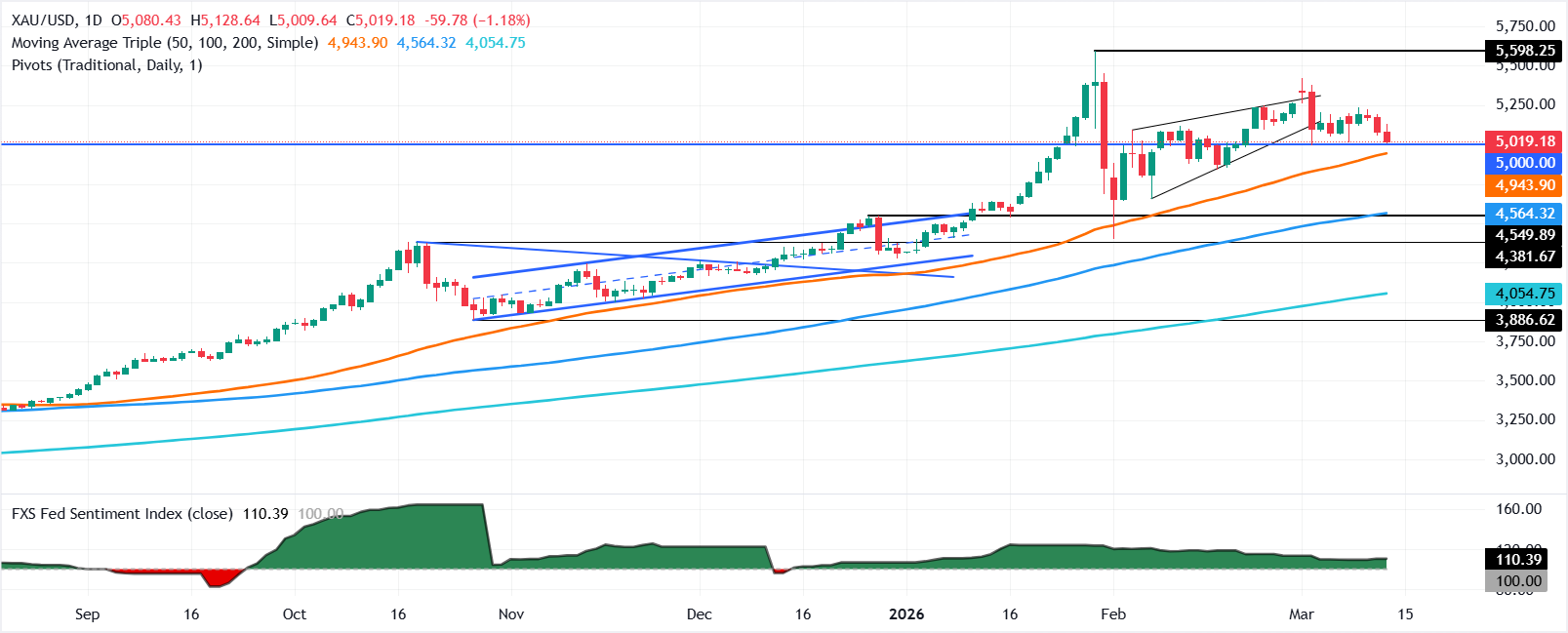
XAU/USD Technical outlook: Gold to challenge $5,000 as key support level
Gold's technical picture has turned bearish in the near term, with XAU/USD poised to drop below $5,000, which could sponsor a test of the 50-day Simple Moving Average (SMA) at $4,925.
Momentum has shifted bearish, as indicated by the Relative Strength Index (RSI), which has fallen below its 50-neutral level.
With that said, the most likely scenario is downwards. Beneath the 50-day SMA lies the February 17 swing low of $4,841, ahead of the February 6 daily low of $4,655. Conversely, the first area of interest for XAU/USD on the upside would be the $5,050 area, followed by $5,100. Up next lies the next key resistance level, being the March month high at $5,238.
Gold FAQs
Gold has played a key role in human’s history as it has been widely used as a store of value and medium of exchange. Currently, apart from its shine and usage for jewelry, the precious metal is widely seen as a safe-haven asset, meaning that it is considered a good investment during turbulent times. Gold is also widely seen as a hedge against inflation and against depreciating currencies as it doesn’t rely on any specific issuer or government.
Central banks are the biggest Gold holders. In their aim to support their currencies in turbulent times, central banks tend to diversify their reserves and buy Gold to improve the perceived strength of the economy and the currency. High Gold reserves can be a source of trust for a country’s solvency. Central banks added 1,136 tonnes of Gold worth around $70 billion to their reserves in 2022, according to data from the World Gold Council. This is the highest yearly purchase since records began. Central banks from emerging economies such as China, India and Turkey are quickly increasing their Gold reserves.
Gold has an inverse correlation with the US Dollar and US Treasuries, which are both major reserve and safe-haven assets. When the Dollar depreciates, Gold tends to rise, enabling investors and central banks to diversify their assets in turbulent times. Gold is also inversely correlated with risk assets. A rally in the stock market tends to weaken Gold price, while sell-offs in riskier markets tend to favor the precious metal.
The price can move due to a wide range of factors. Geopolitical instability or fears of a deep recession can quickly make Gold price escalate due to its safe-haven status. As a yield-less asset, Gold tends to rise with lower interest rates, while higher cost of money usually weighs down on the yellow metal. Still, most moves depend on how the US Dollar (USD) behaves as the asset is priced in dollars (XAU/USD). A strong Dollar tends to keep the price of Gold controlled, whereas a weaker Dollar is likely to push Gold prices up.














