

USD/INR trades subduedly ahead of US-Iran talks in Pakistan
- The Indian Rupee edges higher against the US Dollar on Friday ahead of key events.
- Investors await the US CPI data and the outcome of negotiations between the US and Iran.
- The selling pressure from FIIs has slowed down, following the US-Iran temporary truce.
The Indian Rupee (INR) ticks up against the US Dollar (USD) at around 92.45 on Friday. The USD/INR pair is expected to remain on the sidelines as investors await the United States (US) Consumer Price Index (CPI) data for March at 06:00 pm IST (12:30 GMT) and the outcome of negotiations between the United States (US) and Iran on the 10-point peace proposal in Pakistan over the weekend.

During the press time, the US Dollar Index (DXY), which tracks the Greenback’s value against six major currencies, trades almost flat around 98.85.
US CPI data awaited
Investors will pay close attention to the US inflation data for March, as it will reflect the impact of elevated energy prices, which are driven by the war in the Middle East. The US CPI report is expected to show that the headline inflation accelerated to 3.3% Year-on-Year (YoY) from 2.4% in February. On a monthly basis, the headline inflation is expected to have grown at a faster pace of 0.9% against the previous reading of 0.3%.
The US core CPI – which excludes volatile food and energy items – is estimated to have risen 2.7% YoY, faster than the prior release of 2.5%. Month-on-Month (MoM) core CPI is expected to arrive higher at 0.3% from 0.2% in February.
However, the influence on market expectations for the Federal Reserve’s (Fed) monetary policy outlook is expected to come more from the outcome of US-Iran permanent ceasefire talks in Pakistan than from the inflation data.
The impact of higher oil prices on US inflation would be counted as a one-time event if Iran agrees to let things return to normal near the Strait of Hormuz, whose closure led to an energy supply crisis and prompted inflation expectations globally. Fed members are unlikely to be encouraged to deliver hawkish remarks on the US interest rate outlook due to a one-off increase in inflation.
Iran seized control of the Strait of Hormuz as part of retaliation against the killing of its major leaders by combined military attacks from Israel and the US.
Meanwhile, Iran has demanded recognition of its authority over the Strait of Hormuz, as one of its requirements, for a permanent ceasefire.
The selling pressure by FIIs slows down
Despite the announcement of a two-week ceasefire between the US and Iran, overseas investors continue to dump their stake in the Indian stock market. However, recent data shows that the selling pressure has cooled down significantly.
Since the announcement of the US-Iran temporary truce on early Wednesday, Foreign Institutional Investors (FIIs) have offloaded their stake at an average of Rs. 2,261.58 crore on Wednesday and Thursday, a little over one-fourth of the average selling of Rs. 8,780.39 crore recorded in trading days gone by.
Technical Analysis: Pullbacks in USD/INR seem capped near 20-day EMA
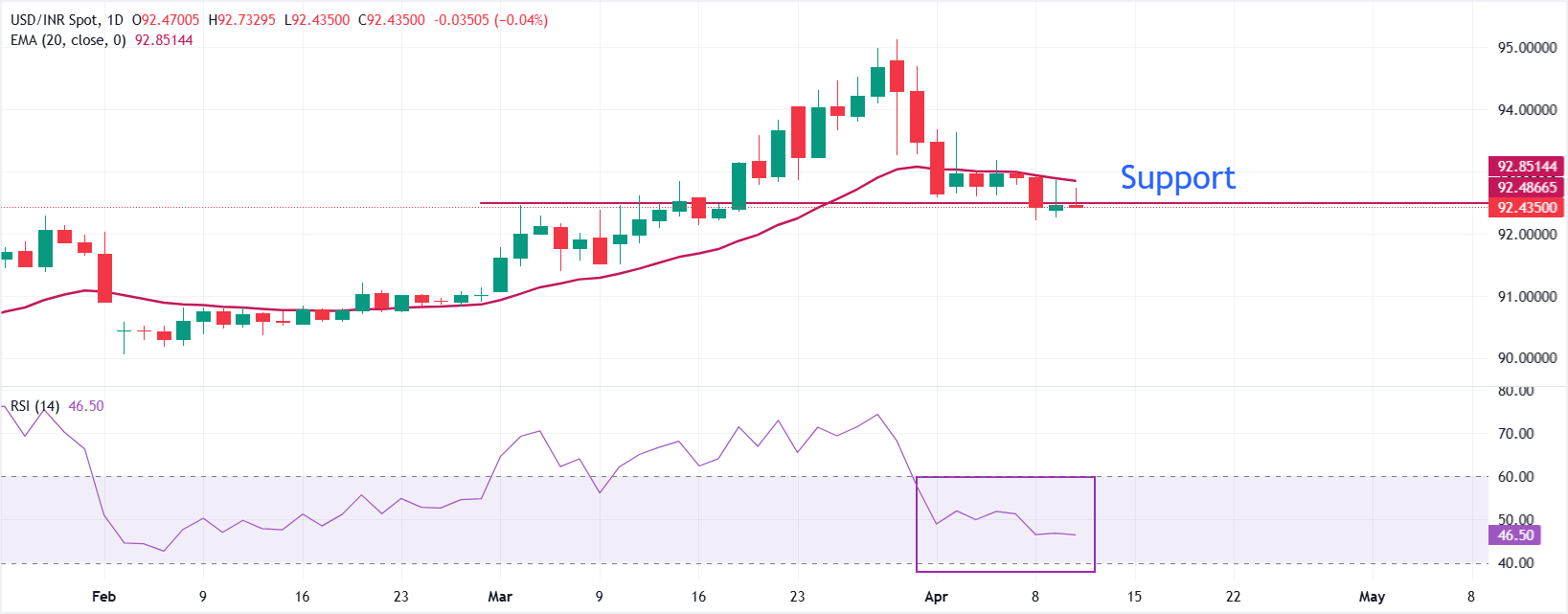
USD/INR trades cautiously around 92.45, with a bearish near-term bias, as spot holds below the 20-day Exponential Moving Average (EMA) at 92.85 after failing to sustain recent highs near 95.12.
The Relative Strength Index (14) hovers just below the neutral 50 mark around 46.5, hinting that upside momentum has faded and keeping the risk skewed toward further corrective weakness while price remains capped by the EMA resistance.
On the topside, immediate resistance is defined by the 20-day EMA at 92.85, and a daily close above this barrier would be needed to ease downside pressure and reopen the path toward the 93.50–94.00 area. Until then, the absence of nearby identified support levels on the chart leaves USD/INR vulnerable to deeper pullbacks, with traders likely to watch prior reaction lows and round figures below 92.00 as the next potential demand zones if selling resumes.
(The technical analysis of this story was written with the help of an AI tool.)
Indian Rupee FAQs
The Indian Rupee (INR) is one of the most sensitive currencies to external factors. The price of Crude Oil (the country is highly dependent on imported Oil), the value of the US Dollar – most trade is conducted in USD – and the level of foreign investment, are all influential. Direct intervention by the Reserve Bank of India (RBI) in FX markets to keep the exchange rate stable, as well as the level of interest rates set by the RBI, are further major influencing factors on the Rupee.
The Reserve Bank of India (RBI) actively intervenes in forex markets to maintain a stable exchange rate, to help facilitate trade. In addition, the RBI tries to maintain the inflation rate at its 4% target by adjusting interest rates. Higher interest rates usually strengthen the Rupee. This is due to the role of the ‘carry trade’ in which investors borrow in countries with lower interest rates so as to place their money in countries’ offering relatively higher interest rates and profit from the difference.
Macroeconomic factors that influence the value of the Rupee include inflation, interest rates, the economic growth rate (GDP), the balance of trade, and inflows from foreign investment. A higher growth rate can lead to more overseas investment, pushing up demand for the Rupee. A less negative balance of trade will eventually lead to a stronger Rupee. Higher interest rates, especially real rates (interest rates less inflation) are also positive for the Rupee. A risk-on environment can lead to greater inflows of Foreign Direct and Indirect Investment (FDI and FII), which also benefit the Rupee.
Higher inflation, particularly, if it is comparatively higher than India’s peers, is generally negative for the currency as it reflects devaluation through oversupply. Inflation also increases the cost of exports, leading to more Rupees being sold to purchase foreign imports, which is Rupee-negative. At the same time, higher inflation usually leads to the Reserve Bank of India (RBI) raising interest rates and this can be positive for the Rupee, due to increased demand from international investors. The opposite effect is true of lower inflation.














