기사

Chart Patterns in Trading: What is it and How to read Them?

Direct Answer: Chart patterns are repeatable price structures on a candlestick chart that help traders plan entries, exits, and risk by defining support, resistance, and the most likely next path of price. Traders use these geometric formations to project future price direction, measure volatility compression, and establish asymmetric risk-to-reward setups. The top 2 ways traders approach a chart pattern trading include Breakout Trading, Range Trading, and executing with confirmation before entry. For foundational knowledge on technical analysis, review our comprehensive guides on What is Technical Analysis: The Ultimate Guide for Beginners.

Key Takeaways

  • Chart patterns vs candlestick patterns: Candles form patterns (few candlesticks), which then form Chart patterns (Many Candlesticks) that map market structure.

  • Continuation vs. Reversal Patterns: Differentiating between trend-resuming structures and trend-exhaustion setups is critical for contextualizing order flow.

  • Techniques for Trading Patterns: Breakouts and ranges work best when traders wait for volume and price action confirmation rules.

  • Entry Timing and Protective Stops: Proper risk management requires utilizing strategic entry stops, and facing false breakouts by placing hard protective stops.


Techniques for Trading Patterns

There are generally 2 different approaches in trading using Chart Patterns. 

Breakouts Trading

Breakout trading involves entering a position as price decisively breaches a defined support or resistance boundary. 

The objective is to capture the rapid price move that occurs when price breaks through a resistance, and the momentum forms generally due to traders trading the opposite direction are forced to cover their positions.

Range Trading

Range trading capitalizes on lateral consolidation by fading the extremes of the pattern boundaries. Traders buy at the lower support threshold and short at the upper resistance until a true breakout materializes.

Range trades work best when the market is neutral and catalysts are absent. When trend conditions return, ranges often convert into breakout setups.

Practice of Confirmation Before Entry

Confirmation is a rule-based filter that reduces low quality entries by requiring price and participation to agree. Traders can confirm with volume, price action, and a higher timeframe check.

Pro Tip:
The best entries come from combining a clean level, a clear close, and a stop at a true invalidation point.

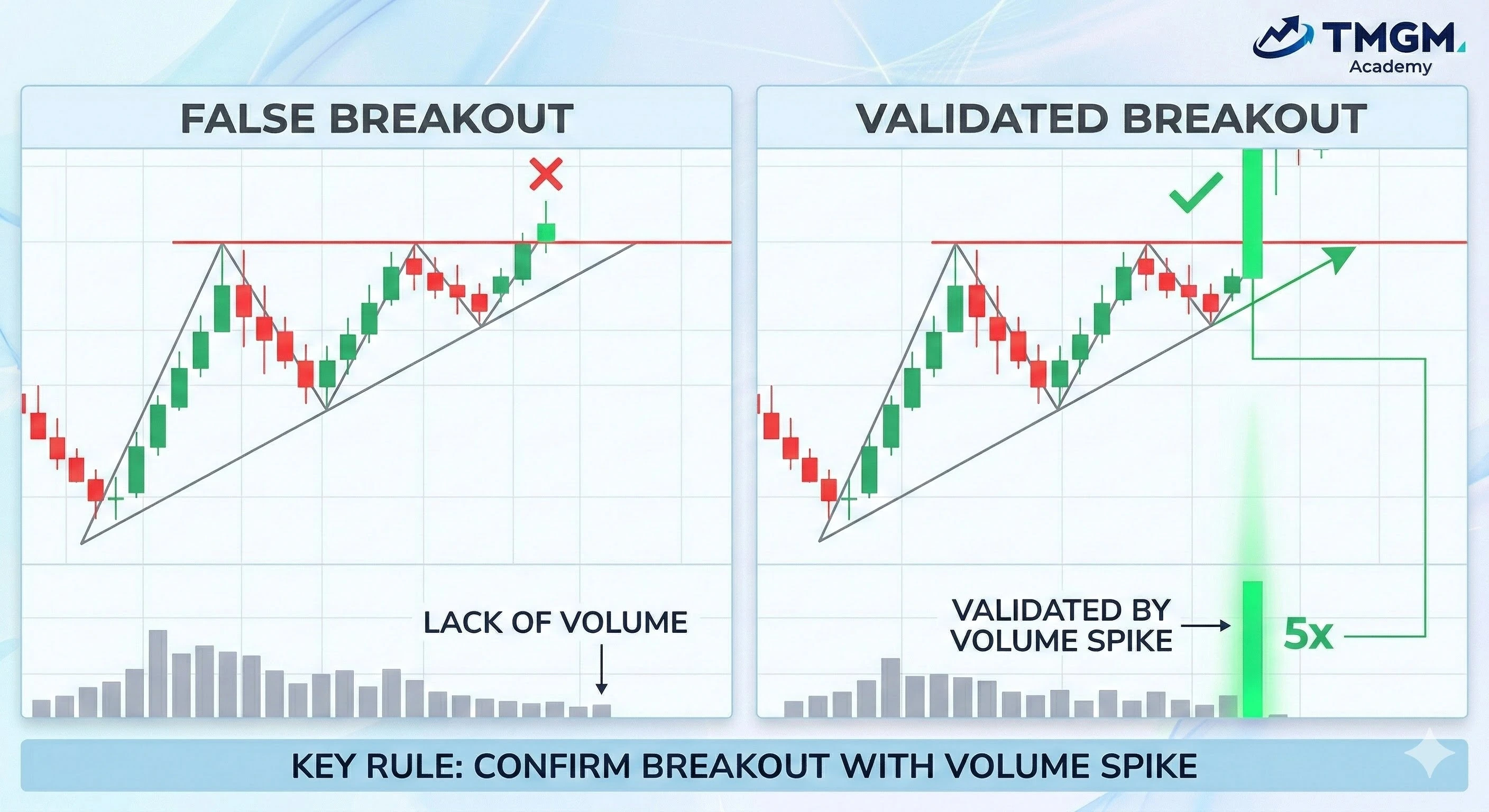
TMGM Academy Confirm Breakout with Volume Spike showing a price breakout through resistance supported by a tall volume bar validating the move.

Volume

Volume is a non-negotiable rule for validating breakouts. A true structural break must be accompanied by a significant spike in relative volume to confirm the breakout is backed by adequate momentum, validating the sustainability of the new trend.

In spot FX, volume is often proxy based, so traders may use tick volume or related futures data if available.


If volume does not expand, breakouts are more likely to chop or fail. Traders can respond by demanding stronger closes or waiting for a retest.


Price Action

Price action confirmation focuses on candlestick closes, wicks, and retests around key levels, relying strictly on the candle stick chart pattern to help determine the validity of a setup.

Each of the following can be a standalone justification of entry, or can be used in combination to stack the confirmations for a more confident entry.

  • 1 Candlestick (Close above resistance): The most important confirmation, it requires a strong, high-momentum candle to close definitively outside the pattern boundary. If entering here, it is considered adequate but aggressive. 

  • 2 or more Candlesticks (Retest): A more conservative approach waits for a breakout, followed by a minor pullback to test the former resistance as new support. This retest clears out weak hands before the true directional move begins.

    • It is best to have both a “Close Above Resistance” candlestick together with a successful retest.

  • Higher Timeframe: Validating a signal on a macro chart (e.g., Daily or Weekly) filters out micro-timeframe noise and algorithm-driven stop hunts.

Pro Tip:
Always correlate your primary trading timeframe with the immediate higher timeframe to ensure you are not trading a breakout directly into macro resistance.

Entry Timing and Protective Stops

Understanding with precision in entry mechanics and defensive stop placement separates professional traders from gamblers. Proper execution requires understanding order types and anticipating engineered liquidity sweeps.

Here are some chart pattern trading entry strategies with explanation:

Entry Stops

  • For momentum-based breakout strategies, traders utilize Buy Stop or Sell Stop orders placed just outside the pattern's boundary to automatically trigger an entry position as price breakouts. 

  • Conversely, range trading strictly demands Limit Orders to secure optimal pricing at the extreme edges of the consolidation.

False and Failed Breakouts

A false breakout (or "fakeout") occurs when price briefly pierces a technical boundary to trigger retail stop losses before reversing violently back into the pattern. These engineered moves are usually deliberately done by market makers to source liquidity for their own macro positions.

Protective Stops

A hard stop loss is mandatory to protect against catastrophic drawdown during failed structural breaks. The placement must be logical, typically resting just beyond the opposing side of the breakout candle or behind a recent, undeniable swing low.

Trading False Breakouts Using Protective Stops


A protective stop is a stop-loss order (to close position) placed to limit potential losses against the trader. For breakouts, that often means beyond the opposite side of the breakout structure, which is usually dependent on previous high/low..

Stops should account for spread and typical noise so traders do not get shaken out by normal and expected volatility. Besides that, your position size should be set by calculating from stop distance, not the other way around.

Some sophisticated traders actively stalk false breakouts, utilizing the failure as a high-probability entry signal in the opposite direction. In this practice, by placing a protective stop just behind the extreme wick of the fakeout candle, risk is tightly defined while the profit target spans the entire width of the chart pattern.

Important:
When fading a false breakout, wait for a definitive close back inside the pattern structure; entering prematurely risks catching a legitimate breakout that is simply pausing.

Chart Patterns vs Candlestick Patterns

Chart patterns describe the bigger picture, called market structure, such as a triangle, wedge, or double top, usually built over many candles. A candle chart pattern is a shorter signal, often one to three candles, used to confirm timing within the broader structure.

Traders typically use chart patterns to define levels and scenarios, then use candlesticks and price action to time execution. On a candle pattern chart, confirmation is usually clearer because the close and the rejection wicks show who controlled the price into the session end.


The Types of Chart Patterns: Continuation vs. Reversal

Understanding market context requires distinguishing between a Continuation Pattern (indicating a pause before trend resumption) and reversal patterns (signaling trend exhaustion and reversal). 

Categorizing chart patterns is important to understand the mechanism, market behaviour and trader’s psychology behind the chart that is on-going.

Continuation Chart Patterns

These formations represent temporary consolidation, allowing the market to build liquidity before resuming the dominant macro trend


Cup and Handle

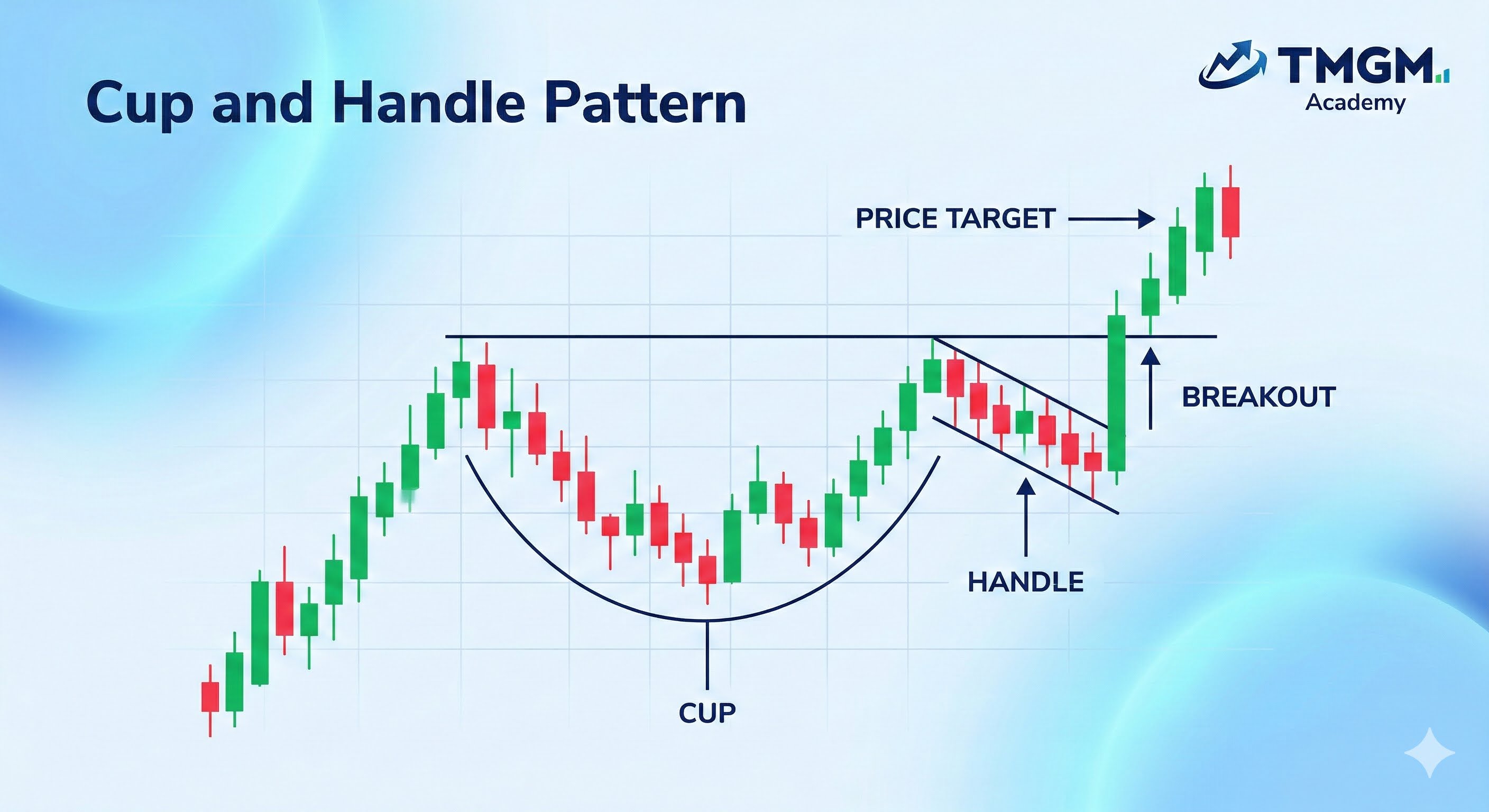
TMGM Academy Cup and Handle Pattern showing a cup, handle consolidation, breakout point, and price target.

  • Cup and Handle Pattern: 
    • A bullish consolidation resembling a bowl or ‘Cup’ followed by a slight downward drift (‘Handle’), preparing for an upward breakout.

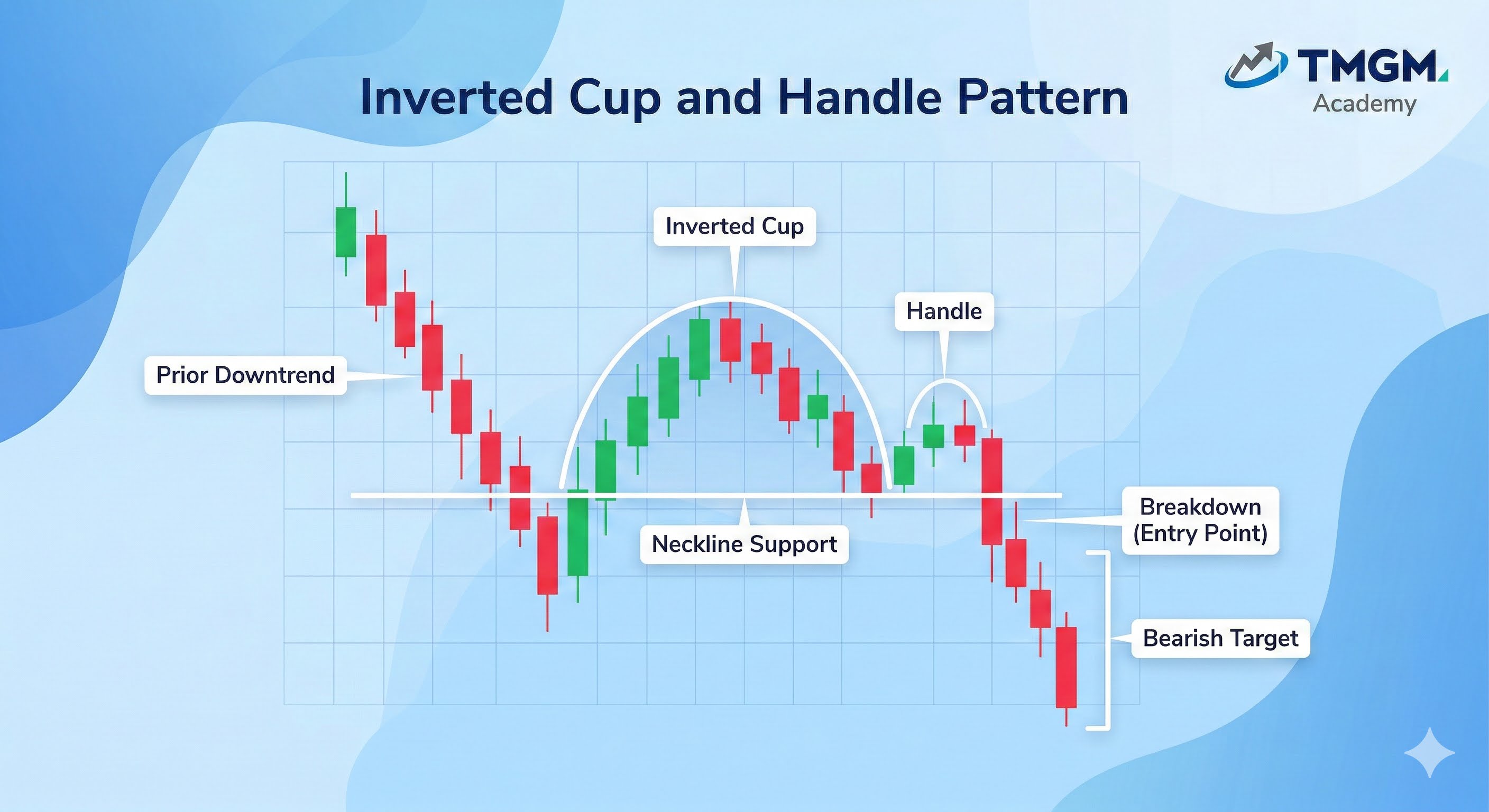
TMGM Academy Inverted Cup and Handle Pattern showing an upside-down cup, rising handle, and bearish breakdown.

  • Inverted Cup and Handle Pattern: 
    • A bearish continuation setup showing a rounded top (Inverse Cup) followed by a minor upward retracement (Handle) before further collapse.


Bull/Bear Flag Pattern

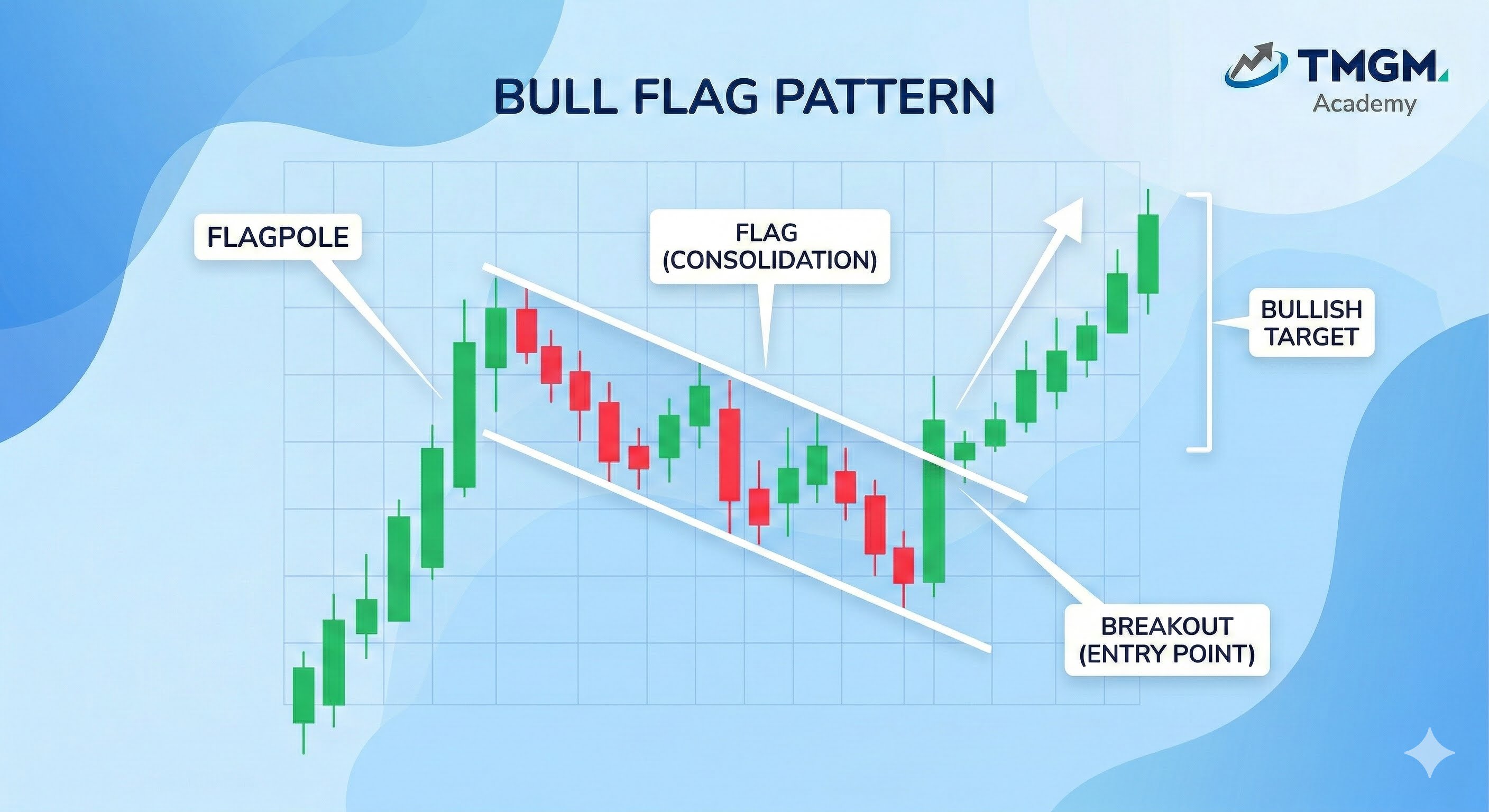
TMGM Academy Bull Flag Pattern highlighting a flagpole, downward flag consolidation, and bullish breakout.

  • Bull Flag Pattern: 
    • A downward-sloping channel (Flag) that forms after a strong bullish trend wave (Flag Pole), indicating profit-taking before the next leg up (Breakout).

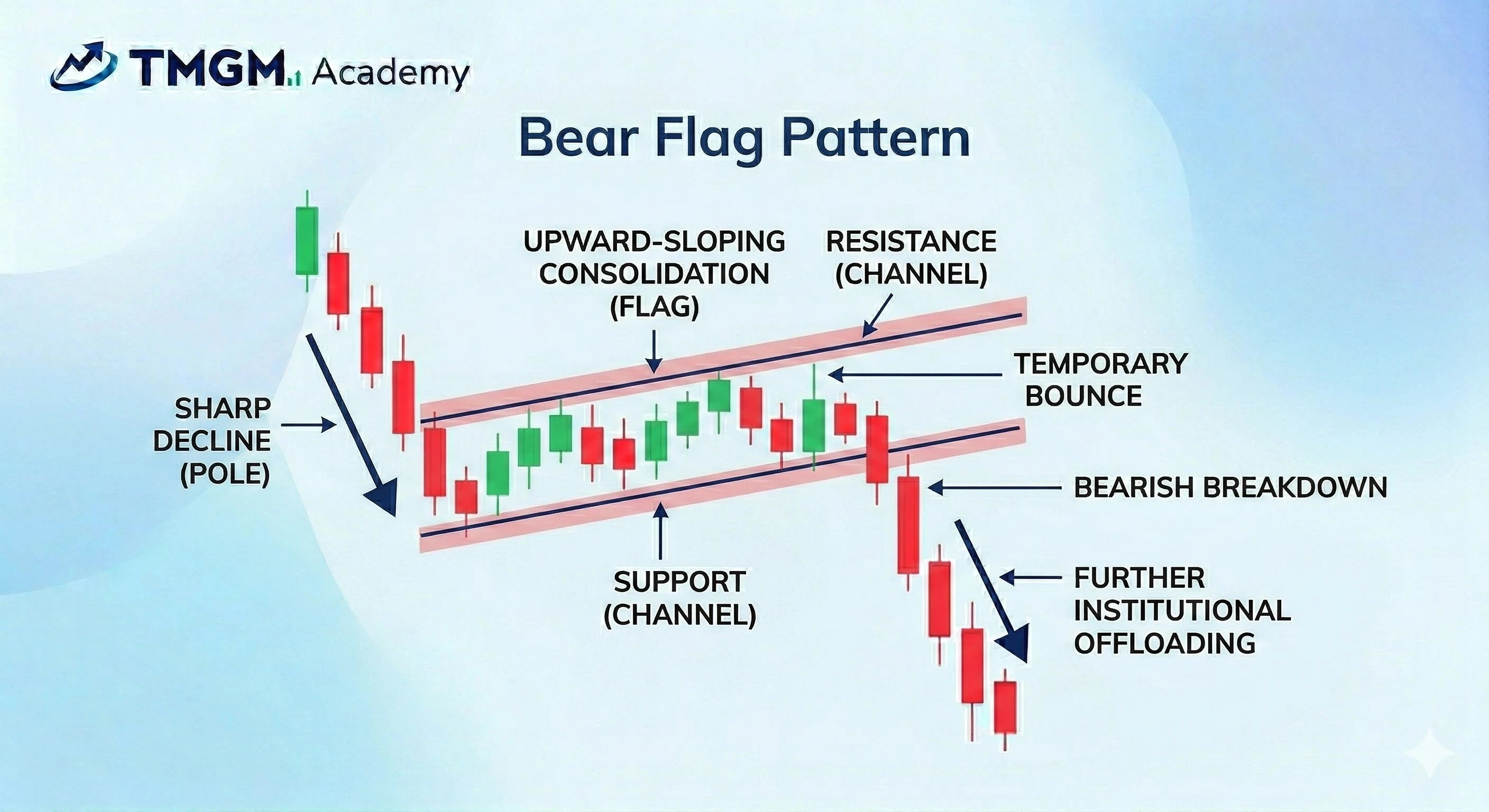
TMGM Academy Bear Flag Pattern showing a sharp decline pole, upward channel support, and bearish breakdown.

  • Bear Flag Pattern: 
    • An upward-sloping consolidation (Flag) following a sharp decline (Flag Pole), signaling a temporary bounce before further Investors’ offloading (Breakout).


Pennants

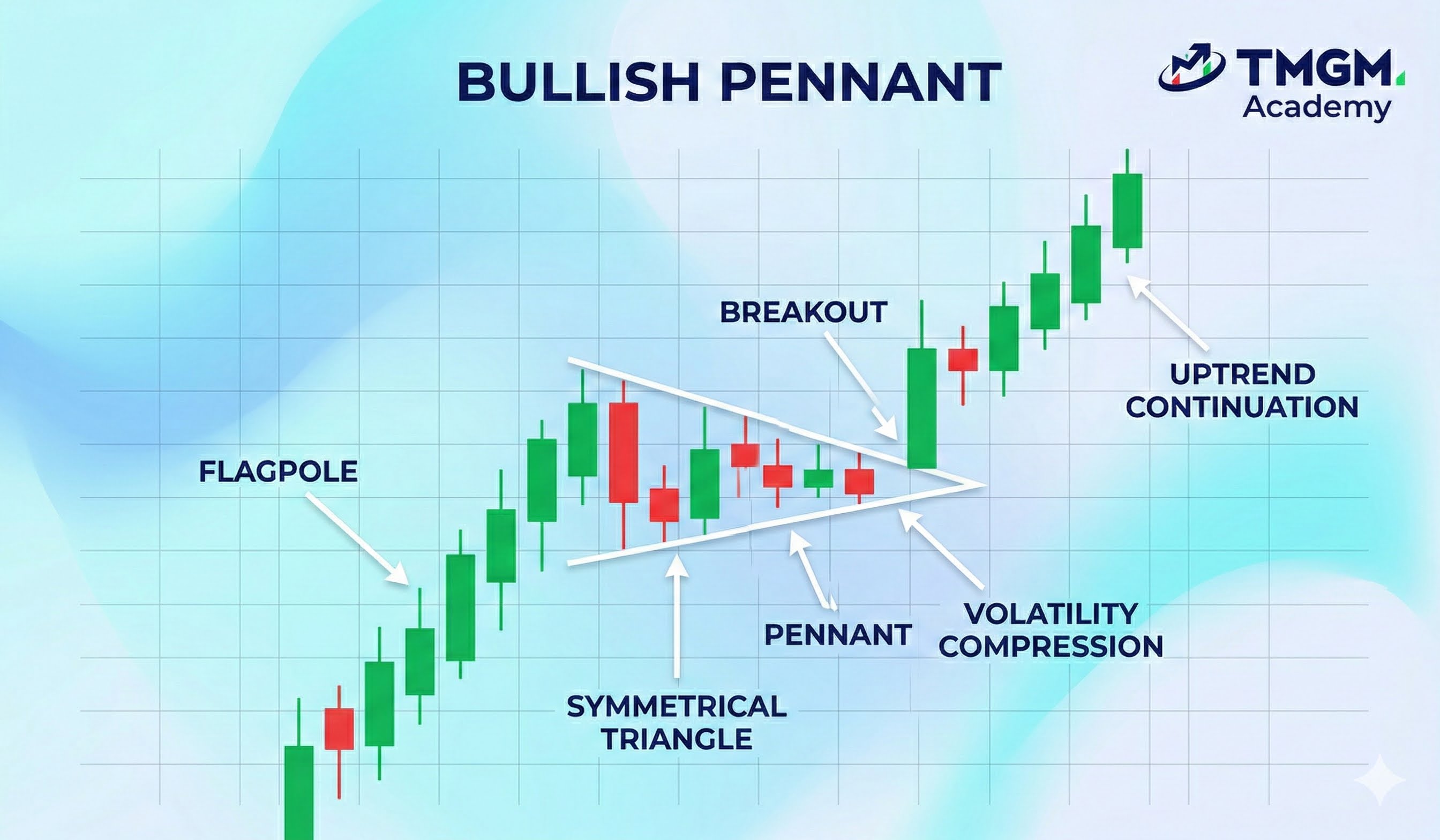
TMGM Academy Bullish Pennant displaying a flagpole, symmetrical triangle consolidation, and upside breakout.

  • Bullish Pennant: 
    • A small symmetrical triangle (Pennant) forming after a bullish flagpole, characterized by extreme volatility compression (Price Tightening).

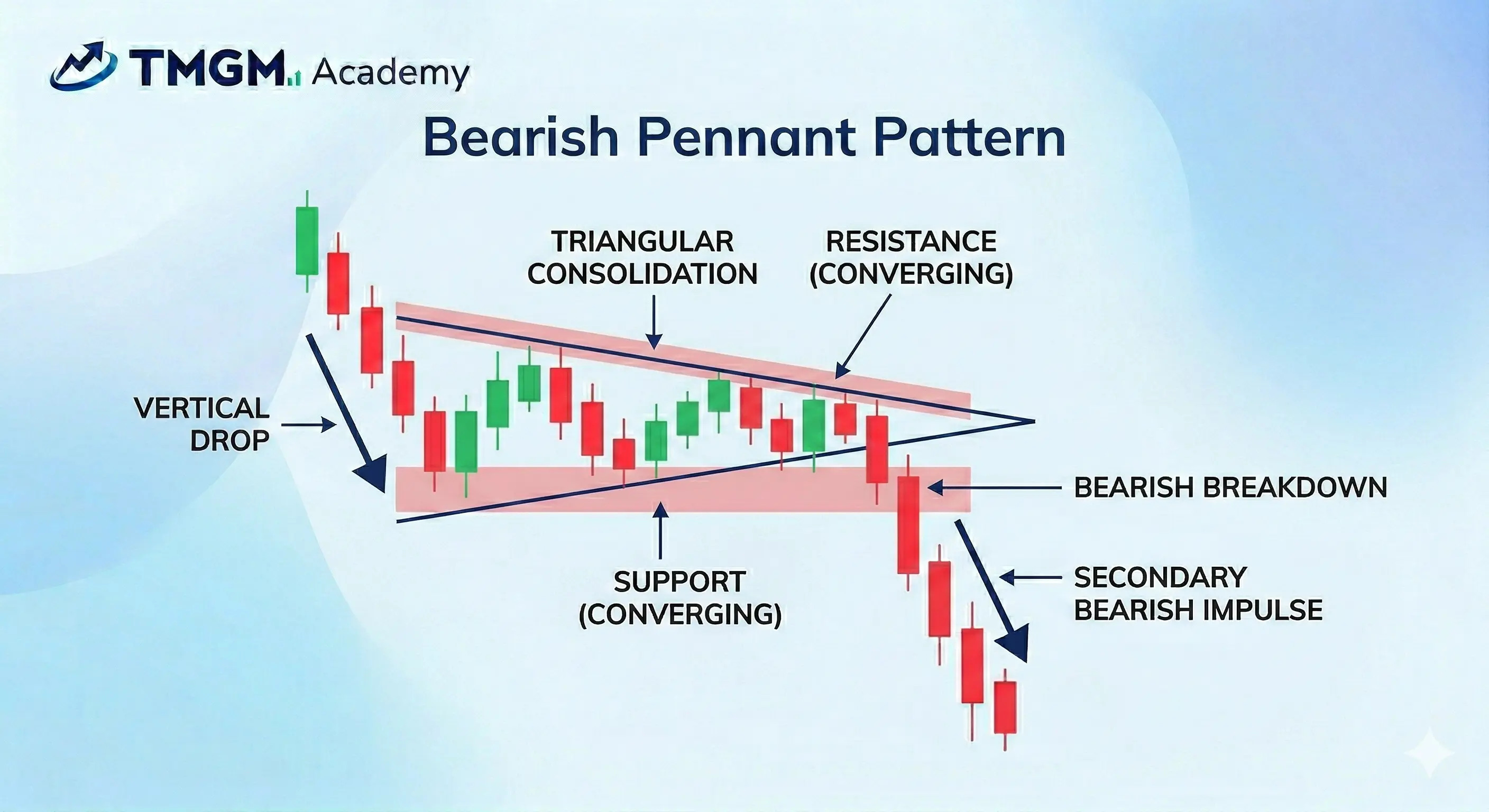
TMGM Academy Bearish Pennant Pattern showing a vertical drop, converging triangle, and secondary breakdown.

  • Bearish Pennant Pattern: 
    • A brief triangular consolidation (Pennant) following a vertical drop (Pole), setting the stage for a secondary bearish impulse (Breakout).


Rectangle Pattern

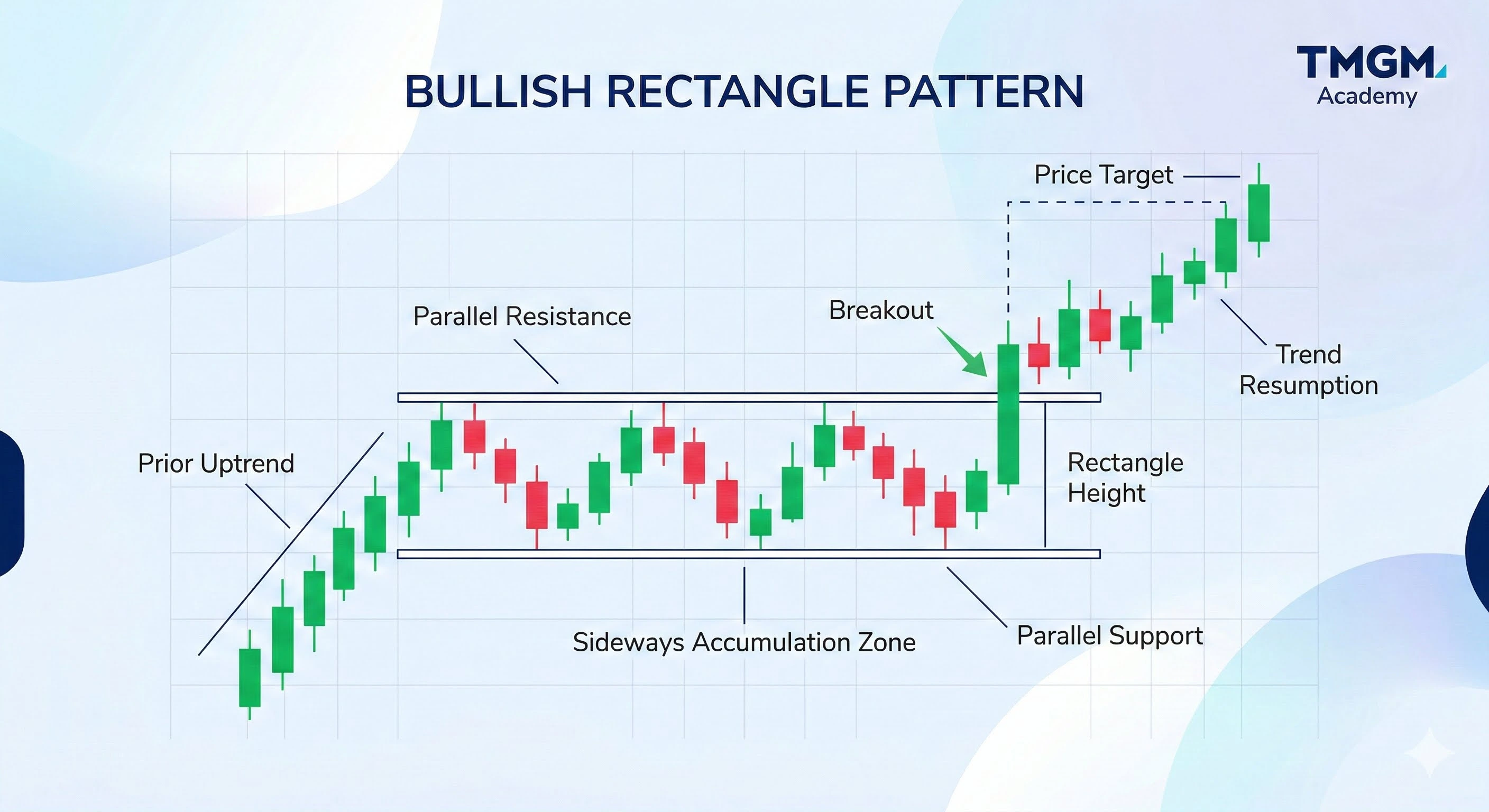
TMGM Academy Bullish Rectangle Pattern featuring a prior uptrend, parallel accumulation zone, and breakout.

  • Bullish Rectangle Pattern: 
    • A sideways accumulation phase (Rectangle) bounded by parallel support and resistance, resolving in the direction of the prior uptrend.


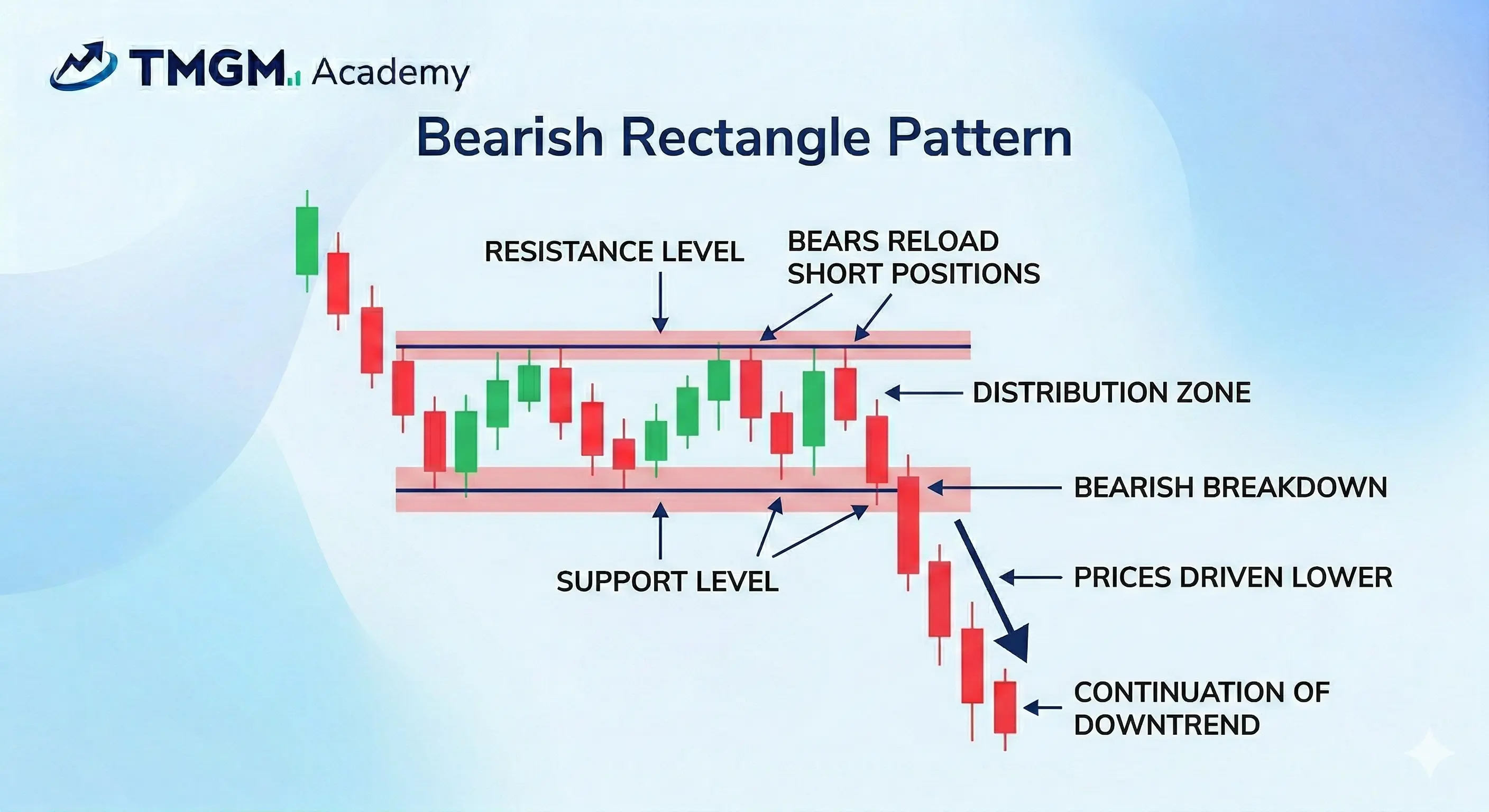
TMGM Academy Bearish Rectangle Pattern displaying parallel resistance/support, distribution, and breakdown.

  • Bearish Rectangle Pattern: 
    • A lateral distribution channel (Rectangle) where bears reload short positions before driving prices lower.


Reversal Chart Patterns

Reversal patterns form at major liquidity zones, indicating a complete shift in institutional bias. They mark the transition from accumulation to markup, or distribution to markdown.

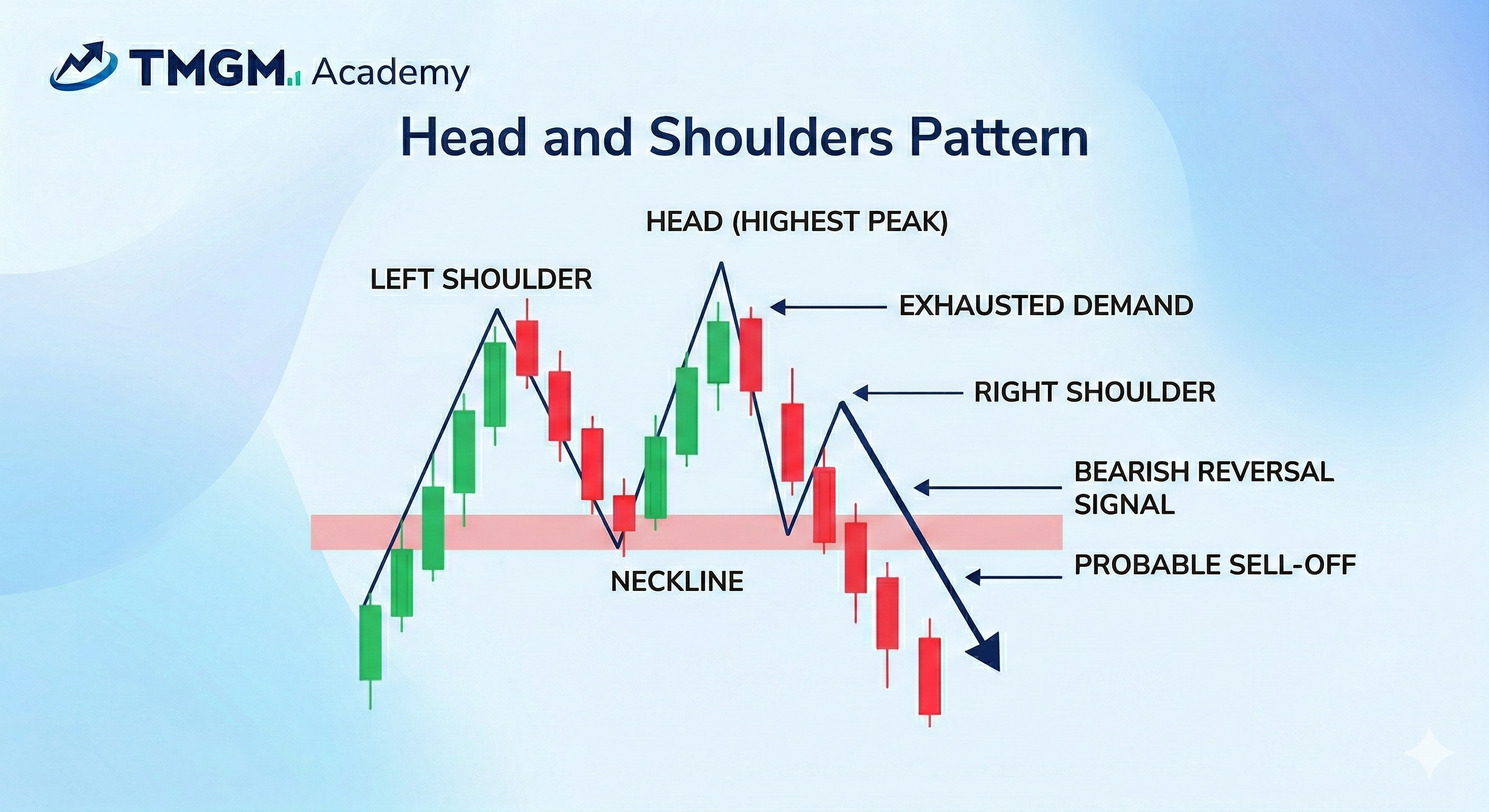
Head and Shoulders

TMGM Academy Head and Shoulders Pattern showing left/right shoulders, a higher head peak, and neckline break.

  • Head and Shoulders Pattern: 
    • A bearish reversal characterized by three peaks (Head and Shoulders), with the central peak being the highest (Head), indicating exhausted demand.

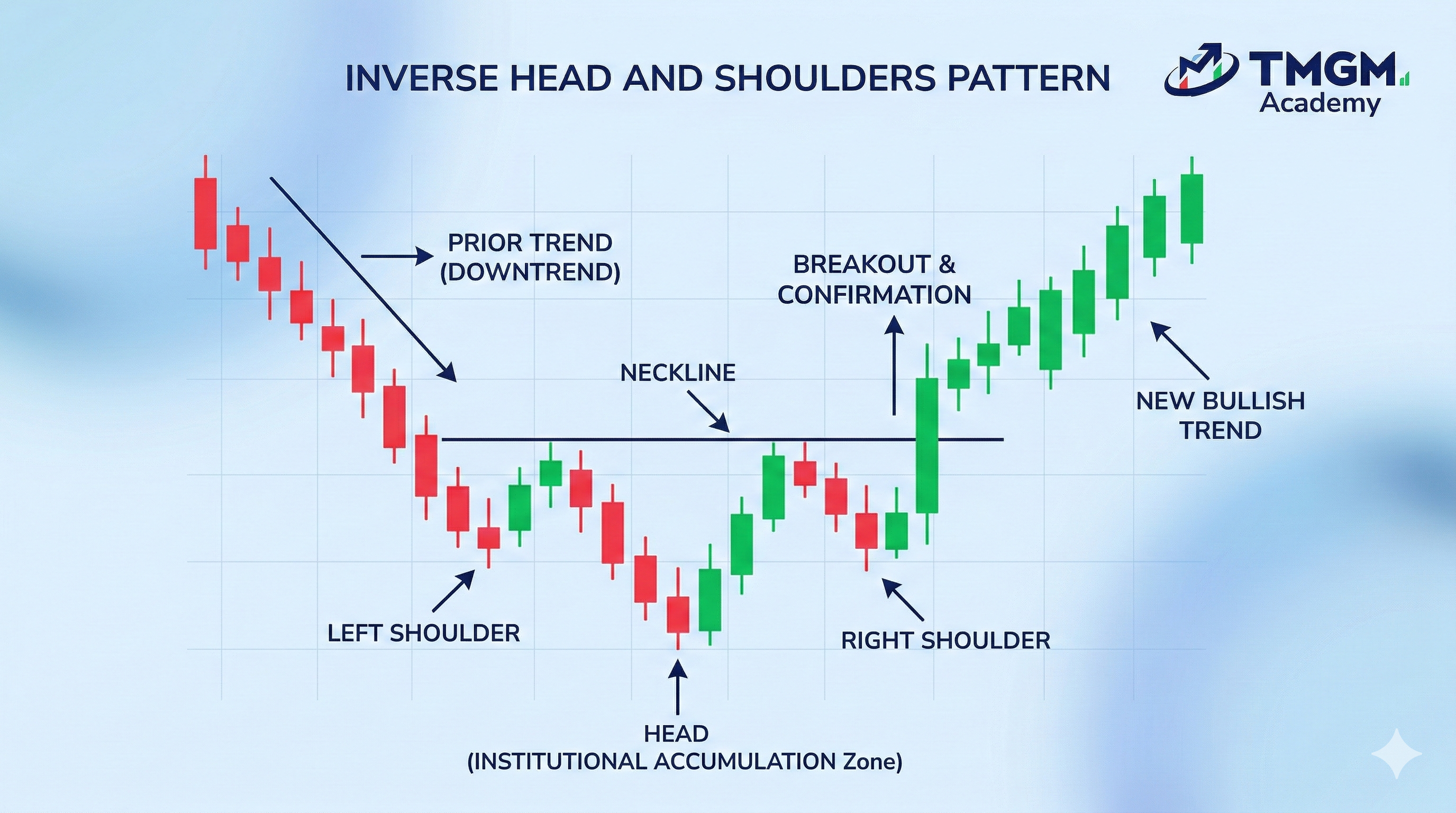
TMGM Academy Inverse Head and Shoulders Pattern showing inverted shoulders, a lower head, and neckline break.


  • Inverse Head and Shoulders Pattern: 
    • A bullish reversal showing three troughs (Inverse Head and Shoulders), signaling aggressive institutional accumulation (Shoulders) below the neckline.

Double Top/Bottom

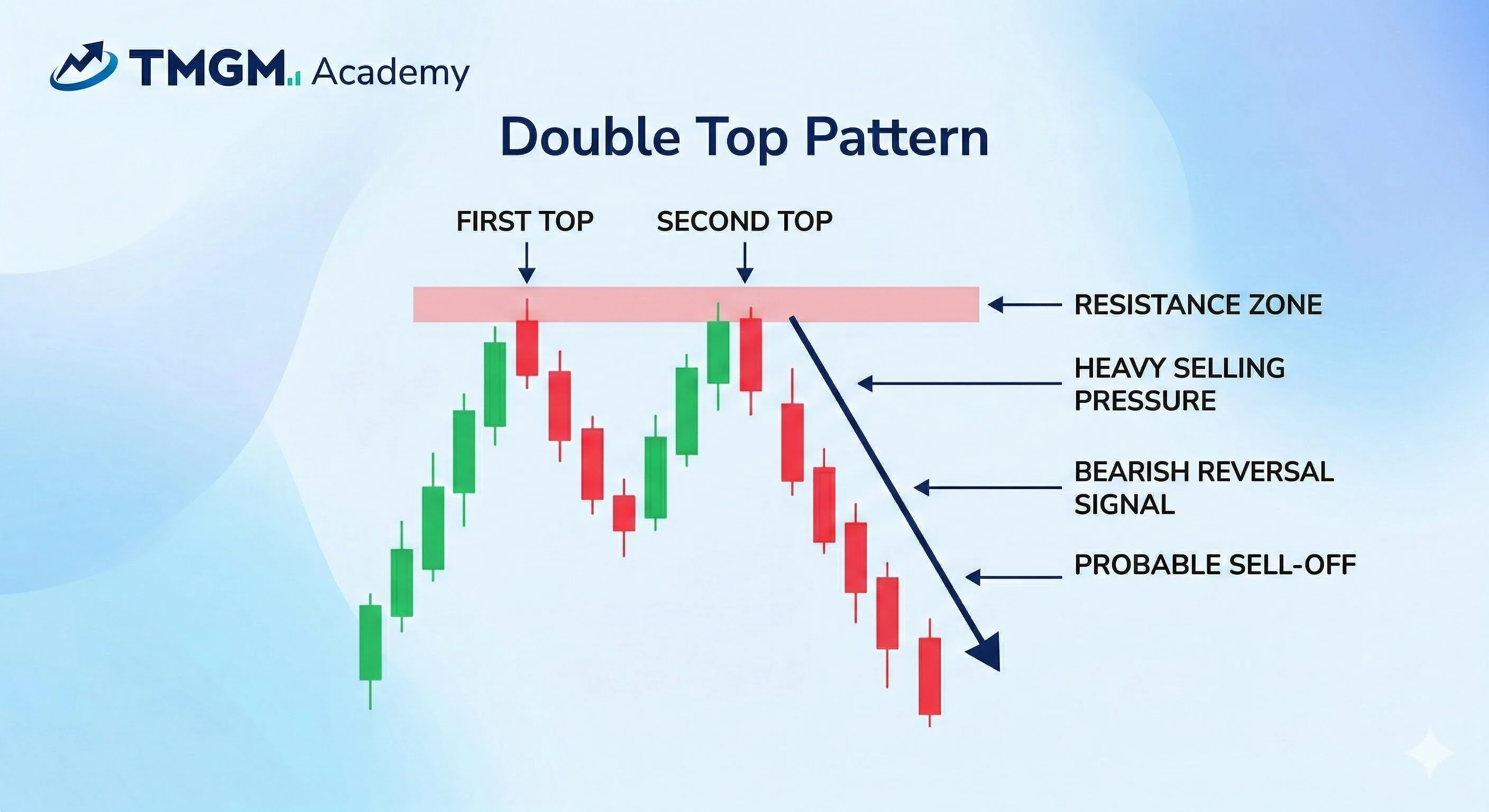
TMGM Academy Double Top Pattern illustrating two peaks at a resistance zone, a neckline, and bearish sell-off.

  • Double Top Pattern: 
    • Two consecutive failed attempts (Double Top) to breach a resistance level, forming an "M" shape that precedes a bearish sell-off.

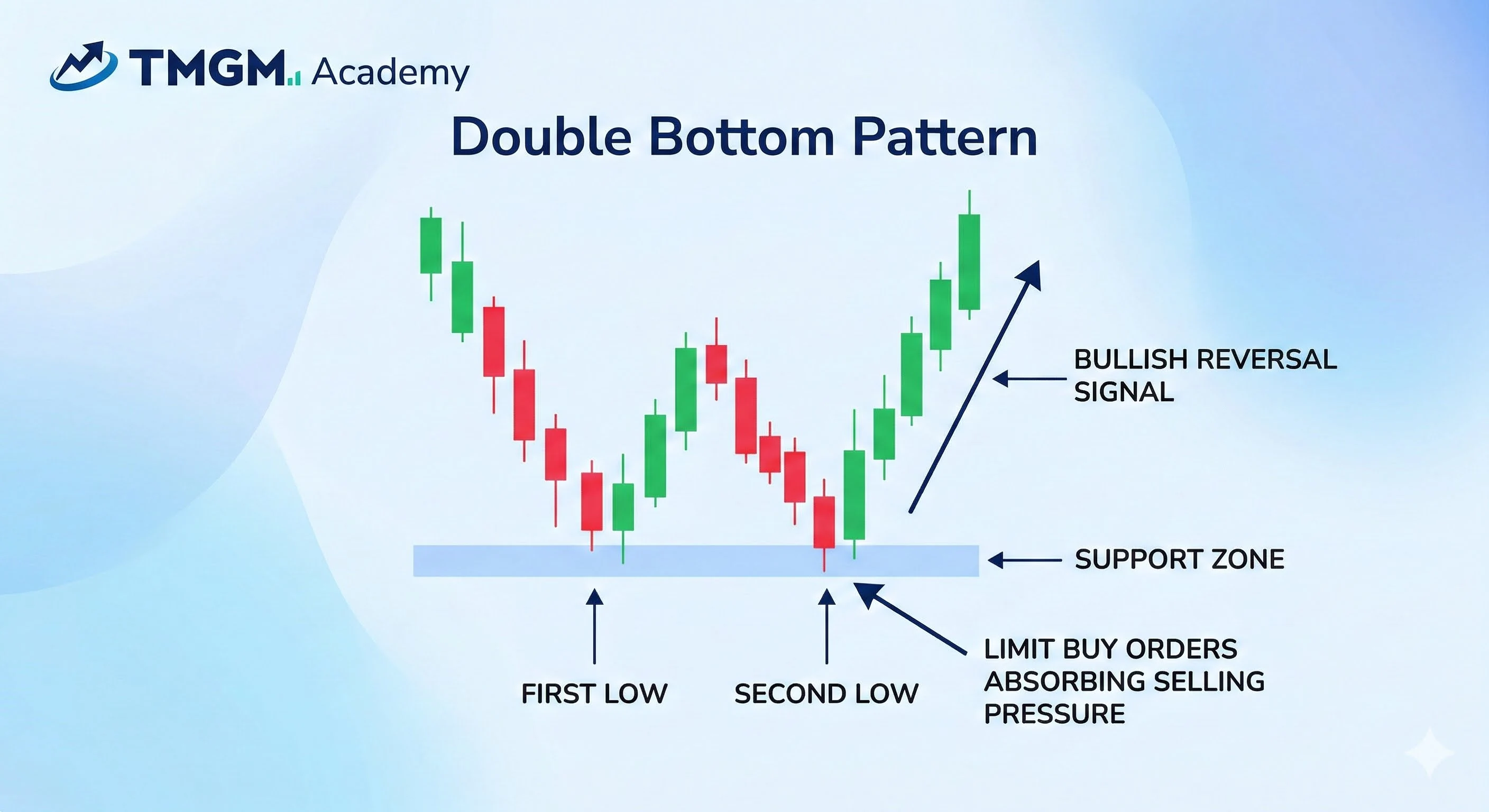
TMGM Academy Double Bottom Pattern showing two distinct lows, a support zone, neckline, and bullish breakout.

  • Double Bottom Pattern: 
    • A "W" formation where price rejects a support zone twice (Double Bottom), confirming heavy limit buy orders absorbing selling pressure.


Triple Top/Bottom

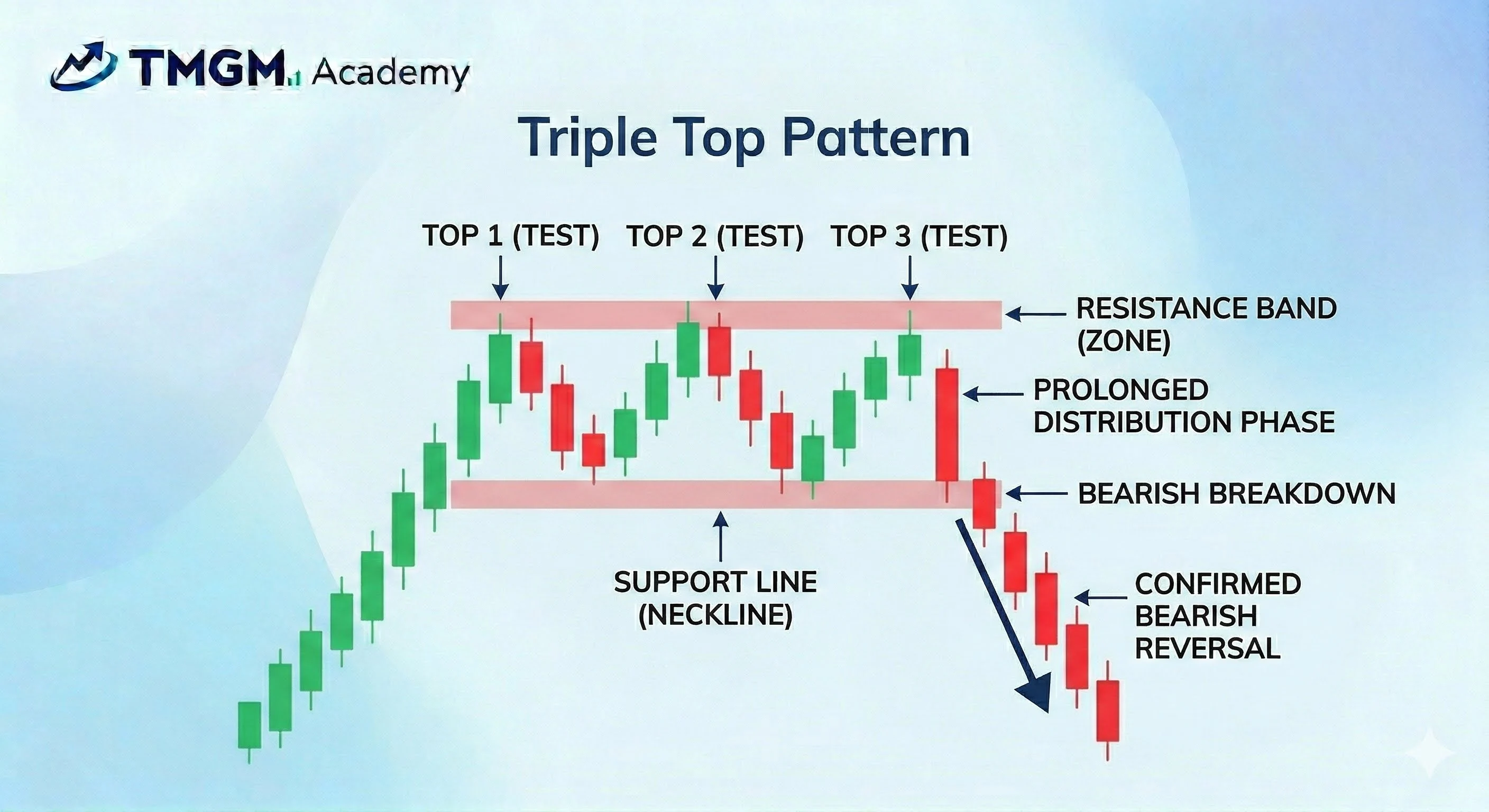
TMGM Academy Triple Top Pattern featuring three peaks at resistance, a support neckline, and a bearish break.

  • Triple Top Pattern: 
    • A prolonged distribution phase where resistance holds across three distinct tests (Triple Top).

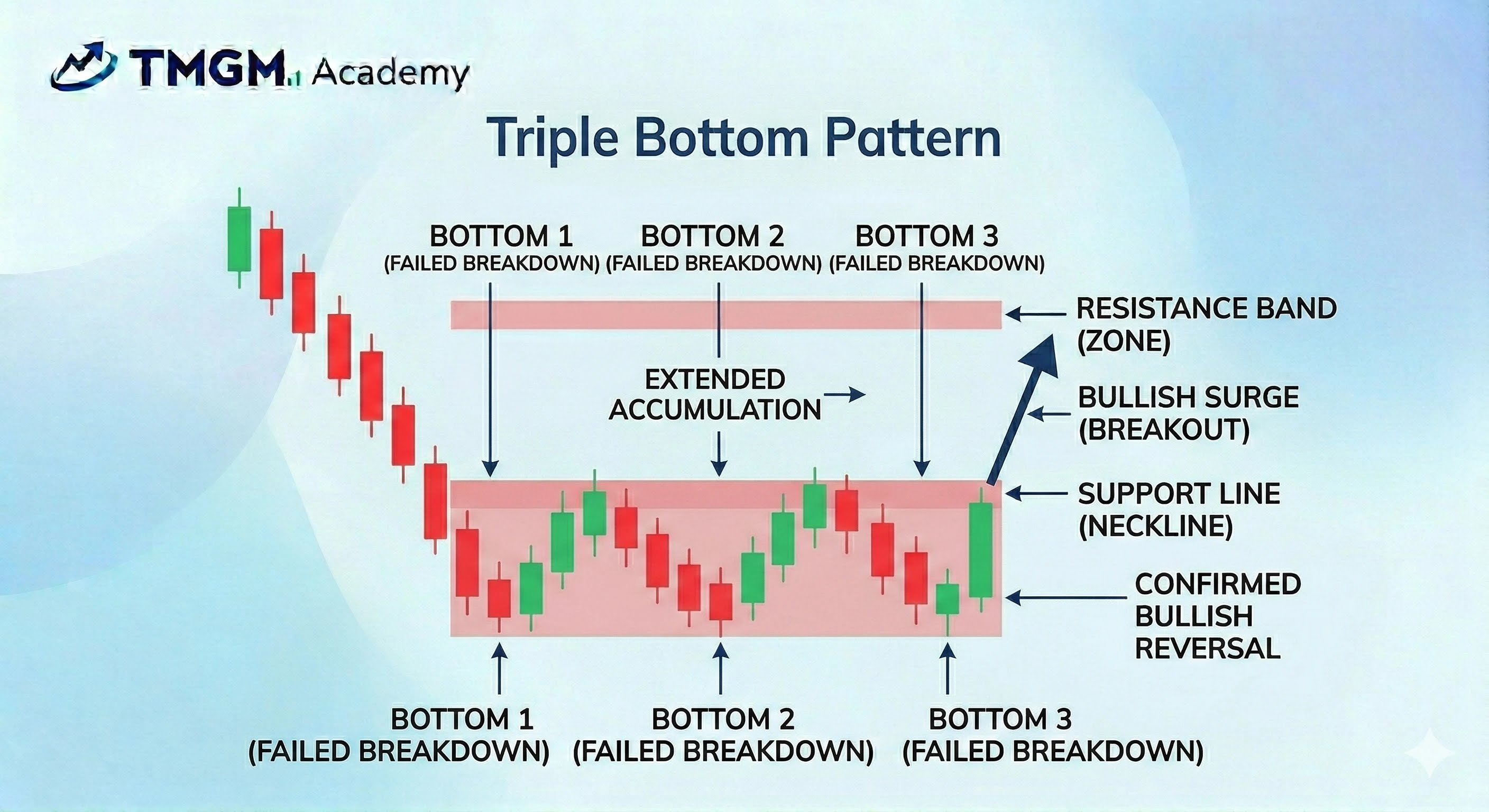
TMGM Academy Triple Bottom Pattern showing three failed breakdowns at support and a confirmed bullish surge.

  • Triple Bottom Pattern: 
    • An extended accumulation phase showing three failed breakdowns (Triple Bottom) before a bullish surge.


Wedges (Rising/Falling

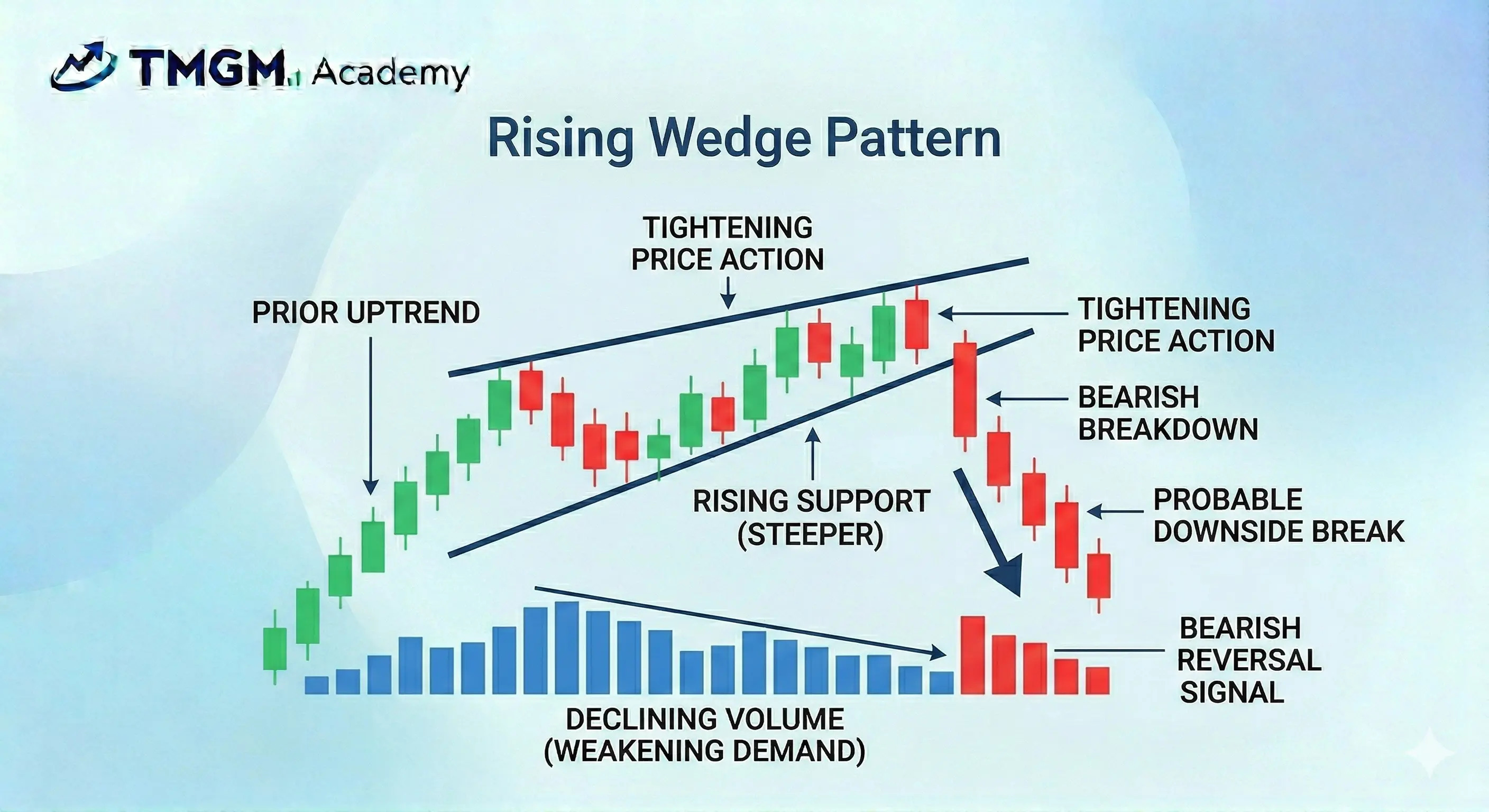
TMGM Academy Rising Wedge displaying tightening price action, steeper rising support, and bearish breakdown.

  • Rising Wedge: 
    • A bearish reversal pattern showing tightening price action (Wedge) and declining volume during an uptrend, warning of a downside break.

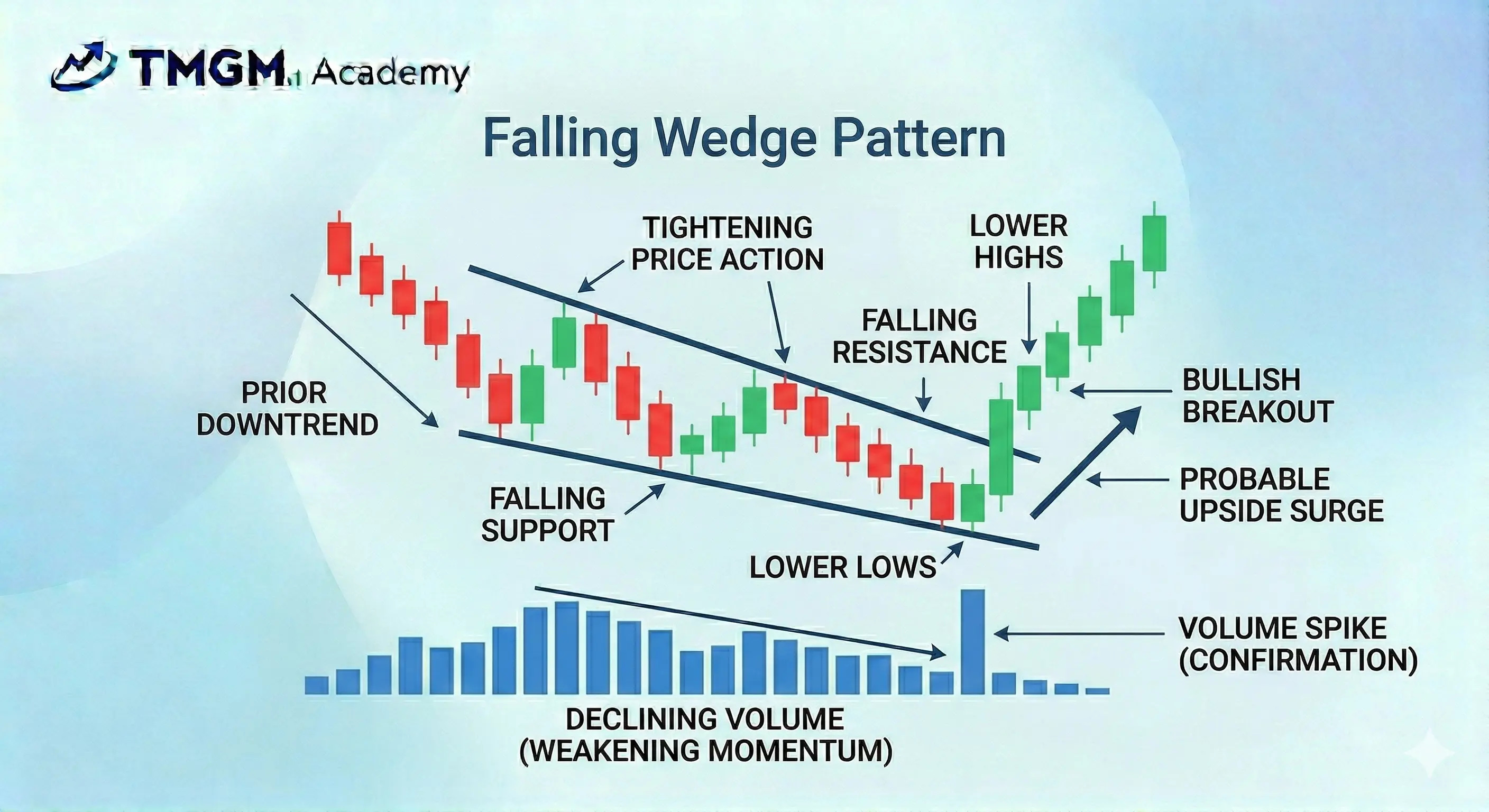
TMGM Academy Falling Wedge highlighting lower highs, falling support, tightening action, and an upside surge.

  • Falling Wedge: 
    • A bullish reversal structure where downward momentum tightens (Wedge), ultimately triggering a high-probability upside breakout.


Bilateral Patterns

Bilateral structures indicate market equilibrium where a breakout can occur in either direction, requiring strict confirmation before capital deployment.

Triangle Pattern

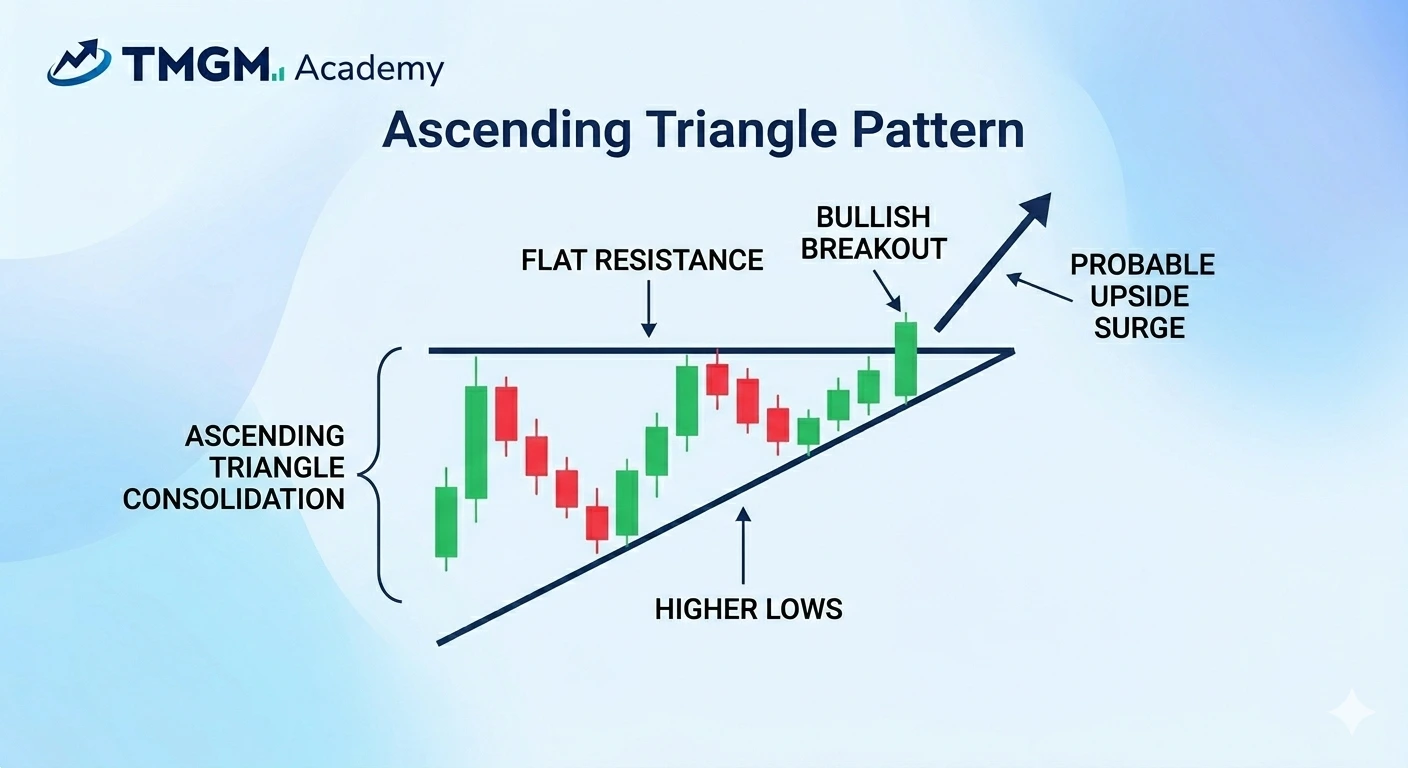
TMGM Academy Ascending Triangle Pattern showing flat resistance, higher lows, and a bullish upside breakout.

  • Ascending Triangle Pattern: 
    • A flat upper resistance paired with higher lows (Triangle), suggesting bulls are aggressively absorbing supply

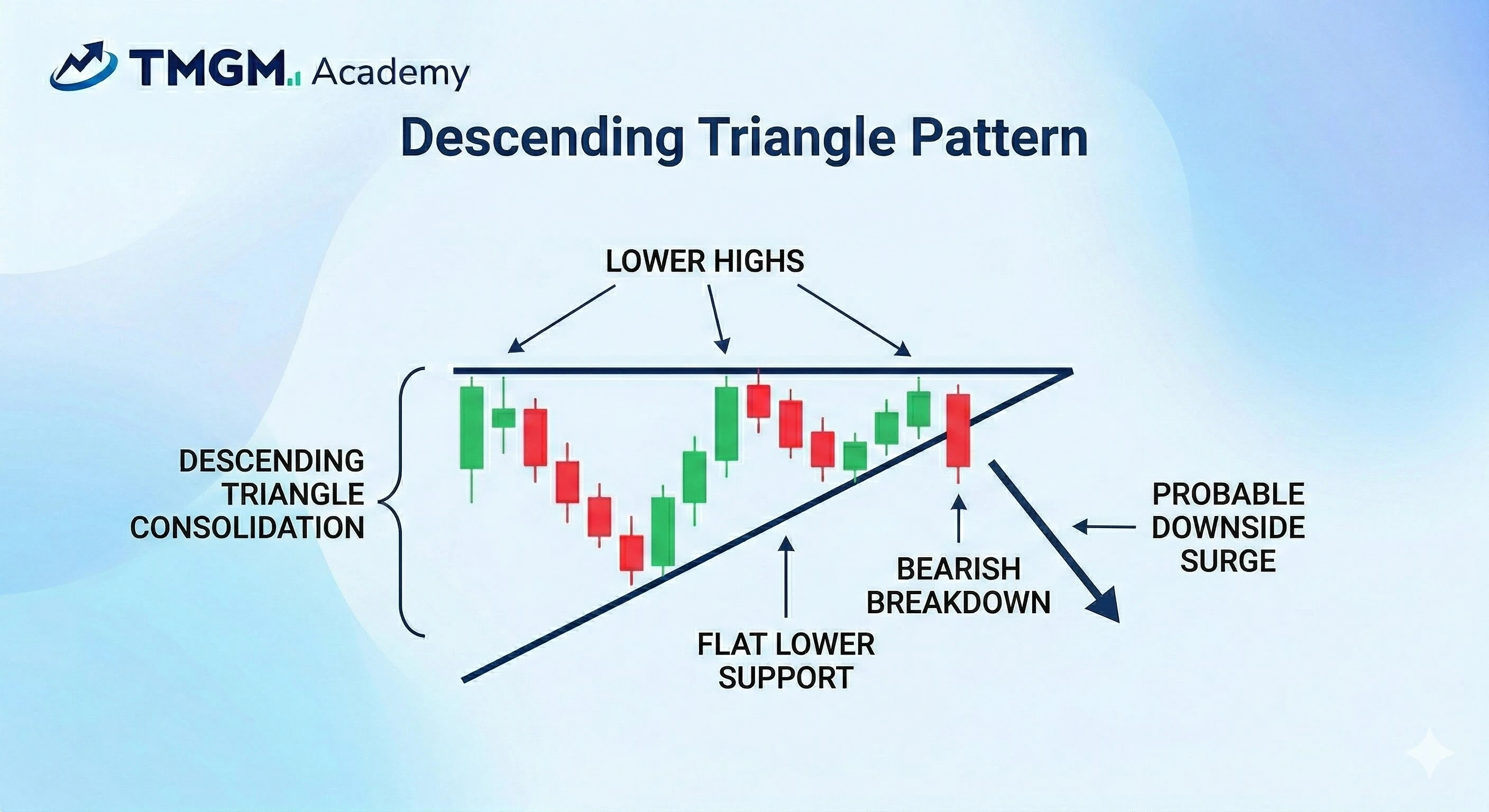
TMGM Academy Descending Triangle Pattern showing lower highs, flat lower support, and a bearish breakdown.

  • Descending Triangle Pattern: 
    • A flat lower support paired with lower highs (Triangle), indicating bears are consistently stepping in at cheaper valuations.

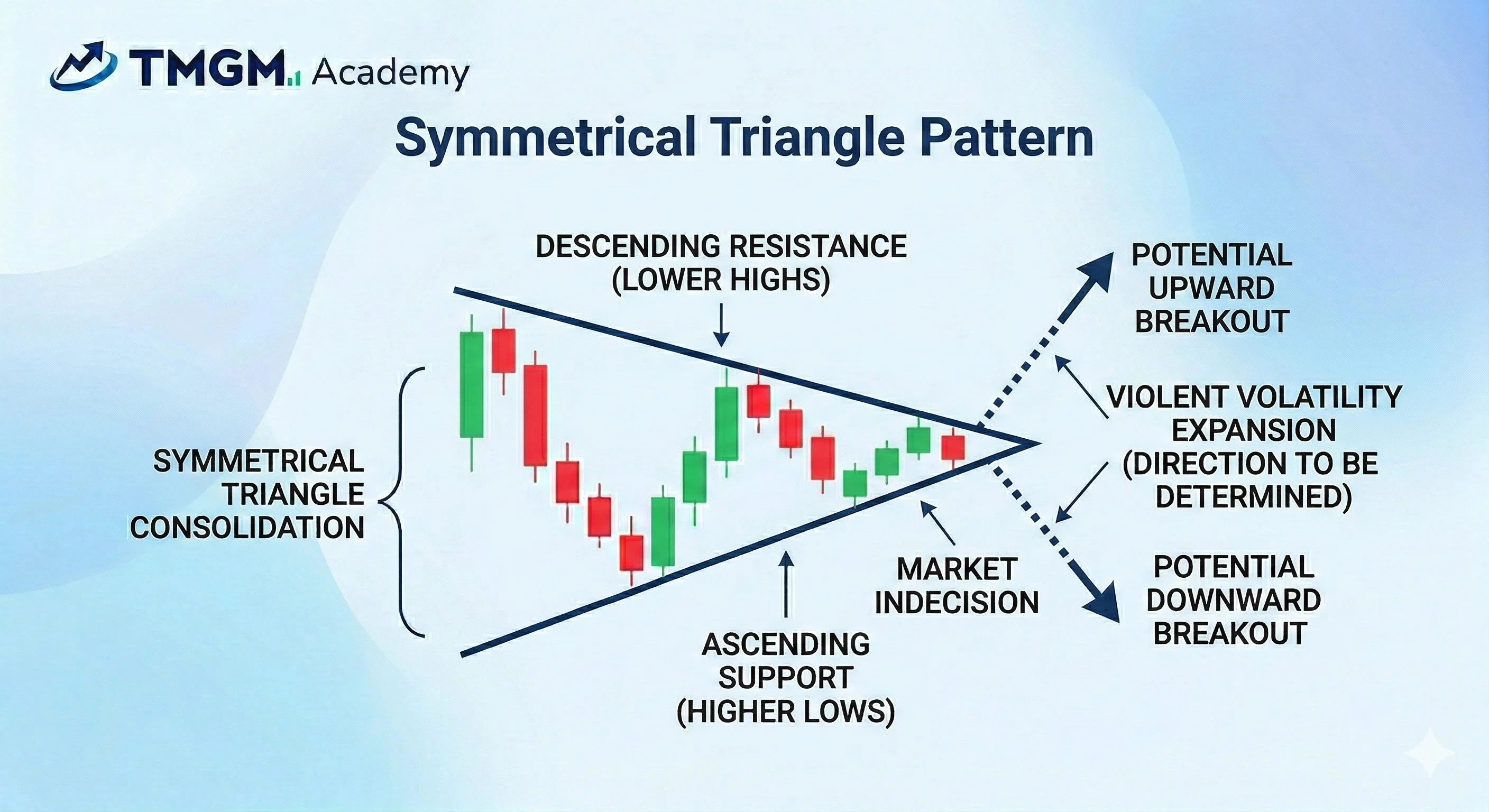
TMGM Academy Symmetrical Triangle Pattern featuring descending resistance, ascending support, and a breakout.

  • Symmetrical Triangle Pattern: 
    • Converging trendlines (Triangle) demonstrating absolute market indecision, often leading to violent volatility expansion upon breakout.


FAQ

Are chart patterns actually reliable in modern algorithmic trading?

Yes, but they act as visual representations of liquidity zones rather than guaranteed predictive models. Algorithms actively target the obvious stop-loss clusters formed around classic patterns, making multi-timeframe confirmation and volume analysis essential for modern reliability.

How do I differentiate between a standard pullback and a complete pattern failure?

A standard pullback features declining volume and smaller-bodied candlesticks as it retests the breakout zone. A complete pattern failure exhibits expanding volume and large, impulsive candles driving price aggressively back through the breakout level.

What is the most effective timeframe for trading continuation patterns?

The 1-hour and 4-hour timeframes offer the optimal balance for chart pattern trading, filtering out the algorithmic noise of the 5-minute charts while providing more frequent setups than the daily charts. Patterns identified on these timeframes must always align with the overarching daily trend.


오늘 더 스마트하게 거래하세요

$10,000 데모 자금
100+ 마켓
낮은 수수료, 타이트한 스프레드
Trading App
TMGM
Trade The World
TMGM Academy 및 Market Insights 팀은 금융 분석가 및 트레이딩 전략가로 구성된 집단입니다. 실시간 기관 데이터에 대한 접근 권한과 10년 이상의 시장 운영 경험을 바탕으로 팀은 외환, 금, 암호화폐, 주식, 원자재(에너지 등), 지수에 대한 사실 기반 분석을 제공합니다. 저희 콘텐츠는 편집 정책 페이지에 명시된 대로 엄격하게 규제됩니다. TMGM은 ASIC 및 VFSC 지침을 준수합니다.
수상 경력에 빛나는 거래 플랫폼에서 100만 명 이상의 고객과 함께하세요
1
실계좌
신청하기
2
계좌에
자금 입금하기
3
즉시 거래
시작하기
계좌 개설