

Trade The World
AUD/JPY Price Forecast: Slips as BoJ’s Ueda signals rate hikes
작성자 Christian Borjon Valencia
게시일: 6 Jan 2026 | 수정일: 6 Jan 2026


POPULAR ARTICLES
The Australian Dollar retreats against the Japanese Yen on Monday, down 0.05% after Bank of Japan Governor Kazuo Ueda revealed that the BoJ would hike rates “if economic and inflation trends align with our projections.” At the time of writing, the AUD/JPY trades at 105.00 almost unchanged.
- BoJ Governor Ueda’s hawkish remarks lift the Yen, capping AUD/JPY near the 105.00 handle.
- Technical momentum remains bullish, with RSI rising and price holding just below last year’s peak.
- A break above 105.22 targets 105.77, while downside risks emerge below 104.40 support.
The Australian Dollar retreats against the Japanese Yen on Monday, down 0.05% after Bank of Japan Governor Kazuo Ueda revealed that the BoJ would hike rates “if economic and inflation trends align with our projections.” At the time of writing, the AUD/JPY trades at 105.00 almost unchanged.
AUD/JPY Price Forecast: Technical outlook
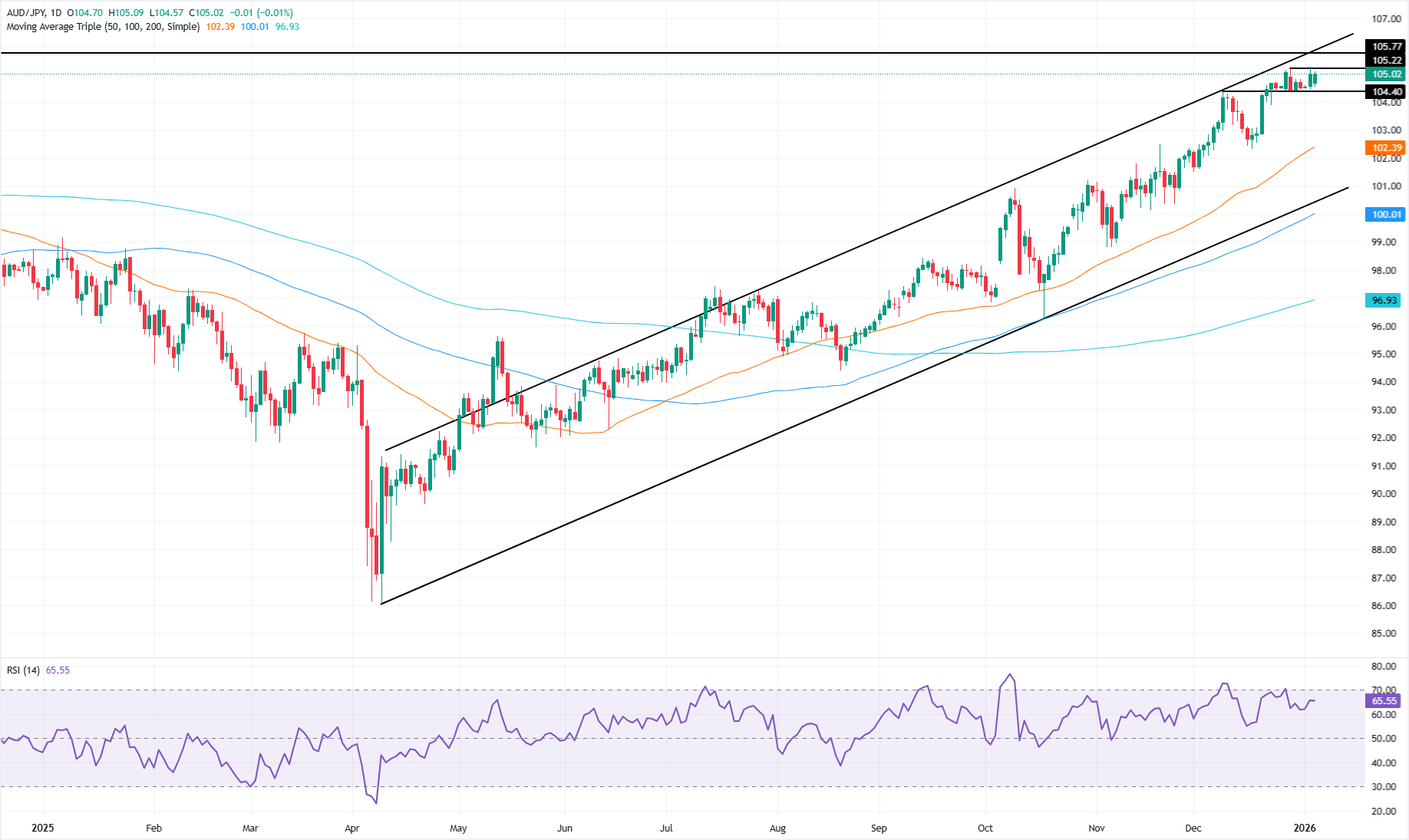
The technical picture reveals that the uptrend in the AUD/JPY remains intact, confirmed by a rising Relative Strength Index (RSI) in convergence with price action. The RSI is at 65.20 with the slope showing signs that bulls are in charge, while the pair remains shy of cracking last year’s peak at 105.22.
If AUD/JPY clears the latter, buyers would push prices towards the July 19, 2024, cycle high at 105.77. On further strength, the next area of supply would be the July 11, 2024, peak at 109.37.
For a bearish continuation, the AUD/JPY first support would be 105.00. A breach of the latter will expose December 9 high of 104.40, ahead of 104.00. Once cleared, below lies the 103.00 figure, followed by the 50-day SMA at 102.40.
AUD/JPY Price Chart – Daily
Australian Dollar FAQs
One of the most significant factors for the Australian Dollar (AUD) is the level of interest rates set by the Reserve Bank of Australia (RBA). Because Australia is a resource-rich country another key driver is the price of its biggest export, Iron Ore. The health of the Chinese economy, its largest trading partner, is a factor, as well as inflation in Australia, its growth rate and Trade Balance. Market sentiment – whether investors are taking on more risky assets (risk-on) or seeking safe-havens (risk-off) – is also a factor, with risk-on positive for AUD.
The Reserve Bank of Australia (RBA) influences the Australian Dollar (AUD) by setting the level of interest rates that Australian banks can lend to each other. This influences the level of interest rates in the economy as a whole. The main goal of the RBA is to maintain a stable inflation rate of 2-3% by adjusting interest rates up or down. Relatively high interest rates compared to other major central banks support the AUD, and the opposite for relatively low. The RBA can also use quantitative easing and tightening to influence credit conditions, with the former AUD-negative and the latter AUD-positive.
China is Australia’s largest trading partner so the health of the Chinese economy is a major influence on the value of the Australian Dollar (AUD). When the Chinese economy is doing well it purchases more raw materials, goods and services from Australia, lifting demand for the AUD, and pushing up its value. The opposite is the case when the Chinese economy is not growing as fast as expected. Positive or negative surprises in Chinese growth data, therefore, often have a direct impact on the Australian Dollar and its pairs.
Iron Ore is Australia’s largest export, accounting for $118 billion a year according to data from 2021, with China as its primary destination. The price of Iron Ore, therefore, can be a driver of the Australian Dollar. Generally, if the price of Iron Ore rises, AUD also goes up, as aggregate demand for the currency increases. The opposite is the case if the price of Iron Ore falls. Higher Iron Ore prices also tend to result in a greater likelihood of a positive Trade Balance for Australia, which is also positive of the AUD.
The Trade Balance, which is the difference between what a country earns from its exports versus what it pays for its imports, is another factor that can influence the value of the Australian Dollar. If Australia produces highly sought after exports, then its currency will gain in value purely from the surplus demand created from foreign buyers seeking to purchase its exports versus what it spends to purchase imports. Therefore, a positive net Trade Balance strengthens the AUD, with the opposite effect if the Trade Balance is negative.

Acuity Trading
Acuity Trading은 2013년에 설립된 런던 기반 핀테크로, AI 기반 대체 데이터와 심리 분석을 통해 트레이딩과 투자를 지원합니다. 시각화된 뉴스와 심리 도구로 온라인 트레이딩 경험을 혁신했으며, 최신 AI 연구와 기술로 알파를 창출하는 대체 데이터와 높은 몰입도의 트레이딩 도구를 제공하며 시장을 선도하고 있습니다.
Read More








