

Ethereum Price Forecast: EF outlines ways to solve growing state issues
작성자 Michael Ebiekutan
게시일: 19 Dec 2025 | 수정일: 19 Dec 2025


인기 기사

The Ethereum (ETH) Foundation's Stateless Consensus team highlighted that the network's 'state' size has increased significantly over the past year following several scalability implementations.
Ethereum price today: $2,920
- The EF noted that Ethereum's growing state could lead to centralization and weaken censorship resistance.
- The Stateless Consensus team outlined state expiry, state archive and partial statelessness as potential solutions to the growing state load.
- ETH bounced near a symmetrical triangle support following a rejection at the 20-day EMA.
The Ethereum (ETH) Foundation's Stateless Consensus team highlighted that the network's 'state' size has increased significantly over the past year following several scalability implementations. This growing state poses risks of centralization, censorship, and scalability limitations in the long run, the Foundation noted in a blog post on Tuesday.
State comprises all data that enables Ethereum to function, including accounts, contract storage, and bytecode.
The state underpins nearly every aspect of the Ethereum ecosystem. Wallets rely on it to display balances and past actions, decentralized applications query it to determine which positions, orders, or messages exist, and infrastructure providers like explorers and bridges continuously read it to deliver services on top of it.
The Ethereum Foundation's (EF) research team warned that if the state becomes too large, too centralized or too difficult to serve, all layers become more fragile, more expensive and harder to decentralize.
Ethereum's state only grows in one direction: up. Every new account, storage write, and bytecode addition contributes data that the network must preserve forever. This steady accumulation creates concrete operational costs that validators and full nodes must bear.
The team estimates that roughly 80% of Ethereum's state has not been touched for over a year, yet every node still needs to store it. Other chains already face similar problems: growing state sizes make running a full node unrealistic for average users, pushing state custody into the hands of a few large providers.
The Foundation expressed concern that if only a small group of well-funded operators can afford to run full nodes, Ethereum's censorship resistance and credible neutrality suffer. While mechanisms like FOCIL and VOPS aim to preserve censorship resistance even with specialized builders, their effectiveness depends on a healthy ecosystem of nodes that can access, hold, and serve the state without prohibitive cost.
How to solve the growing state issues?
To address these challenges, the Stateless Consensus team outlined three complementary approaches in its proposal: state expiry, state archive and partial statelessness.
State expiry temporarily removes inactive state from the active set, allowing it to be revived later with cryptographic proofs. The team explored two variants: mark-expire-revive, which expires individual entries, and multi-era expiry, which periodically rolls state into eras. Both aim to keep the active state small by temporarily removing inactive parts.
State archive separates hot state from cold state. Frequently accessed data remains fast and bounded, while older data is preserved in archival storage for historical verification. This approach keeps node performance relatively stable over time, rather than degrading as the chain ages.
Partial statelessness allows nodes to store only subsets of the state rather than the entire state. Wallets and light clients would cache the data they rely on, reducing dependence on centralized RPC providers. This model lowers storage costs and makes it easier for individuals and smaller operators to run nodes.
The Foundation is prioritizing solutions that deliver immediate benefits while remaining compatible with more ambitious protocol changes later. Current focus areas include improving archive node tooling, strengthening RPC infrastructure, and making partial stateless nodes easier to run.
The team emphasized that this work represents a proposal, not a unified organizational stance, noting that Ethereum's protocol development includes a wide range of opinions. Developers, node operators, and infrastructure teams are being invited to participate in testing and discussion.
Ethereum Price Forecast: ETH recovers symmetrical triangle support
Ethereum saw $147.8 million in liquidations over the past 24 hours, driven by $78.5 million in long liquidations, according to Coinglass data.
ETH saw a rejection at the 20-day Exponential Moving Average (EMA) on Thursday, temporarily pushing its price below the lower boundary of a key symmetrical triangle.
Following a recovery of the triangle's support, the top altcoin has to rise above its upper boundary near the 50-day EMA before it can tackle the $3,470 resistance. However, it has to clear the 20-day EMA to pull off such a move.
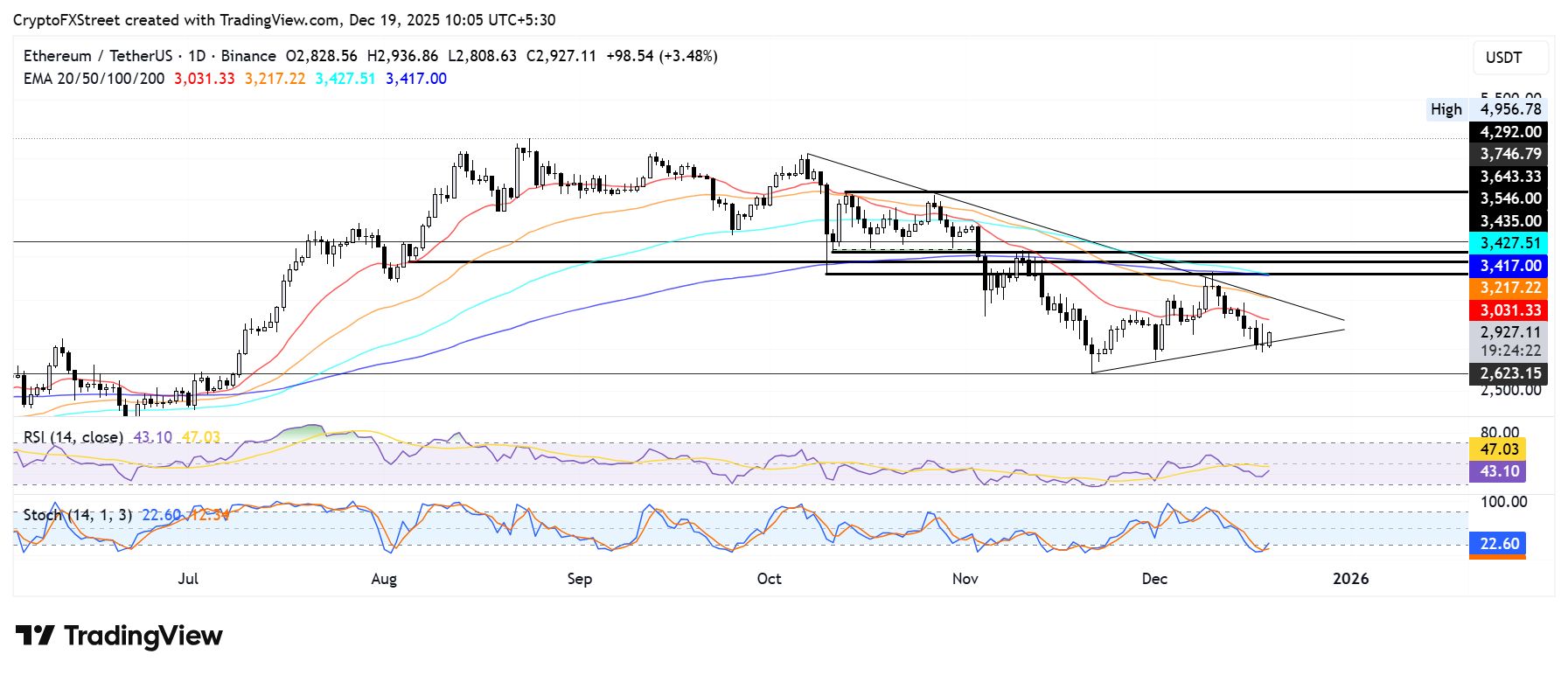
On the downside, ETH could find support at $2,620 if it falls below the triangle's lower boundary.
The Relative Strength Index (RSI) is below its neutral level while the Stochastic Oscillator (Stoch) remains in oversold conditions, indicating a dominant bearish momentum.

Acuity Trading은 2013년에 설립된 런던 기반 핀테크로, AI 기반 대체 데이터와 심리 분석을 통해 트레이딩과 투자를 지원합니다. 시각화된 뉴스와 심리 도구로 온라인 트레이딩 경험을 혁신했으며, 최신 AI 연구와 기술로 알파를 창출하는 대체 데이터와 높은 몰입도의 트레이딩 도구를 제공하며 시장을 선도하고 있습니다.
더 읽기








