

Trade The World
USD/JPY climbs on yield gap, tariff threats from Trump
작성자 Tammy Da Costa, CFTe®
게시일: 11 Jul 2025 | 수정일: 11 Jul 2025


POPULAR ARTICLES

The US Dollar (USD) is trading confidently against the Japanese Yen (JPY) on Friday, as yield differentials and tariff risks continue to weigh on the safe-haven Yen.
- USD/JPY benefits from yield differentials between the US and Japan, pushing prices above 147.00.
- Japan's economy remains at risk after Trump threatens a 25% tariff on all Japanese imports starting August 1.
- USD/JPY bulls push the Relative Strength (RSI) higher, signaling a surge in upside momentum.
The US Dollar (USD) is trading confidently against the Japanese Yen (JPY) on Friday, as yield differentials and tariff risks continue to weigh on the safe-haven Yen.
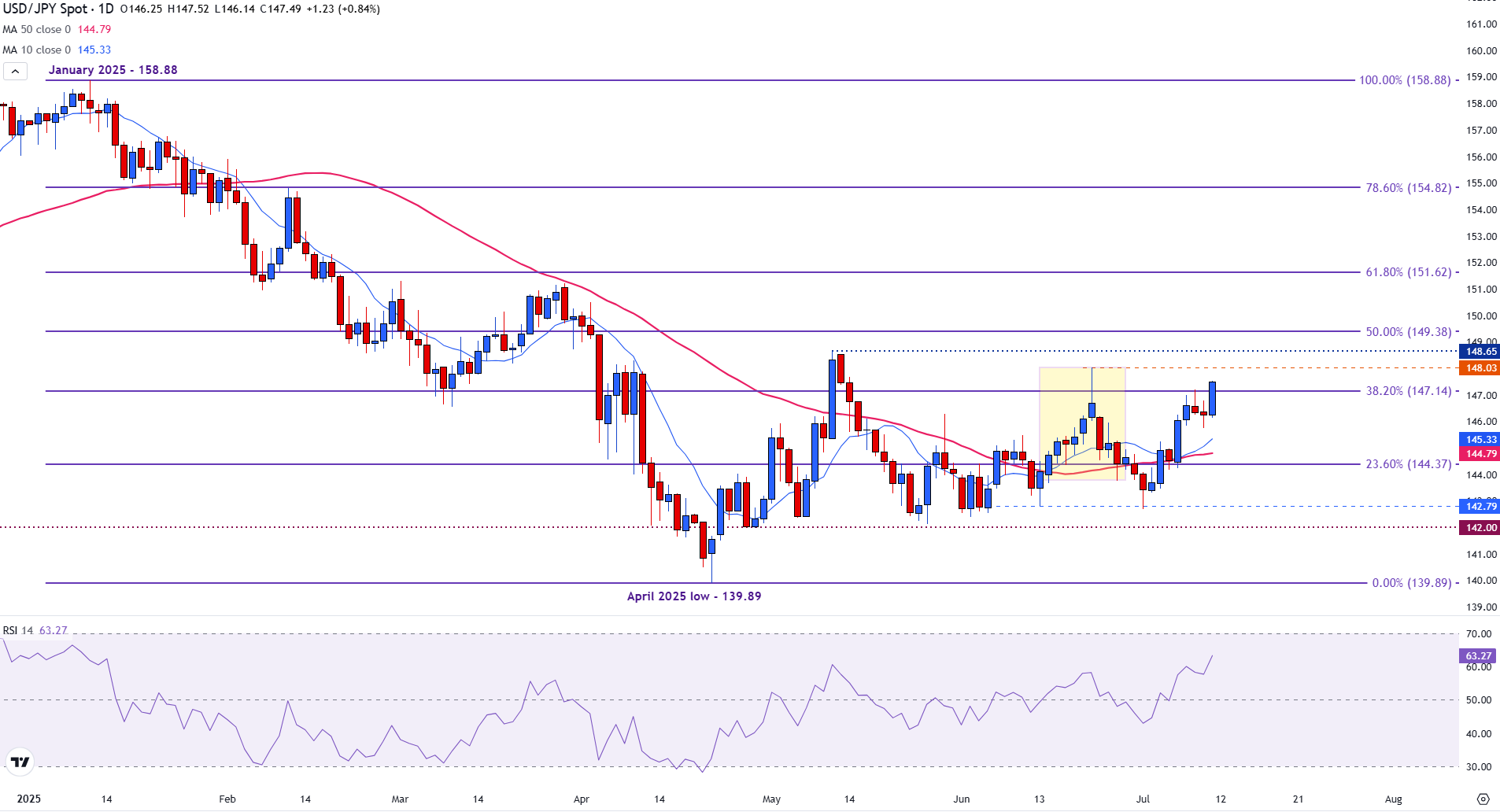
At the time of writing, USD/JPY continues to trade above 147.00 with the next psychological level of 148.00 in sight.
Both Japan and the United States operate under a dual mandate in monetary policy. However, the priorities of their respective central banks differ significantly.
The US Federal Reserve (Fed), which currently maintains its benchmark interest rates between 4.25% and 4.50%, is focused on restoring price stability. By keeping rates elevated for an extended period, the Fed aims to bring inflation down to its 2% target.
Meanwhile, the Bank of Japan (BoJ) continues to operate in a low-rate environment to stimulate economic growth. With its benchmark rate still at 0.50%, the wide gap in interest rates between the two economies has continued to attract investors to the US Dollar, pushing USD/JPY higher.
Tariff concerns are adding further pressure. Japan faces 25% tariffs on automobile exports to the US and 50% on steel and aluminium, with copper set to be added to the list in August. As Tokyo scrambles to secure a trade deal ahead of a possible 25% tariff on all Japanese imports, USD/JPY remains on the rise.
USD/JPY battles resistance at 147.00 as bullish momentum supports the upside move
The USD/JPY pair is currently trading just above the 38.2% Fibonacci retracement level at 147.14, a key technical area derived from the January high of 158.88 to the April low of 139.89.
While a full breakout has yet to be confirmed, the pair is showing strong upward momentum, supported by consecutive bullish candles. USD/JPY price action currently holds above both the 10-day and 50-day Simple Moving Average (SMA), providing additional support at 145.31 and 144.79, respectively.
This positioning reflects a strengthening short-term trend, though the resistance zone between 147.14 and 148.03 remains critical.
A clear daily close above this range would strengthen the bullish case, opening the path toward the 50% Fibonacci level at 149.38. Meanwhile, the Relative Strength Index (RSI) stands at 62, suggesting continued upside potential without entering overbought territory.
USD/JPY daily chart
Japanese Yen FAQs
The Japanese Yen (JPY) is one of the world’s most traded currencies. Its value is broadly determined by the performance of the Japanese economy, but more specifically by the Bank of Japan’s policy, the differential between Japanese and US bond yields, or risk sentiment among traders, among other factors.
One of the Bank of Japan’s mandates is currency control, so its moves are key for the Yen. The BoJ has directly intervened in currency markets sometimes, generally to lower the value of the Yen, although it refrains from doing it often due to political concerns of its main trading partners. The BoJ ultra-loose monetary policy between 2013 and 2024 caused the Yen to depreciate against its main currency peers due to an increasing policy divergence between the Bank of Japan and other main central banks. More recently, the gradually unwinding of this ultra-loose policy has given some support to the Yen.
Over the last decade, the BoJ’s stance of sticking to ultra-loose monetary policy has led to a widening policy divergence with other central banks, particularly with the US Federal Reserve. This supported a widening of the differential between the 10-year US and Japanese bonds, which favored the US Dollar against the Japanese Yen. The BoJ decision in 2024 to gradually abandon the ultra-loose policy, coupled with interest-rate cuts in other major central banks, is narrowing this differential.
The Japanese Yen is often seen as a safe-haven investment. This means that in times of market stress, investors are more likely to put their money in the Japanese currency due to its supposed reliability and stability. Turbulent times are likely to strengthen the Yen’s value against other currencies seen as more risky to invest in.

Acuity Trading
Acuity Trading은 2013년에 설립된 런던 기반 핀테크로, AI 기반 대체 데이터와 심리 분석을 통해 트레이딩과 투자를 지원합니다. 시각화된 뉴스와 심리 도구로 온라인 트레이딩 경험을 혁신했으며, 최신 AI 연구와 기술로 알파를 창출하는 대체 데이터와 높은 몰입도의 트레이딩 도구를 제공하며 시장을 선도하고 있습니다.
Read More








