[TMGM Financial Breakfast] Gold Plunges 6% as Surging Oil Prices and Strong Dollar Undermine Safe-Haven Appeal
The situation intensified after Israel launched a strike on Iran’s South Pars gas field, triggering a chain reaction across energy infrastructure. Iran responded with retaliatory measures, sending crude oil prices sharply higher. At the same time, stronger-than-expected U.S. producer price index (PPI) data reinforced market expectations that the Federal Reserve may tighten policy further.
Although the Fed kept interest rates unchanged, Chair Jerome Powell highlighted the inflationary risks posed by rising oil prices during a press conference. He also noted that the path of future rates carries two-sided risks and did not rule out the possibility of another rate hike. These signals boosted the U.S. dollar and tightened financial conditions, accelerating selling pressure in gold instead of supporting it through safe-haven demand.

Recent developments in U.S.-Iran tensions have expanded beyond the military sphere into the energy sector. The strike on the South Pars gas field—one of the world’s most critical natural gas hubs—has disrupted global supply expectations. Iran’s response targeting energy facilities in the Gulf region has further heightened uncertainty, pushing oil prices up more than 3% intraday.
Historically, such geopolitical conflicts tend to drive investors toward gold. However, the current market reaction has diverged sharply from past patterns. Despite rising oil prices, gold has declined. Analysts attribute this to shifting inflation expectations: higher energy costs are feeding into broader price pressures, raising concerns that the Fed will maintain elevated interest rates for longer. This, in turn, reduces the appeal of non-yielding assets like gold.
The unusual divergence—oil prices rising while gold falls—reflects a broader macroeconomic shift, with the strengthening U.S. dollar emerging as a dominant force. Markets have significantly revised expectations for rate cuts in 2026, with pricing dropping from around 55 basis points to roughly 26 basis points.
This shift in policy outlook has tightened financial conditions, lifting U.S. Treasury yields and the dollar, both of which weigh on gold. As an asset highly sensitive to interest rates, gold faces higher holding costs in a high-rate environment, prompting investors to reduce long positions.
Market Outlook:
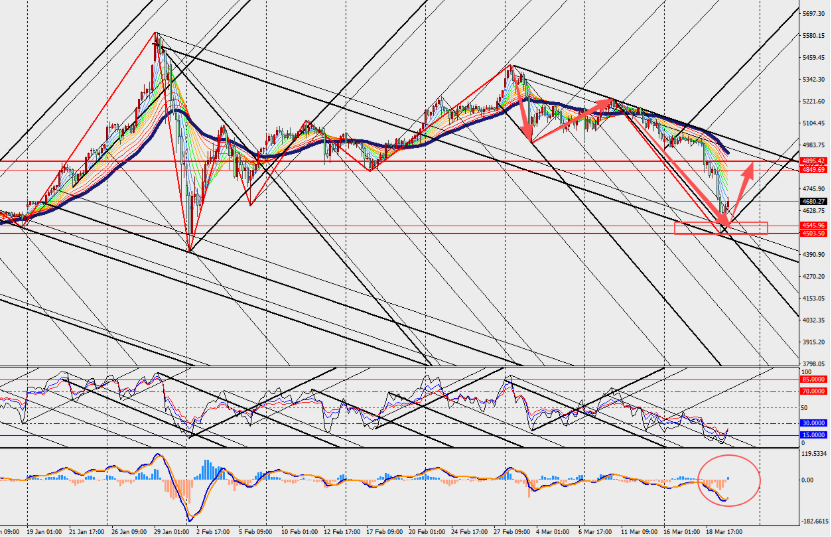
On the technical front, gold has shown signs of a short-term rebound from oversold conditions on the four-hour chart. The MACD indicator has formed a bullish crossover below the zero line, with expanding momentum bars.
However, easing safe-haven demand, rising inflation expectations, and elevated Treasury yields remain key headwinds. Recent declines have also triggered panic selling, exacerbating downward pressure. Meanwhile, a temporary easing of tensions in the Middle East has reduced safe-haven buying, while Fed policy expectations and persistent energy supply uncertainty continue to anchor yields at higher levels.