[TMGM Financial Breakfast] World Gold Council: Gold Has Not Undergone a Structural Shift, Remains a Key Strategic Asset
The World Gold Council (WGC) noted that gold volatility has risen significantly in 2026. However, similar spikes have occurred historically and typically normalize within a few months. Even during periods of sell-offs, global gold market liquidity remains strong, with spot bid-ask spreads staying within reasonable ranges. In an environment where stock–bond correlations are rising, gold continues to serve as a strategic asset for portfolio diversification.
Although gold prices have rebounded several times, persistent geopolitical risks have kept financial markets under pressure. This has increased investors’ demand for liquidity, contributing to elevated gold volatility — particularly amid disruptions to key trading and demand hubs such as Dubai due to Middle East tensions.

It is important to note that gold is not the only asset experiencing higher volatility in 2026. In March, both equities and bonds also saw sharp increases in volatility, a pattern that has occurred historically. For example, during the global financial crisis, investors sold gold — despite its strong prior performance and high liquidity — to meet margin calls and liquidity needs. This resulted in simultaneous volatility spikes across major asset classes.
A similar pattern was observed during the COVID-19 pandemic. In most of these cases, gold ultimately performed well, helping investors raise emergency liquidity and later delivering strong returns once liquidity conditions stabilized. This dual role is a key reason gold maintains its strategic importance: it can act as a source of liquidity during stress periods and as a return-generating asset afterward.
The Council’s analysis also shows that gold volatility exhibits mean-reverting characteristics. Over time, gold’s annualized volatility typically ranges between 10% and 18%. Historical data suggests a volatility half-life of around 1.6 months, similar to equities. This means that even when gold volatility spikes to extreme levels, it tends to revert to long-term averages.
Recent oil price surges linked to the Iran conflict may further increase inflation-driven volatility. At the same time, gold continues to maintain a low to negative correlation with risk assets, providing investors with a hedge option.
Market Interpretation:
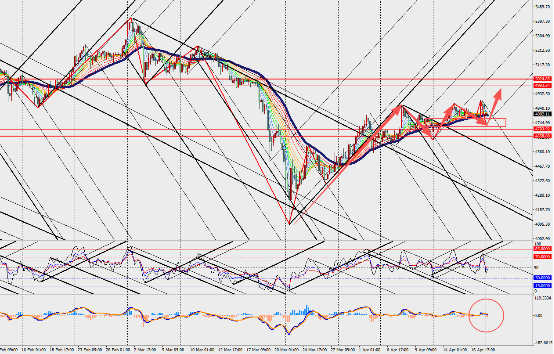
On the four-hour chart, gold is showing a mild pullback with MACD lines and volume bars expanding near the zero axis. Even in periods of heightened volatility, gold’s low correlation with equities makes it a valuable component of diversified portfolios.
Historically, gold often declines at the early stage of risk events as investors seek liquidity. However, if uncertainty persists, gold tends to recover and outperform other asset classes, reinforcing its long-term strategic role.