[TMGM Financial Breakfast] Market Volatility Persists as Gold Investors Await Clarity on U.S.–Iran Tensions
Gold partially recovered intraday losses after U.S. President Donald Trump announced a potential extension of the 10-day Israel–Lebanon ceasefire (which took effect on April 17). At the same time, U.S. Treasury yields pulled back from intraday highs following the release of initial jobless claims data, providing additional support to gold. The easing of tensions in Lebanon has helped reduce geopolitical risk sentiment and indirectly influenced gold demand in relation to the broader Middle East situation.
However, tensions in the Strait of Hormuz continue to escalate. The strait is now effectively under unilateral blockade by the U.S. Navy. Trump stated on Truth Social that the U.S. has full control over the strait, and no vessel can pass without U.S. approval.

Meanwhile, a Pentagon assessment cited by The Washington Post suggests that clearing naval mines in the area could take up to six months, highlighting the risk of prolonged disruption to global oil supply. On April 22, Iran’s Revolutionary Guard seized two vessels in the strait, further intensifying shipping disruptions.
These developments have pushed oil prices higher, increasing global inflation concerns. This, in turn, raises the likelihood that major central banks, including the Federal Reserve, will maintain higher interest rates. While gold is traditionally viewed as a hedge against inflation, rising interest rates reduce its appeal as a non-yielding asset, placing downward pressure on prices.
From a data perspective, U.S. labor market indicators provided some support for gold. Initial jobless claims rose by 6,000 to 214,000 for the week ending April 18, exceeding expectations of 210,000.
At the same time, U.S. economic activity data showed continued strength. The S&P Global Manufacturing PMI rose from 52.3 in March to 54.0 in April, marking a 47-month high. The Services PMI increased from 49.8 to 51.3, reaching a two-month high. Both readings moved above the 50 expansion threshold, indicating improving economic conditions.
Stronger economic data reinforces expectations that the Federal Reserve may keep interest rates elevated, which indirectly pressures gold.
Market Interpretation:
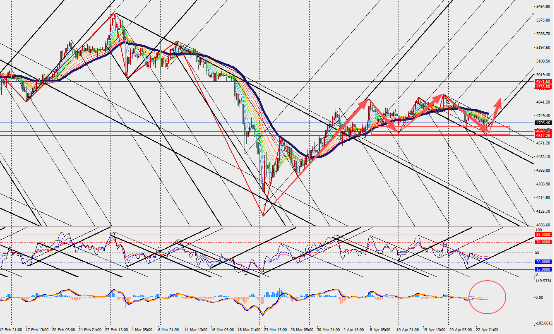
On the four-hour chart, gold is showing a modest rebound, with MACD lines and volume bars expanding in a fluctuating pattern. The market is currently being driven by developments such as potential progress in the Lebanon ceasefire.
However, the timing of economic data releases has also played a role, with yields and macro data influencing short-term price movements. Ultimately, gold — like other assets — remains highly sensitive to headline-driven developments, particularly those related to geopolitics and monetary policy expectations.