

$4,100: The immediate support for Gold
- Gold price plummets to near $4,170 due to renewed Middle East tensions.
- Iran’s Foreign Ministry spokesperson Baghaei said that Tehran needs to reassess the terms of negotiations with the US.
- Investors keenly await the US CPI data for May.
Gold price (XAU/USD) trades 2.1% lower at around $4,170 during the European trading session on Wednesday. The precious metal faces intense selling pressure as Iran has announced that negotiation terms with the United States (US) towards a permanent peace deal have returned under review, following attacks by Washington’s Central Command (CENTCOM).

Earlier in the day, Iran's Foreign Ministry spokesperson Esmaeil Baghaei said that Tehran needs to reassess the terms of negotiations with Washington following overnight clashes, adding that the US has harmed the diplomatic process with its continued ceasefire violations.
On late Tuesday, the US CENTCOM confirmed launching a series of attacks on Iran’s air defense, ground control stations, and surveillance radar sites near the Strait of Hormuz, a vital passage to almost 20% of global energy supply. These attacks were highly anticipated as US President Donald Trump vowed to retaliate against Tehran’s attack on the US Apache helicopter over the Hormuz.
The message from Iran pushing peace talks with the US under review again has prompted fears of a prolonged closure of the Hormuz, a scenario that will keep oil prices elevated, which will result in de-anchored inflation expectations and hawkish guidance from global central banks.
Signs of tightening monetary conditions or higher for longer interest rates bode poorly for non-yielding assets, such as Gold.
To get fresh cues regarding the current status of the US inflation, investors await the Consumer Price Index (CPI) data for May, which will be published at 12:30 GMT.
Gold technical analysis
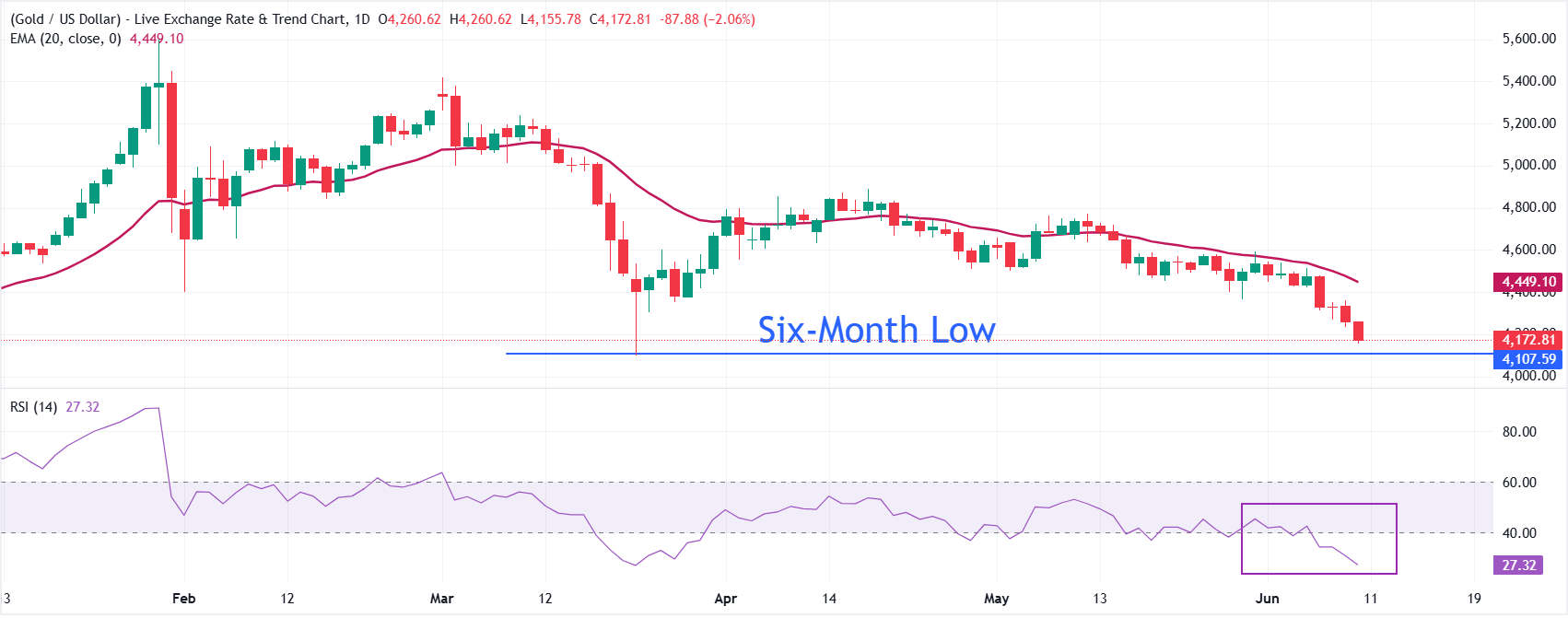
XAU/USD trades lower at $4,172, extending a bearish phase with spot holding well below the 20-day Exponential Moving Average (EMA) at $4,449.
The distance to this short-term trend gauge reinforces a downside bias, while the 14-day Relative Strength Index (RSI) around 27 sits in oversold territory, hinting that selling pressure is stretched but not yet reversed.
On the topside, the 20-day EMA at $4,449 is the first meaningful resistance that bulls would need to reclaim to ease immediate downside pressure and signal a more sustained recovery attempt. Looking down, the six-month low of around $4,100 is the immediate support. The Gold price would be exposed to $4,000 if it fails to hold $4,100.
(The technical analysis of this story was written with the help of an AI tool.)
Gold FAQs
Gold has played a key role in human’s history as it has been widely used as a store of value and medium of exchange. Currently, apart from its shine and usage for jewelry, the precious metal is widely seen as a safe-haven asset, meaning that it is considered a good investment during turbulent times. Gold is also widely seen as a hedge against inflation and against depreciating currencies as it doesn’t rely on any specific issuer or government.
Central banks are the biggest Gold holders. In their aim to support their currencies in turbulent times, central banks tend to diversify their reserves and buy Gold to improve the perceived strength of the economy and the currency. High Gold reserves can be a source of trust for a country’s solvency. Central banks added 1,136 tonnes of Gold worth around $70 billion to their reserves in 2022, according to data from the World Gold Council. This is the highest yearly purchase since records began. Central banks from emerging economies such as China, India and Turkey are quickly increasing their Gold reserves.
Gold has an inverse correlation with the US Dollar and US Treasuries, which are both major reserve and safe-haven assets. When the Dollar depreciates, Gold tends to rise, enabling investors and central banks to diversify their assets in turbulent times. Gold is also inversely correlated with risk assets. A rally in the stock market tends to weaken Gold price, while sell-offs in riskier markets tend to favor the precious metal.
The price can move due to a wide range of factors. Geopolitical instability or fears of a deep recession can quickly make Gold price escalate due to its safe-haven status. As a yield-less asset, Gold tends to rise with lower interest rates, while higher cost of money usually weighs down on the yellow metal. Still, most moves depend on how the US Dollar (USD) behaves as the asset is priced in dollars (XAU/USD). A strong Dollar tends to keep the price of Gold controlled, whereas a weaker Dollar is likely to push Gold prices up.













