

AUD/USD drifts lower after RBA minutes as jobs data looms
- RBA minutes confirmed a hawkish tilt; Thursday's Australian employment report is the next test for the Australian Dollar
- Reserve Bank of Australia (RBA) February meeting minutes showed the Board saw a "stronger case" for a 25 basis point hike to 3.85%, citing materially higher inflation and tight labour market conditions.
- Australian January employment data on Thursday is forecast at 20K (prior 65.2K), with the unemployment rate expected to edge up to 4.2% from 4.1%.
The RBA minutes released on Tuesday reinforced the hawkish tone set by Governor Bullock's post-decision press conference, noting that private demand is growing faster than expected and capacity pressures are greater than previously assessed. The Board signalled it is prepared to hike again if inflation proves persistent, and Wednesday's Wage Price Index (WPI) at 0.8% MoM only underscored that message. Attention now shifts to Thursday's January employment report, where a forecast of 20K new jobs (down sharply from December's 65.2K) and a small tick higher in the Unemployment Rate will test whether the labour market is cooling quickly enough to cap further tightening. On the US side, Initial Jobless Claims and the Philadelphia Fed Manufacturing Survey on Thursday will add or hinder further US Dollar momentum.

Shallow pullback holds above 0.7000 as Stochastic begins to roll off overbought
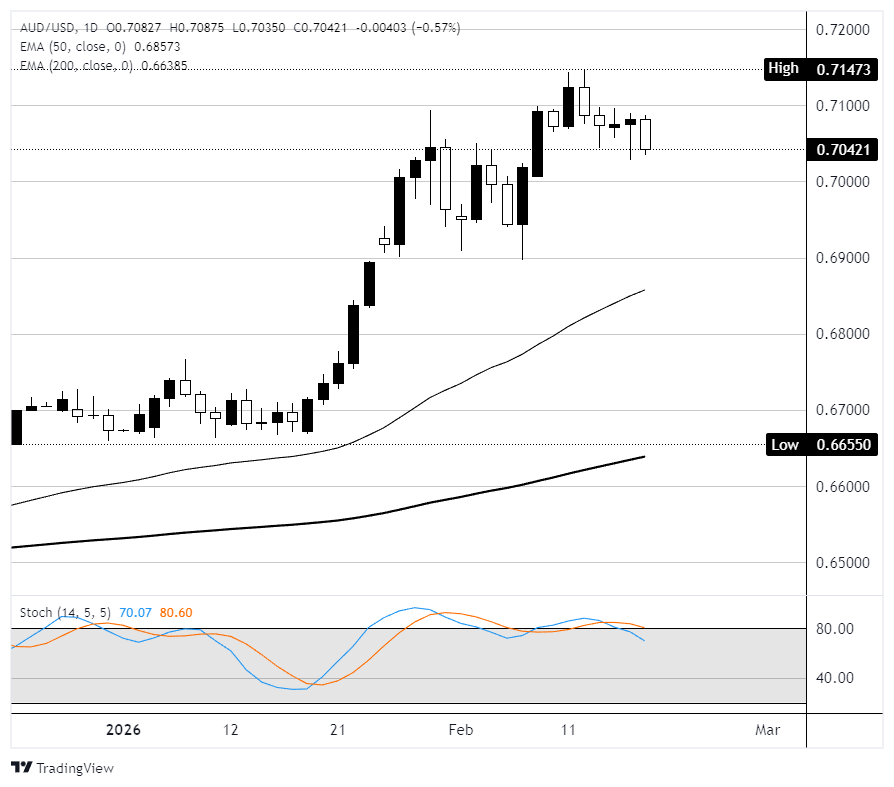
On the daily chart, AUD/USD drifted lower on Wednesday, closing near 0.7040 and shedding 0.56% in a session confined to a narrow range. The pair continues to hold well above the rising 50-day Exponential Moving Average (EMA) at 0.6860 and the 200-day EMA at 0.6640, keeping overall bullish momentum from the late-December rally off 0.6600 firmly in place. The Stochastic Oscillator has crossed bearish from the overbought zone, suggesting near-term momentum is fading, and the pair may consolidate further before its next directional move. Recent candles show a series of small-bodied sessions near the 0.7050 area, pointing to indecision ahead of Thursday's employment release. Immediate support sits at 0.7000, with resistance at the year-to-date high of 0.7147; a break above would target the 0.7200 handle.
AUD/USD daily chart
Australian Dollar FAQs
One of the most significant factors for the Australian Dollar (AUD) is the level of interest rates set by the Reserve Bank of Australia (RBA). Because Australia is a resource-rich country another key driver is the price of its biggest export, Iron Ore. The health of the Chinese economy, its largest trading partner, is a factor, as well as inflation in Australia, its growth rate and Trade Balance. Market sentiment – whether investors are taking on more risky assets (risk-on) or seeking safe-havens (risk-off) – is also a factor, with risk-on positive for AUD.
The Reserve Bank of Australia (RBA) influences the Australian Dollar (AUD) by setting the level of interest rates that Australian banks can lend to each other. This influences the level of interest rates in the economy as a whole. The main goal of the RBA is to maintain a stable inflation rate of 2-3% by adjusting interest rates up or down. Relatively high interest rates compared to other major central banks support the AUD, and the opposite for relatively low. The RBA can also use quantitative easing and tightening to influence credit conditions, with the former AUD-negative and the latter AUD-positive.
China is Australia’s largest trading partner so the health of the Chinese economy is a major influence on the value of the Australian Dollar (AUD). When the Chinese economy is doing well it purchases more raw materials, goods and services from Australia, lifting demand for the AUD, and pushing up its value. The opposite is the case when the Chinese economy is not growing as fast as expected. Positive or negative surprises in Chinese growth data, therefore, often have a direct impact on the Australian Dollar and its pairs.
Iron Ore is Australia’s largest export, accounting for $118 billion a year according to data from 2021, with China as its primary destination. The price of Iron Ore, therefore, can be a driver of the Australian Dollar. Generally, if the price of Iron Ore rises, AUD also goes up, as aggregate demand for the currency increases. The opposite is the case if the price of Iron Ore falls. Higher Iron Ore prices also tend to result in a greater likelihood of a positive Trade Balance for Australia, which is also positive of the AUD.
The Trade Balance, which is the difference between what a country earns from its exports versus what it pays for its imports, is another factor that can influence the value of the Australian Dollar. If Australia produces highly sought after exports, then its currency will gain in value purely from the surplus demand created from foreign buyers seeking to purchase its exports versus what it spends to purchase imports. Therefore, a positive net Trade Balance strengthens the AUD, with the opposite effect if the Trade Balance is negative.














