

Bank of Japan expected to raise interest rate to 1%, its highest since 1995
- The Bank of Japan is expected to hike interest rates to 1% in its June meeting.
- Governor Kazuo Ueda will not precede the meeting due to health issues.
- USD/JPY retains its bullish bias despite easing demand for the US Dollar.
The Bank of Japan (BoJ) will announce its monetary policy decision on Tuesday, at around 3:00 GMT.
The BoJ is widely expected to deliver a hawkish move by hiking the benchmark interest rate by 25 basis points (bps) to 1%, its highest level since 1995. The hike is meant not only to address mounting inflationary pressures but also the Japanese Yen’s (JPY) strength.

Governor Kazuo Ueda, who was hospitalized last week, won’t attend the monetary policy meeting. Deputy Governor Ryozo Himino would chair the policy meeting, while Deputy Shinichi Uchida would hold the press conference following the decision.
Ahead of the announcement, the USD/JPY pair trades above the 160.00 mark, a line in the sand for Japanese authorities, as it is usually seen as an intervention level.
Finally, the Middle East crisis has reached an inflection point: The United States (US) and Iran reached an agreement that will reopen the Strait of Hormuz and extend the ceasefire for another 60 days, allowing talks to continue. Financial markets are optimistic ahead of the announcement, resulting in mild US Dollar (USD) weakness across the FX board.
What to expect from the BoJ interest rate decision?
An interest rate hike has long been priced in, meaning the rate move itself should have a limited impact on the JPY. Japanese policymakers, however, will also discuss the BoJ’s plan to reduce purchases of Japanese Government Bonds (JGBs) to allow long-term rates to be guided more by the market. Their decision on the matter could define the JPY’s near-term direction.
Japan’s annual inflation, as measured by the Consumer Price Index (CPI), stood at 1.4% in April this year, easing from 1.5% in March. However, wholesale inflation jumped to 6.3% You in May, a clear sign that inflationary pressures are likely to extend in time, despite a potential end to the Iran war later this week.
But it is not only about higher Oil prices: the significant depreciation of the JPY also results in inflation stemming from pretty much all imported goods and raw materials. And the BoJ's mandate is clearly focused on the matter: “The Bank of Japan, as the central bank of Japan, decides and implements monetary policy with the aim of maintaining price stability,” targeting 2% annual inflation.
That being said, the current CPI at 1.5% YoY may not be enough to justify a rate hike, but wholesale prices and JPY weakness are.
BoJ Governor Ueda said before being hospitalized that policymakers should not look at Oil prices in isolation, noting that temporary energy shocks can become persistent and affect wages, expectations, and price-setting behavior.
"If inflation expectations are already high and wages are accelerating, the risk of second-round effects is large," Ueda stated, adding that the boundary between temporary and persistent inflation is not mechanical
How could the Bank of Japan's monetary policy decision affect USD/JPY?
As previously noted, market participants have already priced in a 25 bps rate hike. Any decision on future bond purchases is partially discounted. Japanese policymakers don’t tend to surprise investors and tend to act too cautiously. With that in mind, and given that the press conference will be led by Deputy Shinichi Uchida, the BoJ’s announcement is likely to have a limited impact on JPY.
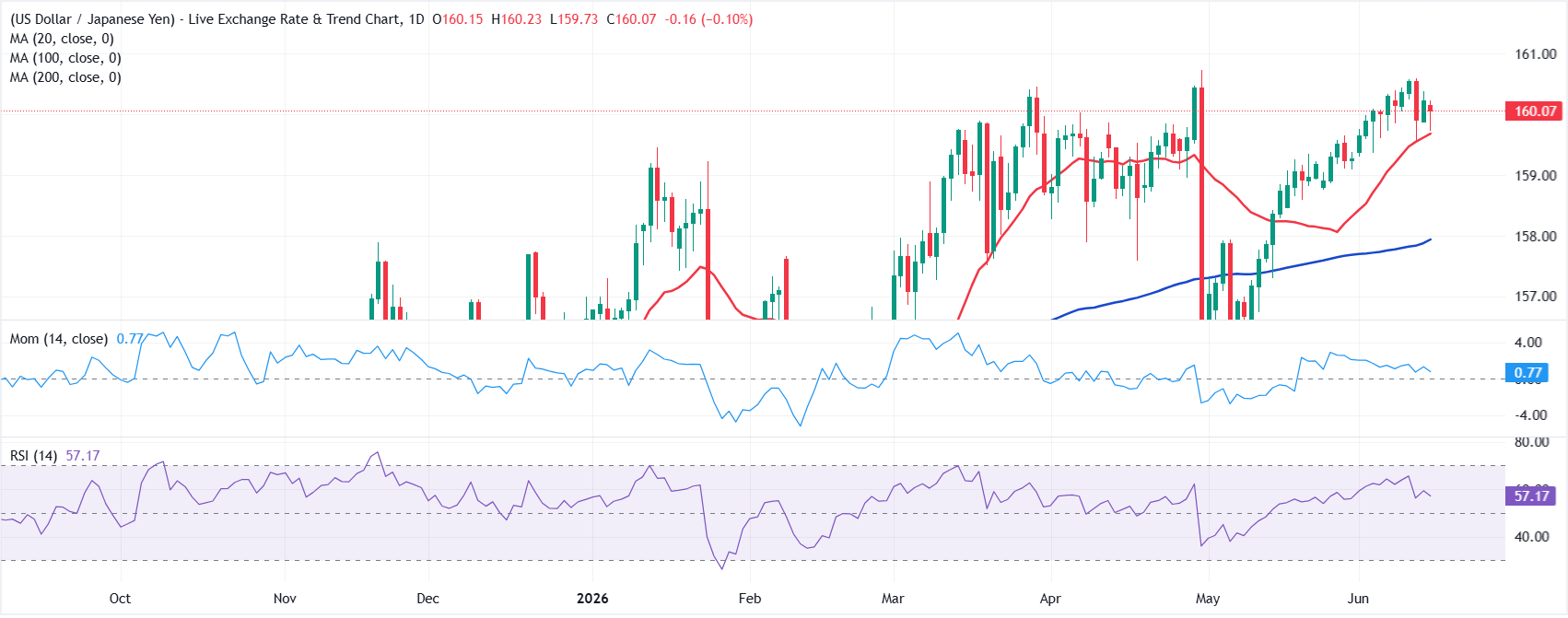
Valeria Bednarik, Chief Analyst at FXStreet, notes: “The USD/JPY pair trades around the 160.00 mark, maintaining the positive bias despite easing market concerns undermining demand for the USD. The daily chart for the pair shows a bullish 20-day Simple Moving Average (SMA) that heads north, well above the 100- and 200-day SMAs. The same chart shows that technical indicators have lost their upward momentum but remain above their midlines, lacking directional strength. The mentioned 20-day SMA has attracted buyers and now provides near-term support at around 159.65”
Bednarik adds: “Once below the aforementioned dynamic support, the pair can extend its slide towards 159.00, while additional selling pressure could see the pair aiming for 158.60, a static support level. The USD/JPY pair peaked at 160.73 in April, a multi-decade high and a critical level to watch should JPY continue to weaken. Next comes 161.00, although it seems unlikely that Japanese authorities will allow the currency to weaken that much without actually intervening in the market.”
Japanese Yen FAQs
The Japanese Yen (JPY) is one of the world’s most traded currencies. Its value is broadly determined by the performance of the Japanese economy, but more specifically by the Bank of Japan’s policy, the differential between Japanese and US bond yields, or risk sentiment among traders, among other factors.
One of the Bank of Japan’s mandates is currency control, so its moves are key for the Yen. The BoJ has directly intervened in currency markets sometimes, generally to lower the value of the Yen, although it refrains from doing it often due to political concerns of its main trading partners. The BoJ ultra-loose monetary policy between 2013 and 2024 caused the Yen to depreciate against its main currency peers due to an increasing policy divergence between the Bank of Japan and other main central banks. More recently, the gradually unwinding of this ultra-loose policy has given some support to the Yen.
Over the last decade, the BoJ’s stance of sticking to ultra-loose monetary policy has led to a widening policy divergence with other central banks, particularly with the US Federal Reserve. This supported a widening of the differential between the 10-year US and Japanese bonds, which favored the US Dollar against the Japanese Yen. The BoJ decision in 2024 to gradually abandon the ultra-loose policy, coupled with interest-rate cuts in other major central banks, is narrowing this differential.
The Japanese Yen is often seen as a safe-haven investment. This means that in times of market stress, investors are more likely to put their money in the Japanese currency due to its supposed reliability and stability. Turbulent times are likely to strengthen the Yen’s value against other currencies seen as more risky to invest in.
Economic Indicator
BoJ Interest Rate Decision
The Bank of Japan (BoJ) announces its interest rate decision after each of the Bank’s eight scheduled annual meetings. Generally, if the BoJ is hawkish about the inflationary outlook of the economy and raises interest rates it is bullish for the Japanese Yen (JPY). Likewise, if the BoJ has a dovish view on the Japanese economy and keeps interest rates unchanged, or cuts them, it is usually bearish for JPY.
Read more.Next release: Tue Jun 16, 2026 03:00
Frequency: Irregular
Consensus: 1%
Previous: 0.75%
Source: Bank of Japan














