


Bitcoin Price Forecast: BTC rebounds above $60,600 after hot US PCE data briefly sends it below $58,000
- Bitcoin extends its recovery, trading above $60,600 on Thursday after a mild rebound the previous day.
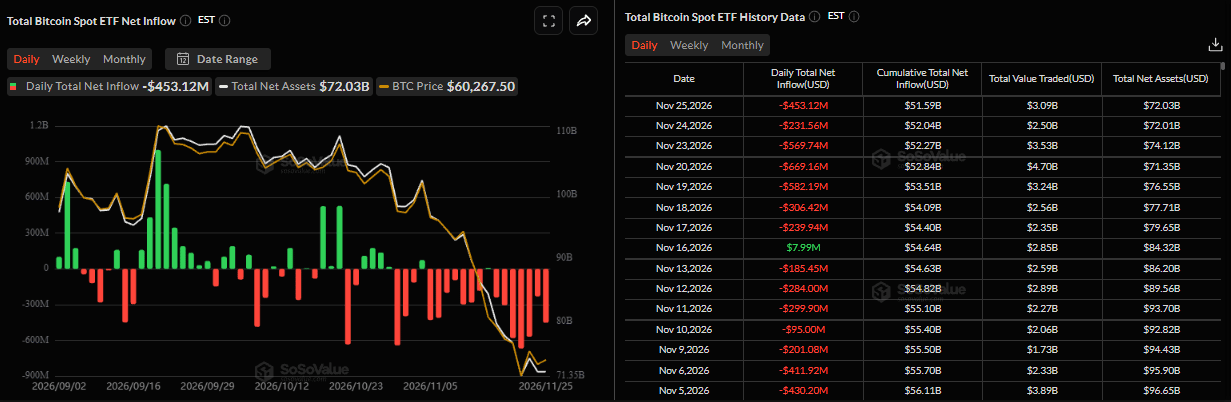
- US-listed spot ETFs recorded an outflow of $453.12 million on Wednesday, extending their seventh consecutive day of withdrawals.
- Rising Fed rate-hike bets, geopolitical uncertainty and a deteriorating technical outlook suggest BTC’s recovery attempts could attract fresh selling pressure.
Bitcoin (BTC) extends its rebound, trading above $60,600 on Thursday after a slight recovery the previous day. Despite the ongoing recovery, BTC remains in a broader downtrend, with persistent outflows from spot Bitcoin Exchange-Traded Funds (ETFs) capping gains. In addition, rising Federal Reserve (Fed) rate-hike bets and mounting geopolitical risks continue to weigh on sentiment. Meanwhile, with the technical outlook deteriorating, further recovery attempts could attract fresh selling pressure, leaving the Crypto King vulnerable to another leg lower.
Heavy institutional selling pressure
Bitcoin has mostly erased its Q3 gains, with the Crypto King hitting a new yearly low of $55,130 last week. Institutional investors have intensified the ongoing selling pressure. SoSoValue data shows BTC spot ETFs recorded net outflows of $453.12 million on Wednesday, marking the seventh straight day of withdrawals.
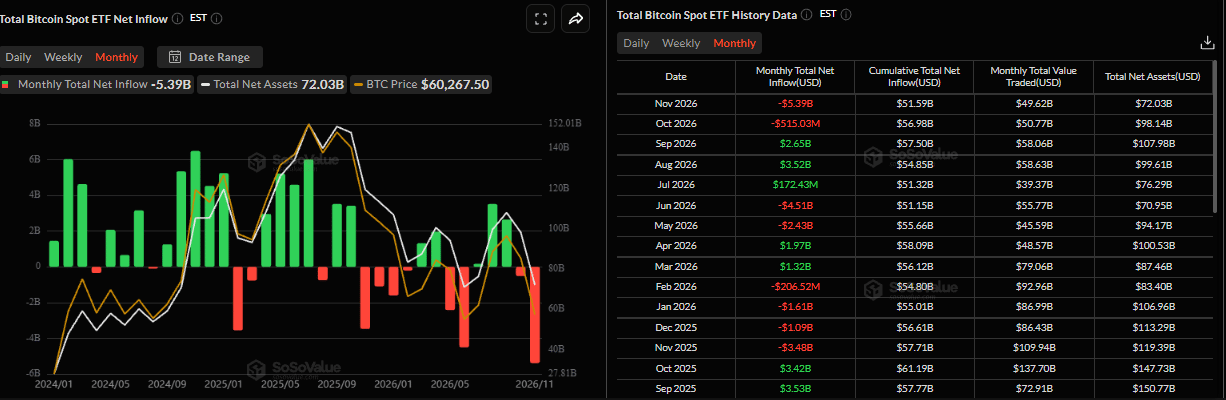
Moreover, BTC spot ETFs have recorded net outflows of $5.39 billion so far in November, the highest monthly outflows since their launch in January 2024. If this trend persists or intensifies through the week, sustained selling pressure could weigh further on Bitcoin, increasing the risk of a retest of its yearly low at $55,130.
Rising Fed rate-hike bets and geopolitical uncertainty weigh on BTC
The much-awaited US Personal Consumption Expenditures Price Index (PCE) reported on Wednesday ticked up 0.3% in October, and the yearly rate climbed to 3.8%, up from September’s upwardly revised reading of 3.7%. Furthermore, the core gauge, which strips out volatile food and energy prices, came in above the market consensus on a yearly basis, accelerating to 3.3% in October from 3.1% the previous month. This latest inflation report reaffirmed market expectations that the US central bank will raise borrowing costs again at its December meeting. Moreover, the CME FedWatch Tool indicates that traders are still pricing in two more rate increases in early 2027, on January 27 and March 17.
Meanwhile, escalating geopolitical tensions in the Middle East could provide additional support for the US Dollar (USD) and limit BTC’s recovery attempts. The Iran-backed Houthis claimed an attack on the King Abdullah Financial District in Riyadh, Saudi Arabia’s capital, on Wednesday, as well as on an oil refinery in the country’s east. The Saudi-led coalition said that it struck Houthi targets at Hodeidah port, while further attacks were reported in Yemen’s capital, Sanaa.
Together, these developments are supporting the Greenback, dampening risk appetite and suggesting any recovery in BTC is more likely to be sold into and remain capped.
Bitcoin technical outlook: All rallies could be fresh selling pressure
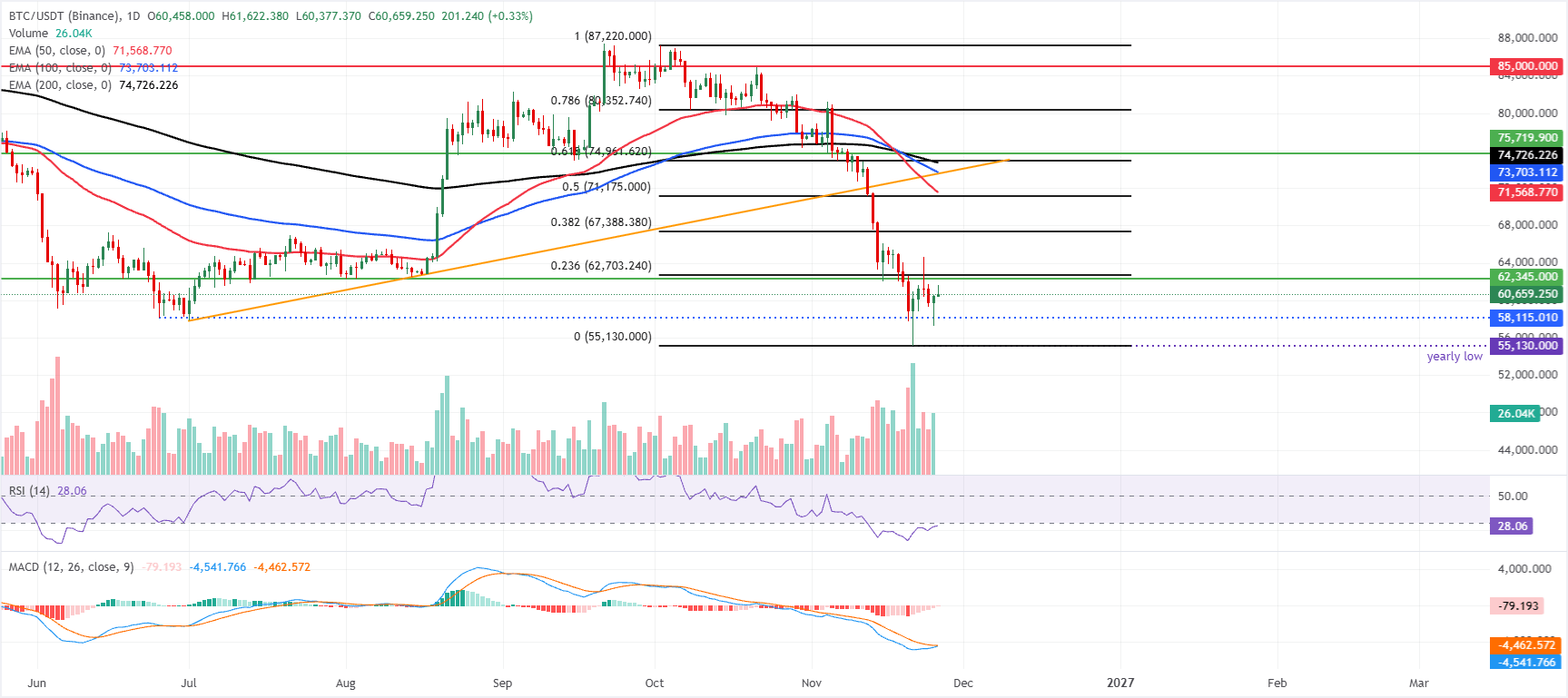
Bitcoin price trades around $60,659 at the time of writing on Thursday, extending recovery after a mild rebound the previous day. Despite the relief rally, BTC remains in a broader bearish phase after breaking decisively below its short- and long-term Exponential Moving Averages (EMAs).
BTC now sits well below the 50-day EMA at $71,569, the 100-day EMA at $73,703 and the 200-day EMA at $74,726, keeping the broader tone under pressure despite an oversold signal, with the daily Relative Strength Index (RSI) near 28. The Moving Average Convergence Divergence (MACD) indicator remains negative but the histogram has narrowed, hinting at waning downside momentum rather than a confirmed trend shift.
On the topside, initial resistance appears at the 23.6% Fibonacci retracement of the recent downswing at $62,703, ahead of a cluster of higher barriers at the 38.2% and 50% retracements at $67,388 and $71,175, respectively, closely aligned with the 50-day EMA at $71,568. Above these, the former trendline break around $73,567 converges with the 100-day EMA at $73,703 and the 200-day EMA at $74,726, while the 61.8% Fibonacci retracement at $74,961 marks a stronger cap before the horizontal resistance at $85,000.
On the downside, the next meaningful structural support emerges at the Fibonacci cycle low anchor near $55,130 (yearly low), where sellers could begin to take profit if the decline extends.
(The technical analysis of this story was written with the help of an AI tool. Know more.)
Bitcoin, altcoins, stablecoins FAQs
Bitcoin is the largest cryptocurrency by market capitalization, a virtual currency designed to serve as money. This form of payment cannot be controlled by any one person, group, or entity, which eliminates the need for third-party participation during financial transactions.
Altcoins are any cryptocurrency apart from Bitcoin, but some also regard Ethereum as a non-altcoin because it is from these two cryptocurrencies that forking happens. If this is true, then Litecoin is the first altcoin, forked from the Bitcoin protocol and, therefore, an “improved” version of it.
Stablecoins are cryptocurrencies designed to have a stable price, with their value backed by a reserve of the asset it represents. To achieve this, the value of any one stablecoin is pegged to a commodity or financial instrument, such as the US Dollar (USD), with its supply regulated by an algorithm or demand. The main goal of stablecoins is to provide an on/off-ramp for investors willing to trade and invest in cryptocurrencies. Stablecoins also allow investors to store value since cryptocurrencies, in general, are subject to volatility.
Bitcoin dominance is the ratio of Bitcoin's market capitalization to the total market capitalization of all cryptocurrencies combined. It provides a clear picture of Bitcoin’s interest among investors. A high BTC dominance typically happens before and during a bull run, in which investors resort to investing in relatively stable and high market capitalization cryptocurrency like Bitcoin. A drop in BTC dominance usually means that investors are moving their capital and/or profits to altcoins in a quest for higher returns, which usually triggers an explosion of altcoin rallies.
인기 기사
1영국 파운드화, 일본은행의 매파적 기조에 엔화 강세 보이며 하락…영란은행 금리 인상 기대에 낙폭 제한2영국 파운드화: 미 달러화 대비 반등 제한적 - UOB3유로화, 독일 소비자신뢰 지표에도 투자심리 개선되지 않으며 소폭 하락세 유지4오늘의 외환시장: 추수감사절 거래 유동성 부족 속 주요 통화 안정세 유지5은 가격 전망: 미국 국채 수익률 하락 속 XAG/USD 보합세 유지6일본 엔화: 인플레이션 위험에 일본은행 금리 인상 필요성 커져 - 단스케은행7Pi Network 가격 전망: 매도 압력 완화에 PI, 상승 추세 전환 조짐8AUD/USD 환율 전망: 0.6600 위에서 상승분 유지…100일 단순이동평균선 아래서 전반적인 추세는 약세 지속9주식: AI 리스크 지속 속 기술주 낙폭 축소 - 코메르츠방크



소셜 미디어












이 웹사이트에 제공된 정보는 일반적인 성격의 정보일 뿐이며 개인 맞춤형 금융 자문을 구성하지 않습니다. 이 웹사이트의 정보를 바탕으로 행동하기 전에, 귀하의 목표, 재정 상황 및 필요에 비추어 해당 정보의 적합성을 고려해야 합니다. CFD 및 FX 마진 계약에 대한 투자는 상당한 위험을 수반하며 모든 투자자에게 적합하지 않을 수 있습니다. 귀하는 최초 예치금보다 더 큰 손실을 입을 수 있습니다. 귀하는 기초자산에 대한 소유권이나 어떠한 이해관계도 보유하지 않습니다. 거래를 시작하기 전에 독립적인 자문을 구하고 관련 위험을 충분히 이해하시기를 권장합니다. 웹사이트에 기재된 상품을 취득하기 전에 공시 문서를 읽고 검토하는 것이 중요합니다. 이 웹사이트에서 제공되는 정보 및 광고는 그러한 사용이 현지 법률 및 규정에 위배되는 국가 또는 관할권의 개인이 사용하도록 의도된 것이 아닙니다. 이 웹사이트에서 제공되는 상품 및 서비스는 미국, 말레이시아 및 태국 거주자를 대상으로 하지 않습니다.
TMGM은 다양한 관할권에서 승인 및 규제를 받고 있습니다.
TMGM으로 거래하는 Trademax Australia Limited는 호주 증권투자위원회(ASIC)의 규제를 받으며, AFSL 번호 436416이고 Level 28, One International Tower, 100 Barangaroo Avenue, 2000 Sydney, NSW Australia에 위치하고 있습니다.
이메일: support@tmgm.com.au
TMGM으로 거래하는 Trademax Global Limited는 바누아투 금융서비스위원회(VFSC)의 승인 및 규제를 받으며, 등록 번호 40356이고 바누아투 포트빌라 쿠물 하이웨이 Law Partners House, 사서함 212호에 등록되어 있습니다.
이메일: support@tmgm.com
Trademax Global Markets (SE) Limited(이하 TMGM)는 세이셸 금융청(FSA)의 인가 및 규제를 받으며, 허가 번호는 SD224입니다. 회사는 세이셸 마헤, 프로비던스 에스테이트 ABIS 센터, 사무실 번호 13에 등록되어 있습니다.
이메일: support@tmgm.com
TMGM으로 거래하는 Trademax Global Markets (International) Pty Ltd는 모리셔스 금융서비스위원회(FSC)의 승인 및 규제를 받으며 라이선스 번호 GB22201012이고, 33, Edith Cavell Street C/o IQ EQ Fund Services (Mauritius) Ltd Port Louis, 11324 Mauritius에 등록되어 있습니다.
이메일: support@tmgm.com
Copyright © TMGM. All rights reserved