

Canadian Dollar loses momentum at key levels heading into December
작성자 Joshua Gibson
게시일: 2 Dec 2025 | 수정일: 2 Dec 2025


인기 기사

The Canadian Dollar (CAD) kicked off the December trading month on soft footing, snapping a four-session winning streak and skidding to a halt near key moving averages against the US Dollar (USD).
- The Canadian Dollar ran out of gas on Monday, giving the Greenback room to breathe.
- Risk appetite struck a notably cautious tone to start December, crimping Loonie gains.
- Canadian PMI results did little to support the CAD as markets shift to US labor data.
The Canadian Dollar (CAD) kicked off the December trading month on soft footing, snapping a four-session winning streak and skidding to a halt near key moving averages against the US Dollar (USD). Risk-off sentiment put some renewed bidding pressure below the Greenback, pushing USD/CAD back into a technical battleground near the 1.4000 price handle.
Canadian S&P Global Purchasing Managers Index (PMI) for the manufacturing sector declined in November, showing continued (and accelerating) declines in both output and new orders. On the US side, November’s S&P Global PMI rose, but the underlying factors continue to worry investors as the late-year upswing in factory production helped to hide a worrying decline in new order activity.
US ADP Employment Change figures for November will lead the way on the economic data docket during the midweek, followed by Canadian labor data on Friday. The latest consumer sentiment survey results from the University of Michigan (UoM) will also be released on Friday to round out the trading week.
Daily digest market movers: Canadian Dollar loses bullish momentum to start December
- The Canadian Dollar fell one-fifth of one percent against the US Dollar in the first session of December’s market window, snapping a five-session winning streak.
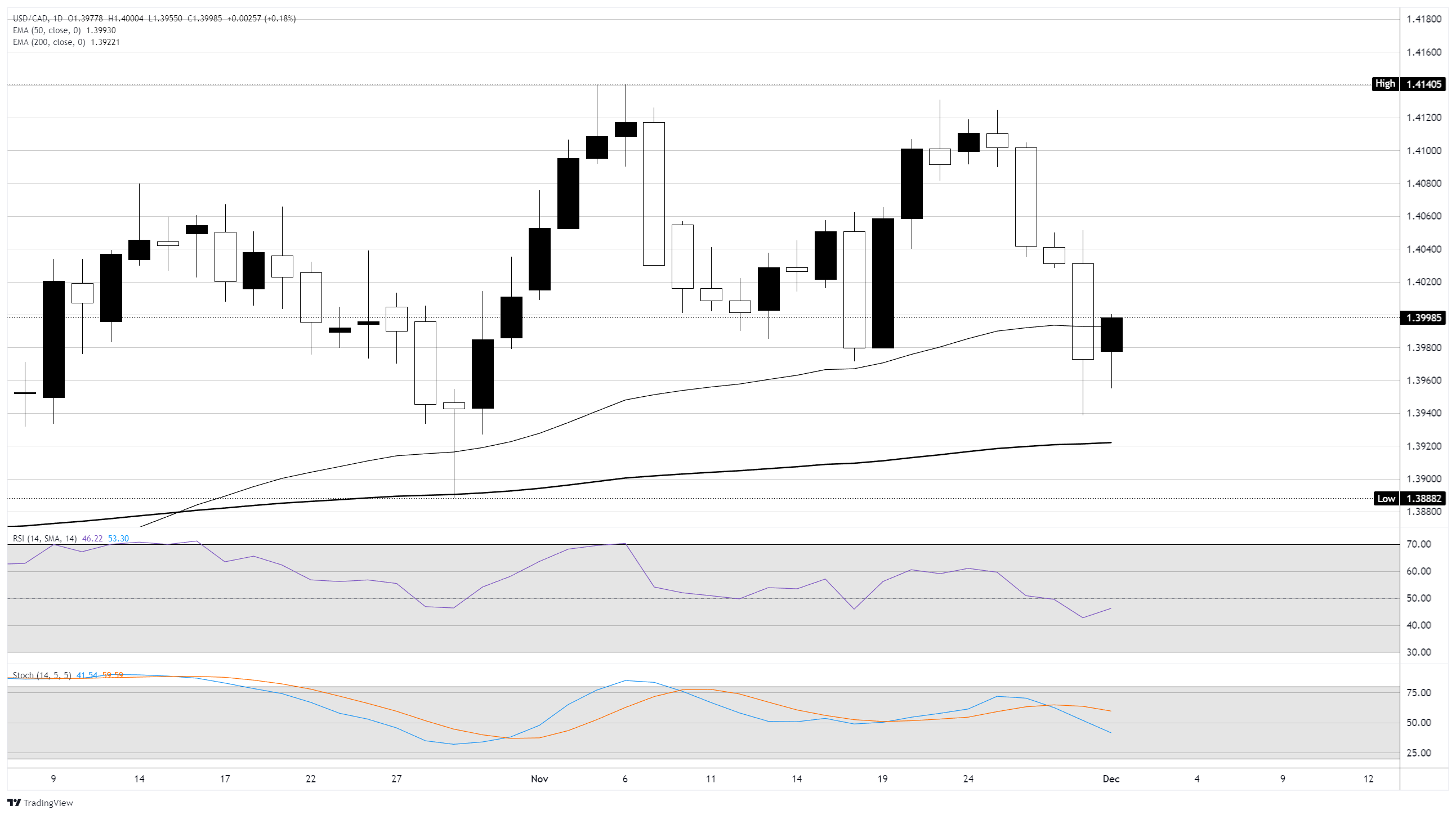
- A near-term stall in recent Loonie strength has drawn a sharp technical floor on the USD/CAD chart, chalking in a support zone at the 1.4000 major price handle and the 50-day Exponential Moving Average (EMA).
- Canada’s November S&P Global Manufacturing PMI sank to 48.4 from the previous 49.6 as industrial activity faces fresh headwinds, presumably from ongoing trade pressures as the Trump administration works to revamp its own USMCA deal, which was touted as the “deal of the century” during Donald Trump’s first term.
- On the US side, S&P Global Manufacturing data swung higher in November, rising to 52.2 from 51.9, driven by a climb in overall manufacturing activity.
- However, the increase in running machines is getting overshadowed by a worrying contraction in new orders, implying that recent improvements in manufacturing activity are dedicated to filling out inventories rather than heading downstream immediately.
- Key data this week will be Wednesday’s US ADP Employment Change data, while Loonie traders will be forced to wait until Friday’s Canadian wages and labor data. Canadian Net Change in Employment is expected to fall to a flat 0K in November, while the Unemployment Rate is expected to tick up again to 7.0% from 6.9%.
Canadian Dollar price forecast
USD/CAD daily candlesticks have found a fresh consolidation patch near the 1.4000 price handle on Monday. The 50-day EMA at 1.3993 continues to climb above the 200-day EMA at 1.3922, keeping the broader bias on the upside. Price holds above both averages, though the short-term slope has softened. RSI at 46 (neutral) signals contained momentum after the recent overbought reading. Immediate support sits at the 50-day EMA at 1.3993, with secondary support at the 200-day EMA at 1.3922.
Stochastic at 41.52 shows waning momentum, aligning with the RSI’s neutral stance. A daily close above the 50-day EMA at 1.3993 could revive upside extension, while a drop through the 200-day EMA at 1.3922 would shift the bias toward a deeper retracement.
USD/CAD daily chart
Canadian Dollar FAQs
The key factors driving the Canadian Dollar (CAD) are the level of interest rates set by the Bank of Canada (BoC), the price of Oil, Canada’s largest export, the health of its economy, inflation and the Trade Balance, which is the difference between the value of Canada’s exports versus its imports. Other factors include market sentiment – whether investors are taking on more risky assets (risk-on) or seeking safe-havens (risk-off) – with risk-on being CAD-positive. As its largest trading partner, the health of the US economy is also a key factor influencing the Canadian Dollar.
The Bank of Canada (BoC) has a significant influence on the Canadian Dollar by setting the level of interest rates that banks can lend to one another. This influences the level of interest rates for everyone. The main goal of the BoC is to maintain inflation at 1-3% by adjusting interest rates up or down. Relatively higher interest rates tend to be positive for the CAD. The Bank of Canada can also use quantitative easing and tightening to influence credit conditions, with the former CAD-negative and the latter CAD-positive.
The price of Oil is a key factor impacting the value of the Canadian Dollar. Petroleum is Canada’s biggest export, so Oil price tends to have an immediate impact on the CAD value. Generally, if Oil price rises CAD also goes up, as aggregate demand for the currency increases. The opposite is the case if the price of Oil falls. Higher Oil prices also tend to result in a greater likelihood of a positive Trade Balance, which is also supportive of the CAD.
While inflation had always traditionally been thought of as a negative factor for a currency since it lowers the value of money, the opposite has actually been the case in modern times with the relaxation of cross-border capital controls. Higher inflation tends to lead central banks to put up interest rates which attracts more capital inflows from global investors seeking a lucrative place to keep their money. This increases demand for the local currency, which in Canada’s case is the Canadian Dollar.
Macroeconomic data releases gauge the health of the economy and can have an impact on the Canadian Dollar. Indicators such as GDP, Manufacturing and Services PMIs, employment, and consumer sentiment surveys can all influence the direction of the CAD. A strong economy is good for the Canadian Dollar. Not only does it attract more foreign investment but it may encourage the Bank of Canada to put up interest rates, leading to a stronger currency. If economic data is weak, however, the CAD is likely to fall.

100만 명이 넘는 사용자가 FXStreet를 통해 실시간 시장 데이터, 차트 도구, 전문가 인사이트, 포렉스 뉴스를 이용합니다. 포괄적인 경제 캘린더와 교육 웨비나는 트레이더가 정보를 유지하고 신중한 결정을 내리도록 돕습니다. FXStreet는 바르셀로나 본사와 전 세계 지역에 걸쳐 약 60명의 팀으로 구성되어 있습니다.
더 읽기








