

Crypto Today: Bitcoin, Ethereum, XRP come under renewed pressure amid ETF outflows, tariff uncertainty
- Bitcoin extends its correction, aiming for $60,000 support, as tariff uncertainty favors the risk-off mood.
- Ethereum drops for the third consecutive day, weighed down by ETF outflows.
- XRP holds near support at $1.32, reflecting muted ETF activity and a weak technical structure.
Bitcoin (BTC), Ethereum (ETH) and Ripple (XRP) are trading under increasing selling pressure at the time of writing on Tuesday, as market participants navigate renewed tariff uncertainty. The Crypto King holds above $63,000, down 2% intraday from its $64,656 open.

Meanwhile, Ethereum is hovering between its intraday low of $1,811 and the immediate resistance at $1,958, which aligns with the Monday high. XRP, on the other hand, sits above support at $1.32, but its upside appears limited by the seller congestion at $1.42.
Bitcoin and Ethereum tumble amid muted market interest, ETF outflows
The drastic shifts in tariff policy in the United States (US) have put global markets on edge, as volatility soars, especially for high-risk assets such as crypto. After the Supreme Court squashed sweeping tariffs imposed by President Donald Trump on Friday, an alternative temporary 10% global tariff was announced and is set to take effect on Tuesday.
At the same time, President Trump added that the temporary 150-day tariff would rise to 15%, further destabilizing sentiment across markets. While the official tariff remains at 10%, uncertainty remains over a potential increase to 15%.
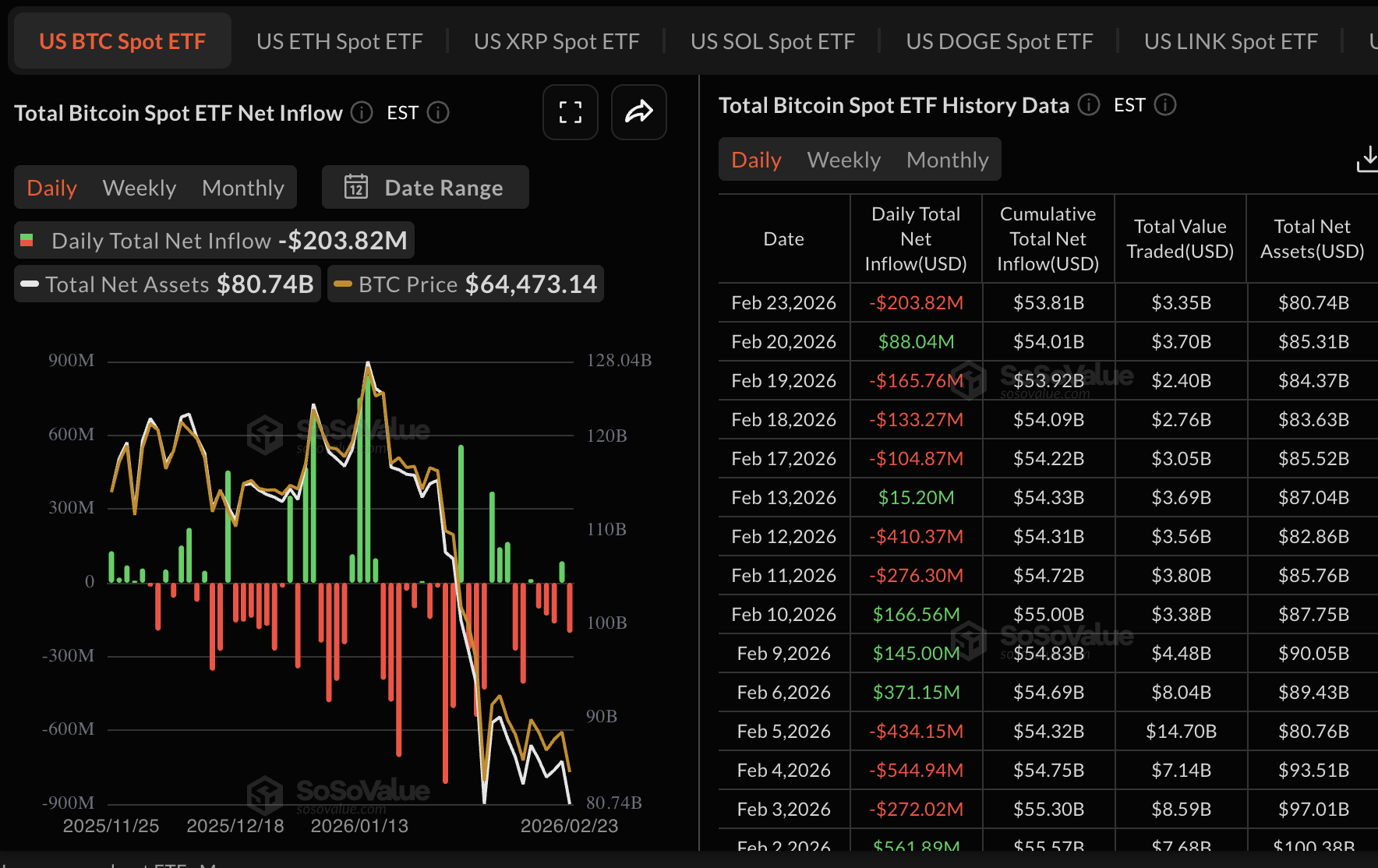
Investors in crypto Exchange Traded Funds (ETFs) are reacting to the ongoing tariff chaos by reducing their exposure, as reflected by approximately $204 million in Bitcoin ETF outflows on Monday. Cumulative inflows currently stand at $53.81 billion, with net assets under management at $80.74 billion.
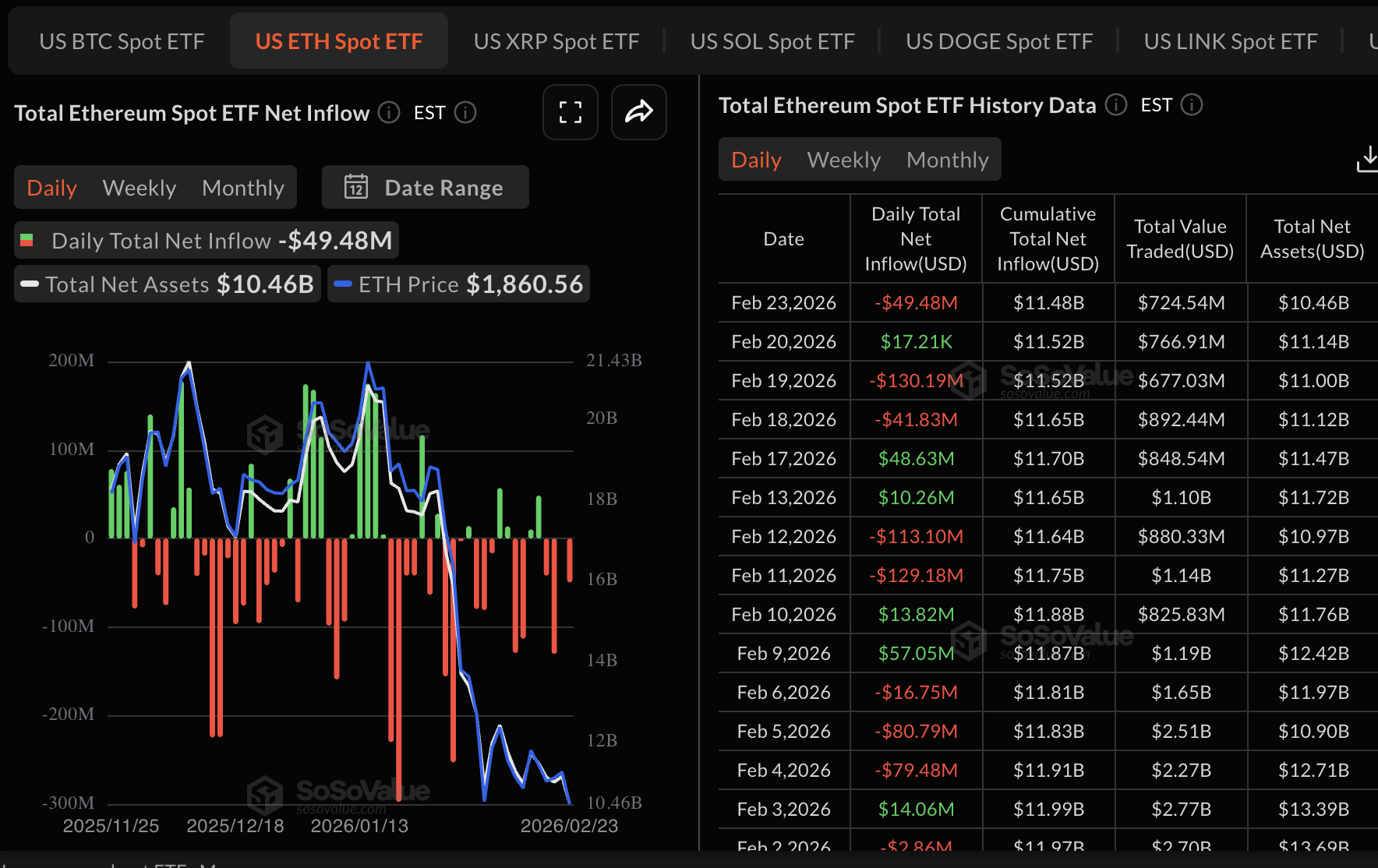
Interest in US-listed Ethereum spot ETFs is also on the back foot, with outflows on Monday totalling nearly $50 million. Cumulative inflows currently stand at $14.48 billion, with net assets under management at $10.46 billion.
XRP ETFs, on the other hand, remained silent on Monday, marking two consecutive days of no activity since Friday. The remittance token’s cumulative inflows currently hold steady at $1.23 billion, with net assets under management at approximately $975 million.
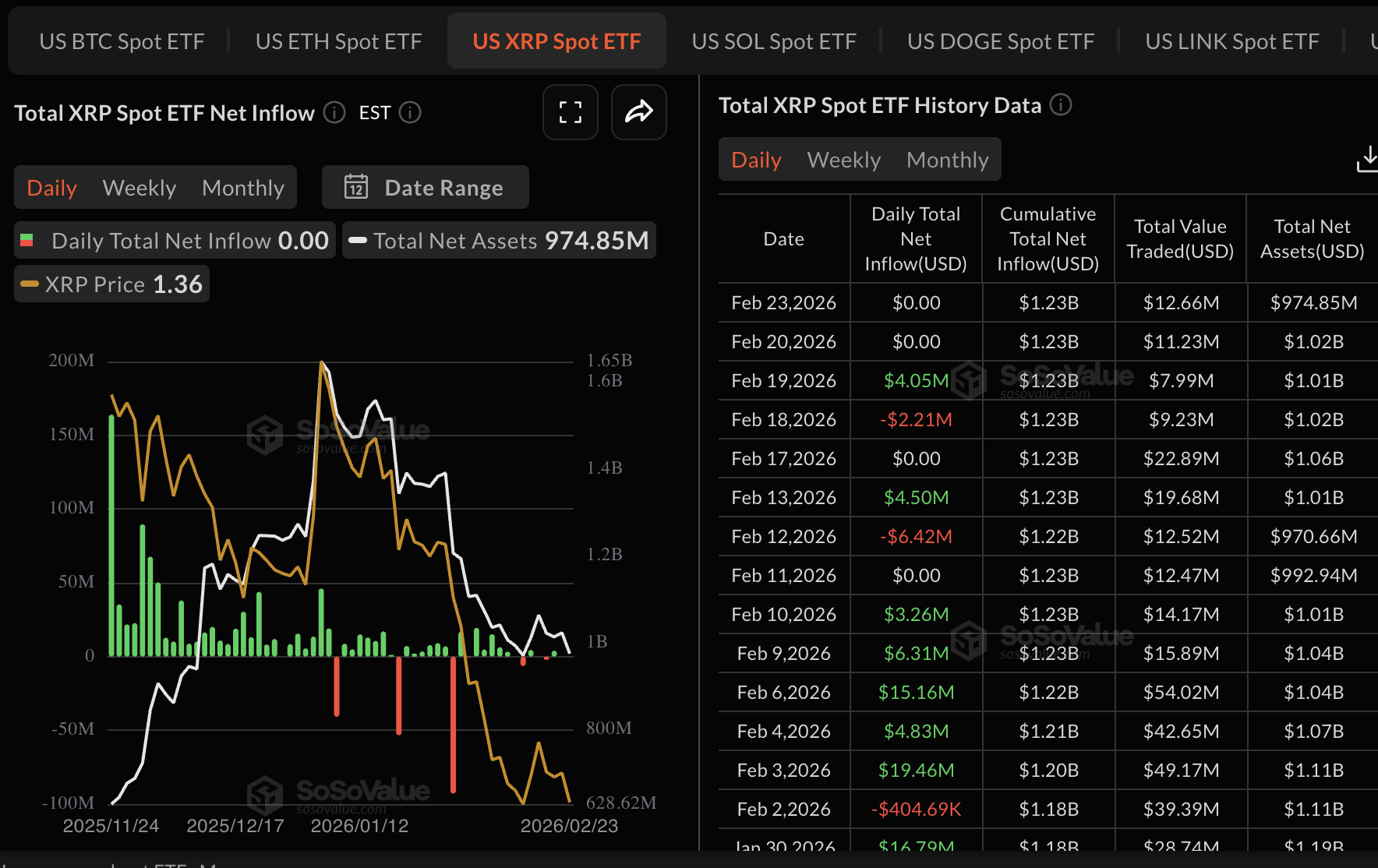
Chart of the day: Bitcoin declines targeting $60,000 support
Bitcoin trades at $63,261, positioned well below the 50-day Exponential Moving Average (EMA), the 100-day EMA and the 200-day EMA. All three moving averages are sloping lower, confirming a dominant downtrend.
The downward resistance trend line from $126,199 continues to cap the broader structure, keeping rallies contained beneath the prior break area near $86,650. At the same time, the Moving Average Convergence Divergence (MACD) line holds above its signal line, with a contracting positive histogram, suggesting fading bullish momentum after the recent rebound stalled below 72,271.
Meanwhile, the Relative Strength Index (RSI) near 30 stays in weak territory, indicating lingering selling pressure despite having emerged from oversold extremes earlier in the month.
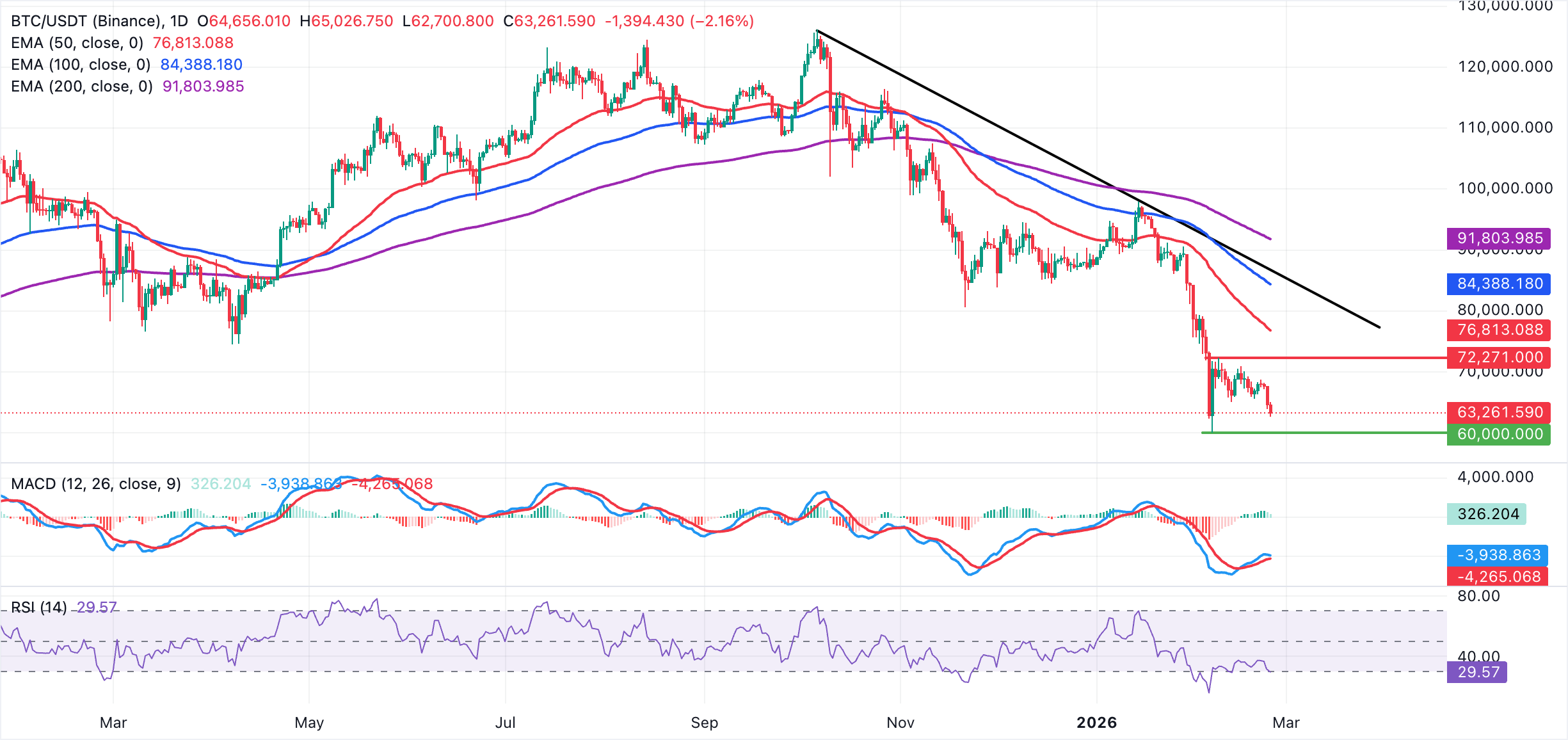
Initial resistance lies around the February 12 low of $65,118. On the downside, immediate support sits around recent lows at $63,000-$62,900. Below that, focus would shift toward 60,000, aligning with the February 6 low.
Altcoins technical outlook: Ethereum, XRP sellers tighten their grip
Ethereum is trading amid a general bearish bias, as price extends toward an intraday low of $1,811. Its daily closes sit well beneath the 50-, 100-, and 200-day EMAs clustered between roughly $2,400 and $3,000, underscoring an established downside phase. The smart contract token’s momentum remains weak, with the RSI below 30 and the MACD line above its signal line but still below the zero line, suggesting a bearish backdrop with only modest relief attempts.
Initial resistance aligns near the prior bounce area around $2,050, where recent highs failed.
On the downside, immediate support is defined by the daily low around $1,811, with a clear loss of this floor opening room toward the mid‑$1,700s and then the $1,600 area, where buyers would be expected to reassess the broader bullish trend from the long-term rising support line.
-1771932868971-1771932868971.png)
Meanwhile, XRP hovers at $1.33 amid near-term bearish bias. The price extends its slide well below the descending resistance trend line, and now trades beneath the 50-day, 100-day, and 200-day EMAs, which all hover above $1.64.
The MACD line inches above the signal line but remains marginally below the zero mark with a contracting histogram, suggesting only modest upside attempts within a broader weakening structure. Similarly, the RSI near 34 stays below the 50 midline, indicating persistent bearish momentum rather than an oversold capitulation.
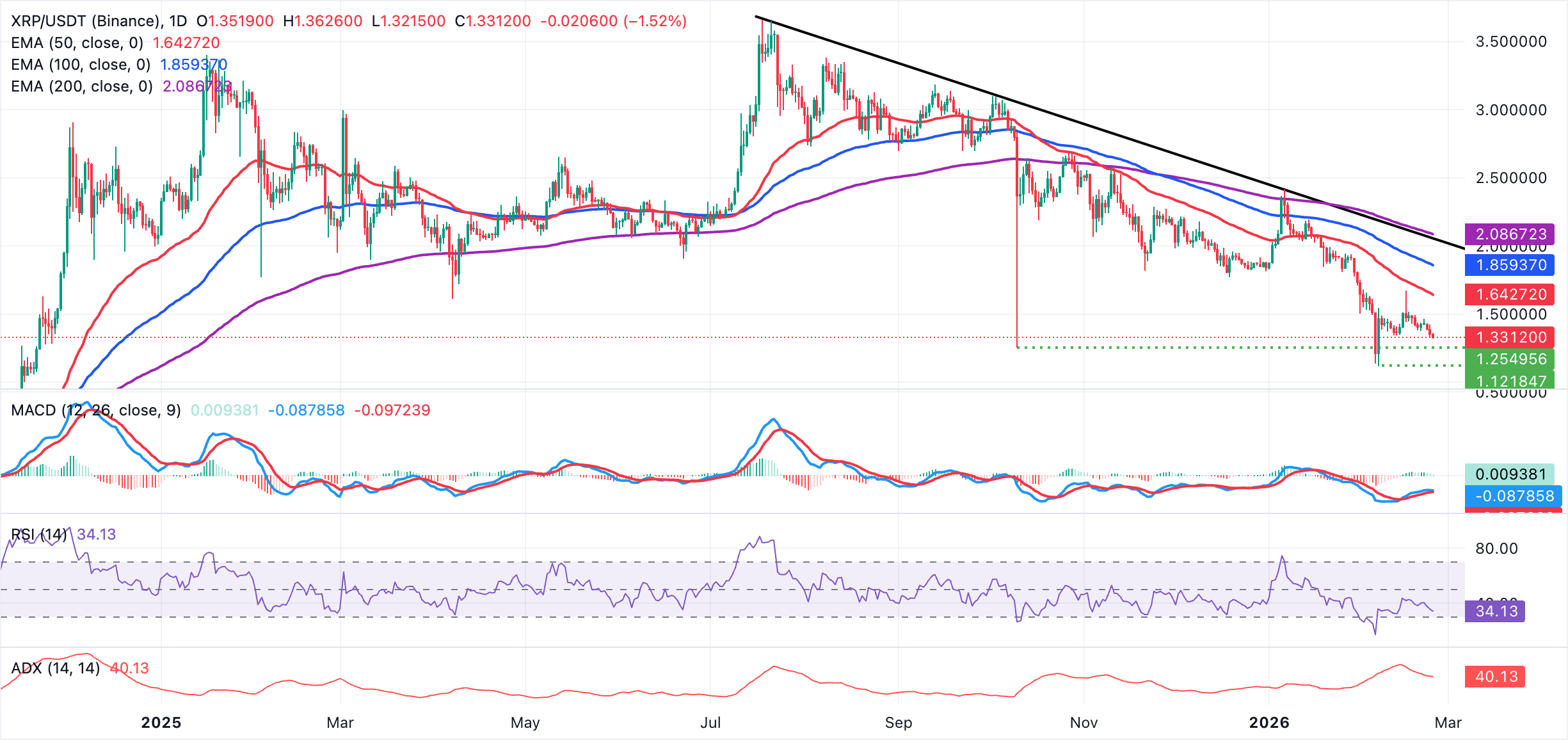
Immediate resistance emerges near the recent rebound high around $1.51, followed by the 50-day EMA at 1.64, where prior bounces have stalled. A stronger corrective phase would see additional supply toward the 100-day EMA, near $1.86. On the downside, initial support is at the psychological $1.30 level, with a break below opening the way toward the prior trough around $1.12.
Crypto ETF FAQs
An Exchange-Traded Fund (ETF) is an investment vehicle or an index that tracks the price of an underlying asset. ETFs can not only track a single asset, but a group of assets and sectors. For example, a Bitcoin ETF tracks Bitcoin’s price. ETF is a tool used by investors to gain exposure to a certain asset.
Yes. The first Bitcoin futures ETF in the US was approved by the US Securities & Exchange Commission in October 2021. A total of seven Bitcoin futures ETFs have been approved, with more than 20 still waiting for the regulator’s permission. The SEC says that the cryptocurrency industry is new and subject to manipulation, which is why it has been delaying crypto-related futures ETFs for the last few years.
Yes. The SEC approved in January 2024 the listing and trading of several Bitcoin spot Exchange-Traded Funds, opening the door to institutional capital and mainstream investors to trade the main crypto currency. The decision was hailed by the industry as a game changer.
The main advantage of crypto ETFs is the possibility of gaining exposure to a cryptocurrency without ownership, reducing the risk and cost of holding the asset. Other pros are a lower learning curve and higher security for investors since ETFs take charge of securing the underlying asset holdings. As for the main drawbacks, the main one is that as an investor you can’t have direct ownership of the asset, or, as they say in crypto, “not your keys, not your coins.” Other disadvantages are higher costs associated with holding crypto since ETFs charge fees for active management. Finally, even though investing in ETFs reduces the risk of holding an asset, price swings in the underlying cryptocurrency are likely to be reflected in the investment vehicle too.
(The technical analysis of this story was written with the help of an AI tool.)














