

Dow Jones Industrial Average futures hold near 50K as Iran offer offsets tariff noise
- DJIA futures push toward 50,000 in pre-market trading after a sharp rally from Thursday's lows.
- Iran delivers updated peace proposal to Pakistani mediators, sending Oil sharply lower.
- Apple jumps over 3% pre-market on earnings beat and upbeat revenue guidance.
- Trump threatens 25% tariffs on European Union cars and trucks, weighing on automakers.
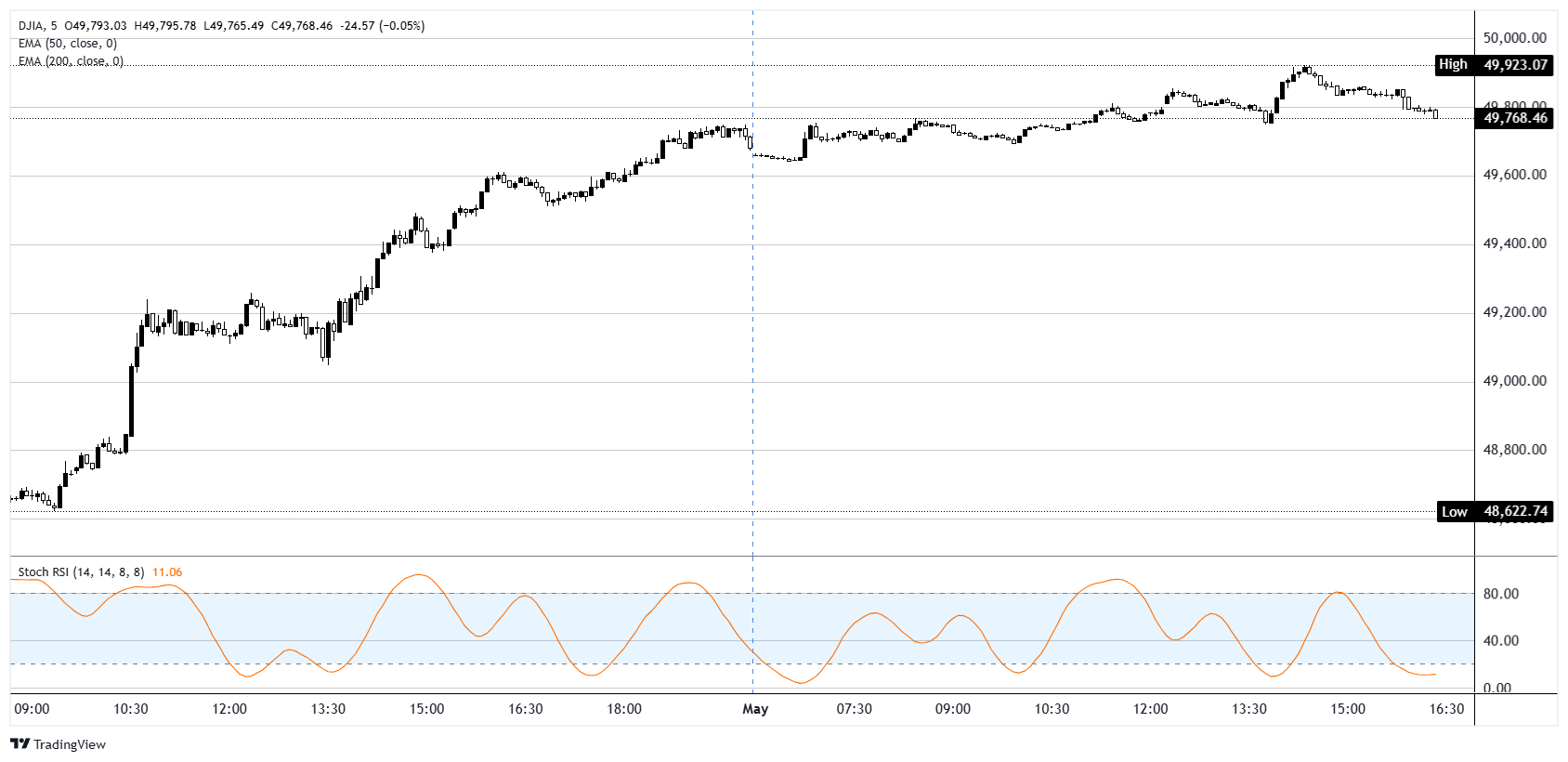
Dow Jones Industrial Average (DJIA) futures traded above 49,800 in overnight and pre-market action, building on a near 1,500-point rally from Thursday morning's lows around 48,500 and pressing toward the 50,000 mark for the first time. S&P 500 futures held firmly above 7,200 after the cash index closed at a fresh record yesterday, locking in its strongest monthly performance since 2020. Nasdaq Composite futures pointed to a continuation of Thursday's tech-led gains, with the Dow itself coming off its strongest month since November 2024. The risk tone is being driven by hopes that Iran's latest diplomatic offer can wind down the Strait of Hormuz standoff, even as Treasury Secretary Scott Bessent escalates the rhetoric and President Donald Trump opens a fresh tariff front against Europe.

Iran responds via Pakistan as Bessent ratchets up the pressure
Iran delivered the text of a revised negotiating proposal to Pakistani mediators on Thursday evening, the official IRNA news agency reported, marking the first concrete diplomatic movement in weeks. Pakistani officials privately suggested optimism that a deal is closer than at any point since the April 8 ceasefire, with the Iranian offer reportedly addressing nuclear issues that Trump previously rejected as inadequate. WTI Crude Oil futures fell 3% to trade above $101 a barrel, with Brent slipping 2% to above $108, after Brent briefly touched $126 a barrel on Thursday on fears talks had collapsed. The diplomatic thaw lands awkwardly against Bessent's appearance on Fox Business this week, in which he called Iran "the head of the snake for global terrorism," boasted that Treasury is "sprinting for the finish line" of Operation Economic Fury, and pledged to track down Islamic Revolutionary Guard Corps retirement funds and villas in the South of France. Friday's expiry of the 60-day War Powers clock adds another layer of urgency.
Apple jumps on services strength as iPhone revenue misses
Apple (AAPL) climbed more than 3% in pre-market trading after the consumer technology giant posted a fiscal second-quarter beat on both earnings and revenue, with current-quarter revenue guidance landing above Wall Street estimates. The upbeat outlook overshadowed iPhone revenue falling short of estimates for the second time in three quarters, suggesting investors are willing to look past hardware softness so long as services and the forward outlook keep delivering. The move helps anchor mega-cap tech sentiment heading into the Friday session and supports Nasdaq Composite futures bidding for a third straight record close.
Trump opens a new tariff front on European Union autos
Trump posted on Truth Social that he will raise tariffs on European cars and trucks to 25% next week, accusing the European Union of failing to comply with the agreed trade deal, while noting no tariff would apply to vehicles produced in US plants. Stellantis (STLA) fell more than 2% on the news, while Ferrari (RACE) slipped nearly 1.5%. Equity futures held the bulk of overnight gains despite the threat, suggesting traders are treating the move as a negotiating opening rather than a fait accompli. David Krakauer, vice president of portfolio management at Mercer Advisors, told CNBC he remains strategically bullish on equities even with the conflict ongoing, though he warned "there could be always new news or some sentiment declining, where we could see a little bit of a pullback here after a strong pop up."
ISM Manufacturing data lands stagflationary
The April Institute for Supply Management (ISM) Manufacturing Purchasing Managers Index (PMI) printed at 52.7, narrowly missing the 53 consensus and matching the prior reading. The detail is where the print bites: the Employment Index collapsed to 46.4 from 48.7, well short of the 49 consensus and squarely back in contraction, while Prices Paid surged to 84.6 from 78.3 against an 80 forecast. New Orders ticked up to 54.1, but the broader read is unambiguously stagflationary, with manufacturing inflation pressures accelerating into a softening labor market. The print sets a tense backdrop for next Friday's Nonfarm Payrolls (NFP) report, where consensus already looks for a sharp slowdown to 73K from 178K, and complicates the Federal Reserve (Fed) path further still.
Dow Jones 5-minute chart
Dow Jones FAQs
The Dow Jones Industrial Average, one of the oldest stock market indices in the world, is compiled of the 30 most traded stocks in the US. The index is price-weighted rather than weighted by capitalization. It is calculated by summing the prices of the constituent stocks and dividing them by a factor, currently 0.152. The index was founded by Charles Dow, who also founded the Wall Street Journal. In later years it has been criticized for not being broadly representative enough because it only tracks 30 conglomerates, unlike broader indices such as the S&P 500.
Many different factors drive the Dow Jones Industrial Average (DJIA). The aggregate performance of the component companies revealed in quarterly company earnings reports is the main one. US and global macroeconomic data also contributes as it impacts on investor sentiment. The level of interest rates, set by the Federal Reserve (Fed), also influences the DJIA as it affects the cost of credit, on which many corporations are heavily reliant. Therefore, inflation can be a major driver as well as other metrics which impact the Fed decisions.
Dow Theory is a method for identifying the primary trend of the stock market developed by Charles Dow. A key step is to compare the direction of the Dow Jones Industrial Average (DJIA) and the Dow Jones Transportation Average (DJTA) and only follow trends where both are moving in the same direction. Volume is a confirmatory criteria. The theory uses elements of peak and trough analysis. Dow’s theory posits three trend phases: accumulation, when smart money starts buying or selling; public participation, when the wider public joins in; and distribution, when the smart money exits.
There are a number of ways to trade the DJIA. One is to use ETFs which allow investors to trade the DJIA as a single security, rather than having to buy shares in all 30 constituent companies. A leading example is the SPDR Dow Jones Industrial Average ETF (DIA). DJIA futures contracts enable traders to speculate on the future value of the index and Options provide the right, but not the obligation, to buy or sell the index at a predetermined price in the future. Mutual funds enable investors to buy a share of a diversified portfolio of DJIA stocks thus providing exposure to the overall index.













