

Dow Jones Industrial Average steady as Iran rebuff lifts Oil, CPI in focus
- DJIA futures trade flat as traders digest Trump's rejection of Iran's latest ceasefire counterproposal.
- Oil prices jump more than 2% with the Strait of Hormuz still effectively shut.
- Markets brace for Tuesday's April CPI, the single most important macro print of the week.
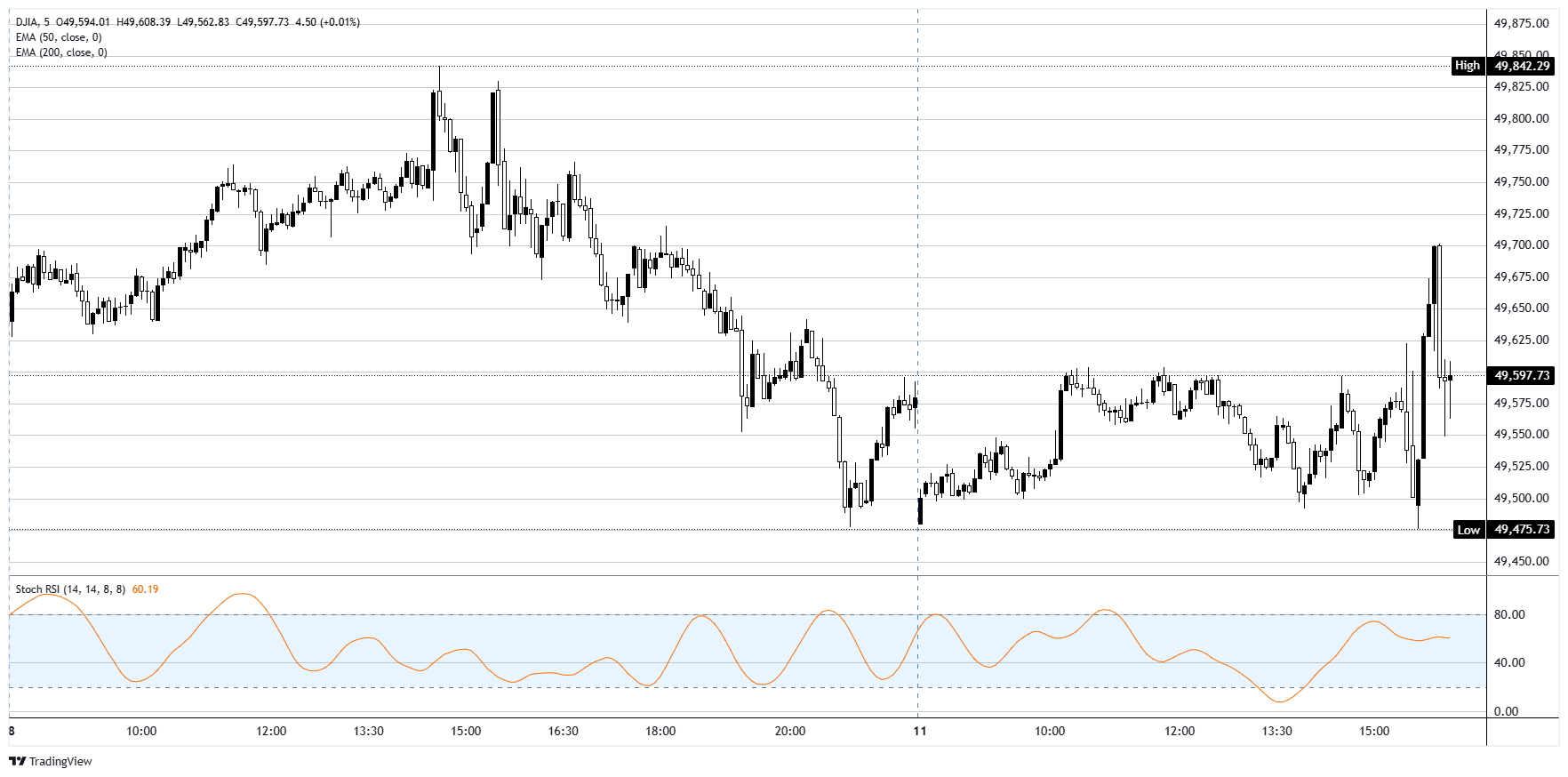
US equity index futures opened the week little changed as Wall Street weighed a renewed flare-up in the US-Iran standoff against this week's marquee inflation print. Dow Jones Industrial Average (DJIA) futures hugged the flat line above 49,500 in premarket trade, with the S&P 500 ticking marginally lower and the Nasdaq Composite softer after Friday's record-setting close. The Russell 2000 outperformed, helped by a bid for energy and small-cap industrials.

Trump rejects Iran offer, Oil spikes
President Trump on Sunday torpedoed Iran's response to the latest US ceasefire proposal, calling it "totally unacceptable" on social media and warning that the truce was on "massive life support." Tehran's counter-proposal reportedly included recognition of Iranian sovereignty over the Strait of Hormuz and a demand for war reparations, alongside a refusal to dismantle nuclear enrichment infrastructure. With the waterway still effectively closed after 10 weeks, West Texas Intermediate (WTI) crude rallied more than 2% toward $97 a barrel, while Brent pushed above $103. Drone attacks on Kuwait, the UAE, and a cargo ship in Qatari waters over the weekend kept the geopolitical risk premium firmly embedded in energy markets.
April CPI takes center stage
Tuesday's Consumer Price Index (CPI) is the only macro print that really matters this week. Consensus calls for headline CPI to rise 0.6% MoM and 3.7% YoY in April, with core CPI at 0.3% MoM and 2.7% YoY. The release will offer the first clean read on how much of the Oil shock has bled into non-energy categories. A core surprise above 0.3% would all but bury what little is left of 2026 rate-cut hopes; CME FedWatch currently pegs the probability of a hold at next month's Federal Open Market Committee (FOMC) meeting above 95%, with markets pricing essentially no cuts for the rest of the year. Bank of America has formally scrapped its 2026 cut call, while JPMorgan expects YoY inflation to stay above 3% well into 2027.
Intel jumps on Apple chip deal
Intel (INTC) led the premarket gainers, rallying as much as 6% after the Wall Street Journal reported the chipmaker had reached a preliminary agreement with Apple (AAPL) to manufacture some of the chips used in Apple devices. The news lifted the broader semiconductor complex, with Micron Technology (MU) up more than 3% and South Korea's SK Hynix surging 12% on separate reports of a potential Samsung worker strike that could tighten memory supply. Apple ticked higher in sympathy, while Lumentum (LITE) gained around 4% after being added to the Nasdaq-100 Index. Nvidia (NVDA) traded firmer as the AI complex continued to set the tone for index direction.
Moderna spikes on hantavirus angle, Palantir slips
Moderna (MRNA) was among the biggest single-name movers, jumping as much as 12% after US health officials reported a passenger on a repatriation flight had tested positive for the Andes strain of hantavirus. The biotech confirmed it had already been developing a hantavirus vaccine candidate ahead of the outbreak aboard the cruise ship Hondius, building on a 12% rally on Friday. On the other side of the tape, Palantir (PLTR) fell more than 2% on lingering valuation concerns following last week's Q1 print, while Wendy's (WEN) dropped around 3% after JPMorgan cut the burger chain to Underweight with a sharply lower price target.
Powell exits, Warsh waits in the wings
Adding to the macro stew, Federal Reserve (Fed) Chair Jerome Powell's term formally ends Friday, May 15. The Senate is expected to confirm Kevin Warsh as his successor this week, marking the first Fed Chair transition since 2018. Markets have so far shrugged off the handover, partly because the April FOMC minutes already showed three members objecting to the policy statement language and Governor Miran dissenting in favour of a 25 basis point cut. Whether Warsh proves more or less hawkish than Powell is largely academic in the near term, with a hot CPI virtually guaranteed to keep the Fed on hold regardless of who occupies the chair. Separately, Trump heads to Beijing from Wednesday through Friday for a summit with Xi Jinping, where the Iran war and AI export controls are expected to dominate the agenda.
Dow Jones 5-minute chart
Dow Jones FAQs
The Dow Jones Industrial Average, one of the oldest stock market indices in the world, is compiled of the 30 most traded stocks in the US. The index is price-weighted rather than weighted by capitalization. It is calculated by summing the prices of the constituent stocks and dividing them by a factor, currently 0.152. The index was founded by Charles Dow, who also founded the Wall Street Journal. In later years it has been criticized for not being broadly representative enough because it only tracks 30 conglomerates, unlike broader indices such as the S&P 500.
Many different factors drive the Dow Jones Industrial Average (DJIA). The aggregate performance of the component companies revealed in quarterly company earnings reports is the main one. US and global macroeconomic data also contributes as it impacts on investor sentiment. The level of interest rates, set by the Federal Reserve (Fed), also influences the DJIA as it affects the cost of credit, on which many corporations are heavily reliant. Therefore, inflation can be a major driver as well as other metrics which impact the Fed decisions.
Dow Theory is a method for identifying the primary trend of the stock market developed by Charles Dow. A key step is to compare the direction of the Dow Jones Industrial Average (DJIA) and the Dow Jones Transportation Average (DJTA) and only follow trends where both are moving in the same direction. Volume is a confirmatory criteria. The theory uses elements of peak and trough analysis. Dow’s theory posits three trend phases: accumulation, when smart money starts buying or selling; public participation, when the wider public joins in; and distribution, when the smart money exits.
There are a number of ways to trade the DJIA. One is to use ETFs which allow investors to trade the DJIA as a single security, rather than having to buy shares in all 30 constituent companies. A leading example is the SPDR Dow Jones Industrial Average ETF (DIA). DJIA futures contracts enable traders to speculate on the future value of the index and Options provide the right, but not the obligation, to buy or sell the index at a predetermined price in the future. Mutual funds enable investors to buy a share of a diversified portfolio of DJIA stocks thus providing exposure to the overall index.














