

Ethereum’s upcoming updates: Will prices finally respond to record network usage?
- The Ethereum Foundation plans two major updates for the network in 2026, Glamsterdam and Hegotá.
- Following the previous Pectra and Fusaka updates, the upcoming upgrades aim for higher throughput, tighter L2 integration, and long-term decentralization.
- FXStreet interviewed ETH developers and market experts about their views on upcoming updates.
Ethereum (ETH) blockchain enters 2026 with a more structured approach, as the foundation’s roadmap outlines two major updates, Glamsterdam and Hegotá, for the network this year. These updates are built after the major updates in 2025 and aim for higher throughput, tighter Layer 2 (L2) integration, and long-term decentralization. To gain more insights, FXStreet interviews market experts on their views on upcoming updates.
History of events and updates for the ETH network
Ethereum has undergone several events since its launch in 2015. The timeline and brief explanation are provided below:
Year | Event | Explaination |
2015 | Ethereum mainnet launch (Frontier) | Introducing the original proof-of-work blockchain and smart contracts. |
2017–2018 | ICO boom era | Driving massive adoption but also regulatory scrutiny. |
2022 | The Merge (Paris) | Transition from proof-of-work to proof-of-stake, drastically reducing energy use and enabling staking rewards. |
2023 | Shapella | Enabled validator withdrawals following the Merge. |
2024 | Dencun | Introduced proto-danksharding (EIP-4844 blobs), dramatically lowering Layer 2 rollup data costs. |
2025 | Pectra | Delivered native account abstraction elements, higher blob counts, and other UX/scaling improvements. |
2025 | Fusaka | Activated on mainnet at slot 13,164,544, raising default gas limits (~60 million per block), introducing Peer-to-Peer Data Availability Sampling (PeerDAS) for better data availability, and further optimizing validator/node performance for cheaper L2 settlements. |
What’s there for Ethereum in 2026?
After the latest update on December 3, 2025 (Fukasa), Ethereum announced a new roadmap for the protocol on February 18. This year, two updates are down the line, and the details are explained below.
Glamsterdam
Glamsterdam upgrade is designed to clear the path for the next generation of scaling. The main focus is scaling Layer 1 (L1) by reorganizing how the network processes transactions and manages its growing database, by fundamentally updating how Ethereum creates and verifies blocks.
This update is targeted for the first half of 2026 (currently in development). The upgrade focuses heavily on Layer 1 scalability and includes up to 22 Ethereum Improvement Proposals (EIPs).
According to the Ethereum.org post, this upgrade centers on three main goals: speeding up processing (parallelization), expanding capacity, and preventing database bloat (sustainability).
In short, Glamsterdam will introduce structural changes to ensure that as the network increases capacity, it remains sustainable and performance stays high.
Hegotá
The Hegotá upgrade is scheduled for the second half of 2026, after the Glamsterdam update. The proposals are still under discussion per the roadmap.
What actually changes under the hood?
According to Ethereum’s “Protocol Priorities Update for 2026” post, the protocol’s update work is organized into three tracks: Scale, improve UX and harden the L1.
On the scaling front, this brings together what was previously split across Scale L1 and Scale Blobs into a single, unified effort. Increasing L1 execution capacity and expanding data availability throughput are deeply intertwined. Gas limit increases depend on the execution engine performance, while Blob scaling depends on networking and consensus changes that touch the same client code.
“Coordinating these efforts under one roof makes us faster and reduces the surface area for a more holistic view,” reported the post.
Meanwhile, on the User Experience (UX) side, the focus in this update is on two main areas: native account abstraction and interoperability.
Regarding account abstraction, proposals such as EIP-7701 and EIP-8141 aim to make smart contract wallets native, removing the need for intermediaries (bundlers/relayers) and reducing extra gas costs. Also, moving away from traditional Elliptic Curve Digital Signature Algorithm (ECDSA) signatures toward quantum-resistant cryptography improves long-term security.
On the interoperability side, the update is building on the foundation laid by the Open Intents Framework, aiming for smooth, trust-minimized transfers across Layer 2 networks. In addition, improvements in L1 and L2 speeds will support better UX and real-time-like interactions across the ecosystem.
In short, the improved UX track is basically Ethereum trying to hide complexity from users, make wallets smarter and safer, unify the fragmented L2 ecosystem and prepare for future threats like quantum computing.
Lastly, a new “Harden the L1” track is introduced, which focuses on preserving Ethereum’s core strengths: security, censorship resistance, and network resilience, as it scales.
Key people from the foundation are working toward these goals, with Fredrik Svantes working on security, Thomas Thiery on censorship resistance, and Parithosh Jayanthi on network resilience and testing.
In short, the “Harden the L1” track is Ethereum’s defensive layer, making the network safer, keeping it uncensorable, ensuring it remains reliable under stress, and preparing for future threats (like quantum computing).
Beyond 2026 updates
Justin Drake, Ethereum Foundation researcher, posted on X on February 25, laying out a plan for seven hard forks through 2029 named “strawmap,” as shown in the chart below.
Drake highlighted the five goals the team describes as “north stars,” which are as follows:
- fast L1 and fast UX, via short slots and finality in seconds
- gigagas L1: 1 gigagas/sec (10K TPS), via zkEVMs and real-time proving
- teragas L2: 1 gigabyte/sec (10M TPS), via data availability sampling
- post quantum L1: durable cryptography, via hash-based schemes
- private L1: first-class privacy, via shielded ETH transfers
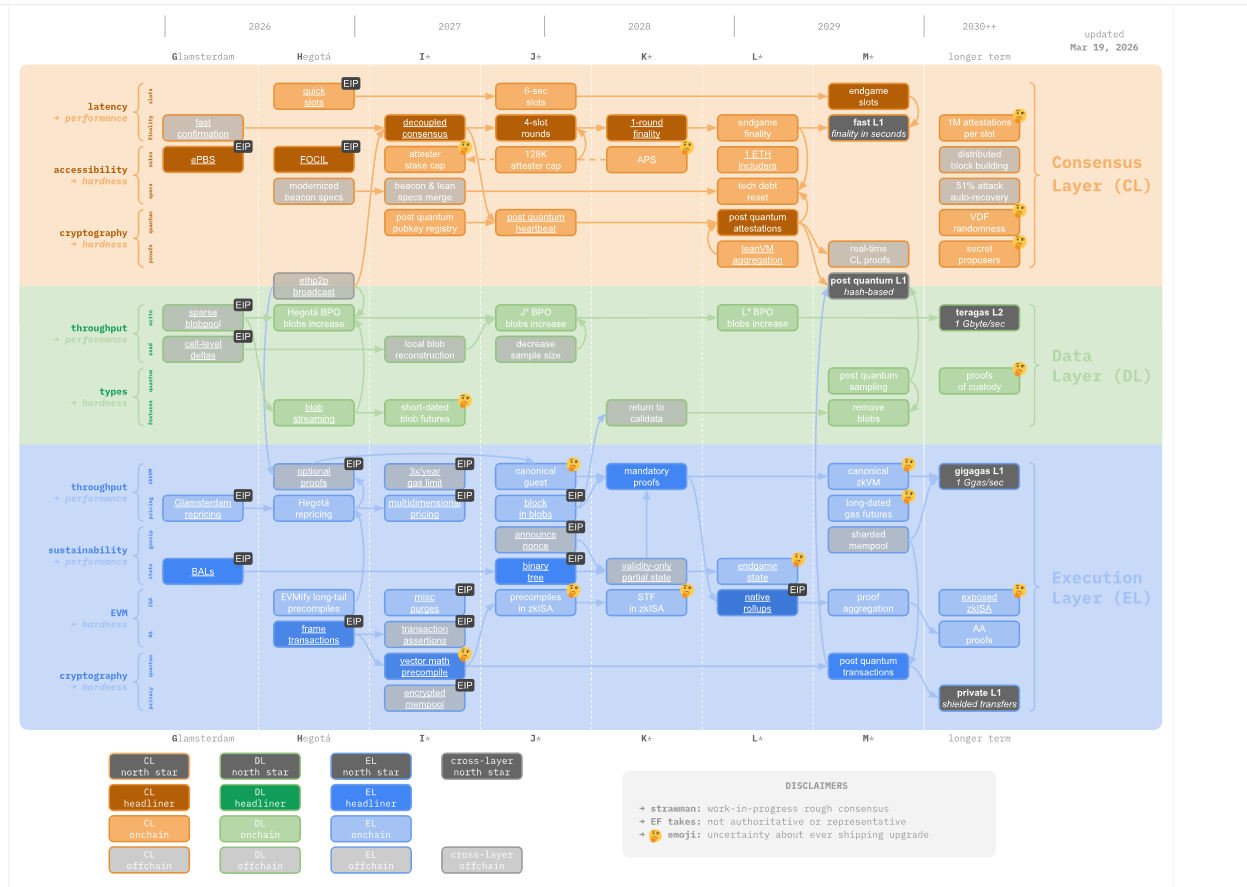
Meanwhile, Ethereum co-founder Vitalik Buterin endorsed the strawmap as “very important,” noting progressive slot-time cuts and fast finality.
Buterin summarized, “expect to see progressive decreases of both slot time and finality time, and expect to see these changes to be intertwined with a ‘ship of Theseus’ style component-by-component replacement of Ethereum’s slot structure and consensus with a cleaner, simpler, quantum-resistant, prover-friendly, end-to-end formally-verified alternative.”
What is on-chain data showing?
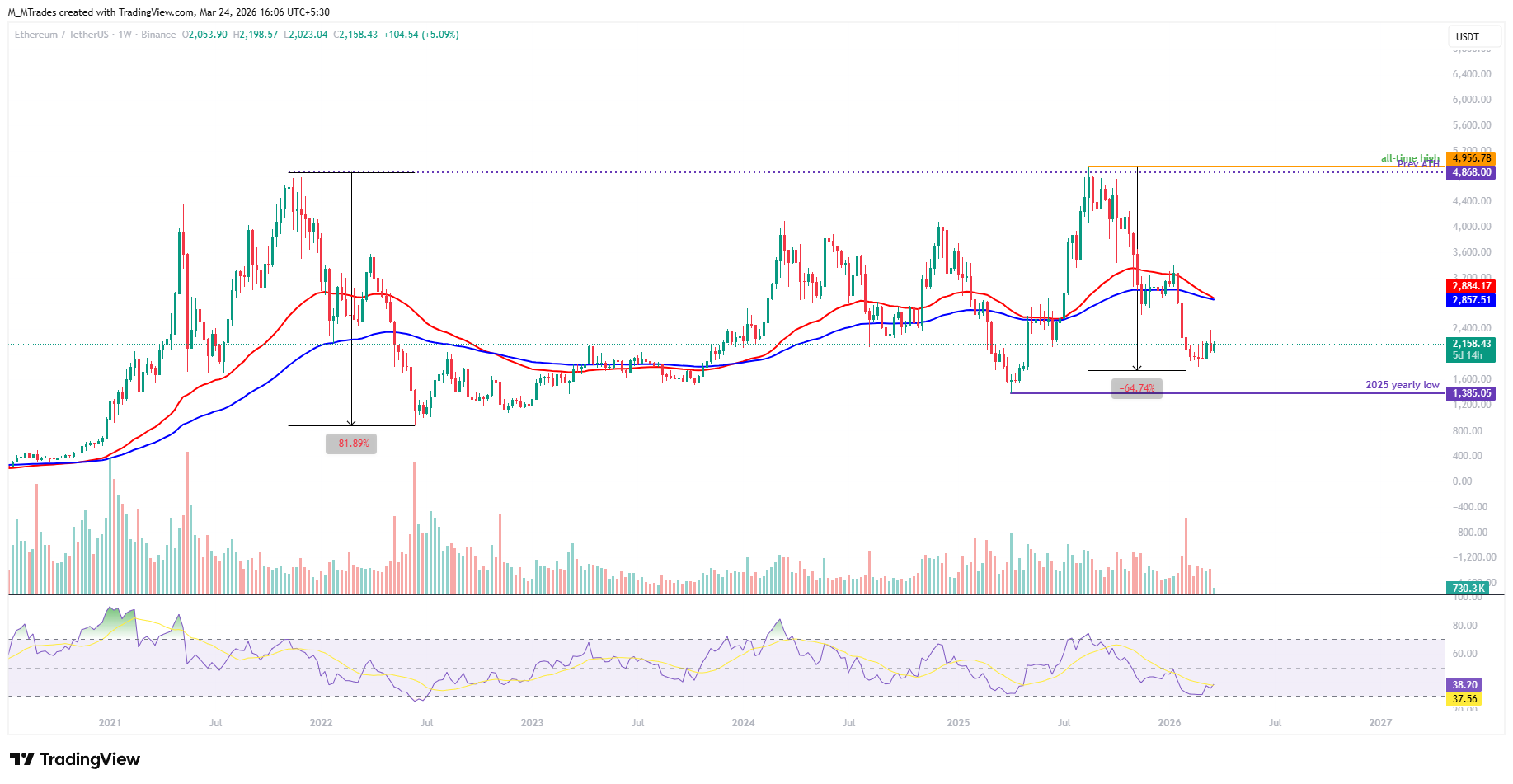
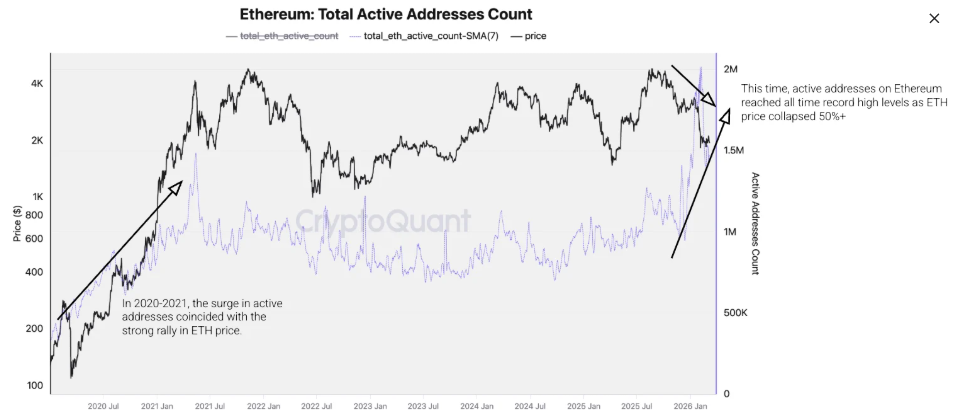
From on-chain data, Ethereum’s network activity has reached record highs, while its price has fallen by more than 55% from its all-time high of $4,956 in August 2025, indicating a clear divergence between network usage and asset performance.
The CryptoQuant chart below shows that active addresses on the ETH network have surged to record highs (above 1.8 to 2.0 million daily users in February), while its price has moved in the opposite direction, declining by more than 55% since August, even as user activity continued to grow. This diverges from previous cycles. In 2021, the surge in active addresses coincided with a strong rally in ETH’s price.
In addition, the surge in transfers generated by smart contract interactions (internal calls) reached record highs in February, significantly exceeding the levels observed during the 2021 and 2018 bull markets. At the same time, the ETH price has declined by more than 55% from its cycle highs, diverging from the pattern observed in previous cycles.
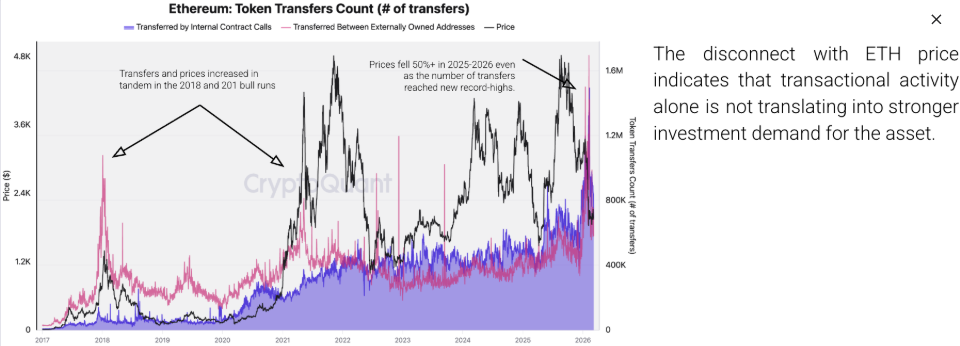
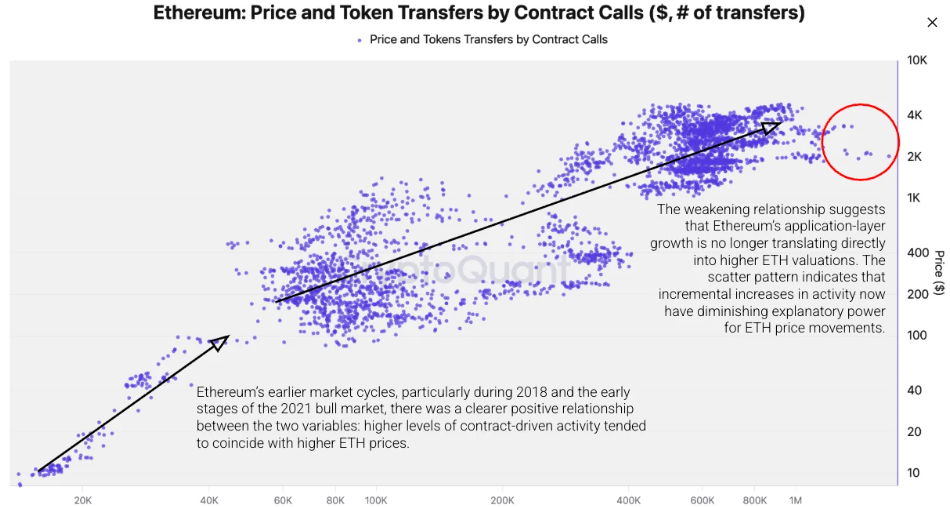
CryptoQuant analyst reported that “the historical relationship between smart contract activity and ETH price has deteriorated.”
The analyst continued, “In earlier cycles, ETH price showed a clearer positive relationship with contract-driven activity, with higher transfer counts coinciding with rising prices. Over time, this relationship weakened. Indeed, the latest observations (red circle) cluster at high activity but relatively low prices, indicating a deterioration in the historical correlation to smart-contract activity.”
Expert insights
To gather more insights on these, FXStreet reached out to market experts regarding their views on the upcoming updates, which are stated below:
Nic Puckrin, CEO and co-founder of Coin Bureau
Q: What are your biggest concerns or excitements about Ethereum’s long-term roadmap (e.g., single-slot finality, Verkle trees/stateless clients, quantum resistance?
Ethereum has an ambitious roadmap. Improvements in speed, decentralization, usability. It’s all necessary and useful. But ambitious can also mean slow to implement. So it’s important for investors to watch what actually gets shipped and how it’s implemented versus what’s promised. Quantum resistance is an important element, particularly as institutional investors are beginning to pay more attention to this. If Ethereum makes meaningful progress with post-quantum security, this will send a strong message to the wider crypto ecosystem. But these positive developments don’t necessarily translate into higher prices for ETH.
Q: What are the key things that traders or ETH investors should keep in mind when trading in 2026?
The first is to separate the roadmap from market pricing. The drivers are very different and a successful upgrade doesn’t mean the price of ETH will go up. The second is to carefully watch whether the upgrade improves on-chain economics. Metrics like validator incentives, staking participation, L2 activity, and fee generation are important here. The third is execution risk. The roadmap is ambitious, but what will actually get executed and how quickly? Ethereum’s upgrades have been delayed in the past, so it could happen again.
Curve Finance Team
Q: What do you see as the biggest technical or economic risks/opportunities coming from the Glamsterdam upgrade (H1 2026), particularly enshrined PBS (ePBS via EIP-7732) and block-level access lists?
From our perspective, Glamsterdam looks less like a ‘headline’ upgrade and more like a set of changes that quietly improve how Ethereum behaves under real conditions — which, in the long run, is definitely a positive for DeFi on the whole. The most tangible upside we see to this upgrade is centered around gas efficiency and execution predictability. If block-level access lists and ePBS (EIP-7732) actually make block processing more structured, that should translate into more stable gas dynamics, especially during periods of stress. This has direct importance for systems like Curve’s Llamalend, where liquidations need to happen reliably. When gas spikes or transactions become harder to execute, the risk of bad debt goes up considerably. So any improvement here becomes a way to reduce that risk. More broadly, better baseline gas conditions give project teams more room to build for usability without having to compromise and over-optimizing for gas costs. A lot of current DeFi design is shaped by constraints — if those constraints can be made to ease up, it translates to better products for everyone.
Q: How is this update going to affect ETH staking and its price in the short- and long-term?
For ETH staking, Glamsterdam mostly has an indirect effect — it doesn’t meaningfully change yield mechanics, but if it makes Ethereum more useful and reliable as a base layer. That’s constructive for ETH over time — and staking follows from that. As for where Ethereum goes next, we believe that the main question to ask is simple: can Ethereum scale and improve UX without compromising decentralization? If yes, that’s a structural positive for the DeFi ecosystem. Especially for primitives like lending, swaps, and stablecoins, where inefficiencies are immediately visible to users. Their roadmap looks ambitious, but the biggest concern is about execution: whether these upgrades actually translate into something users and developers can feel.
Bitfinex Analysts
Q. Biggest technical risks and opportunities from Glamsterdam (ePBS via EIP-7732 and Block-Level Access Lists)
Glamsterdam is the most consequential Ethereum upgrade since The Merge, and enshrined proposer-builder separation (ePBS) is its centrepiece. By enshrining the relationship at the protocol level via EIP-7732, Ethereum eliminates its dependency on trusted off-chain relayers (entities such as Flashbots that currently mediate between block proposers and builders). That dependency has always been Ethereum’s most underappreciated centralisation risk: at peak activity, three or four builder entities consistently won more than 85 percent of blocks. ePBS removes that single point of failure.
The opportunity is significant. Researchers estimate MEV extraction could fall by up to 70 percent, meaning the tax that sophisticated bots levy on every swap, loan, and liquidation on Ethereum’s base layer shrinks materially. The risk is equally real: validators will inherit new timing-critical duties around payload timeliness and committee membership that introduce fresh liveness risks if clients aren’t updated correctly.
Block-level access lists via EIP-7928 are the less-discussed but arguably more structurally important feature. By requiring a block to declare its full read/write storage footprint upfront, access lists unlock genuine parallel execution, multiple transactions processed simultaneously without state conflicts. That’s the architectural precondition for reaching 10,000 transactions per second. The transitional risk: DeFi protocols that rely on complex, undeclared state access patterns may experience unexpected gas repricing as access lists are enforced. Developers should be stress-testing their contracts on testnet now.
Q. Impact on Ether Staking and price, short- and long-term
For stakers, Glamsterdam is structurally positive in two ways. First, ePBS smooths MEV reward distribution. Rather than outsized rewards accruing to validators lucky enough to propose high-value blocks, the market mechanism becomes more predictable. Solo stakers and smaller node operators gain relative to the institutional builders who currently capture disproportionate MEV. Second, the 10x throughput increase and 78 percent gas fee reduction should drive meaningfully higher base-layer activity. Fee revenue to validators scales with network usage. With 37 million Ether already locked in staking (30.6 percent of circulating supply) and BlackRock’s staked Ether exchange-traded product (ETP) attracting $2.7 billion in recent inflows even during the current market drawdown, the institutional staking case is building quietly. Short-term, Ether at approximately $2,100, down 40 percent from its October 2025 high, isn’t pricing in Glamsterdam as a catalyst. The macro environment (oil-driven inflation, Federal Reserve hawkishness, risk-off in equities) is the dominant variable, not protocol upgrades. Long-term, the picture is more constructive: every major throughput upgrade in Ethereum’s history has expanded the total addressable market for on-chain activity, which is the true driver of Ether demand. The upgrade itself doesn’t create a buy event; it creates the infrastructure for the next demand cycle.
Marcin Kazmierczak, Co-Founder of RedStone
Q: How is this upgrade going to affect ETH staking and its price?
For staking, ePBS is net positive for smaller validators specifically. The current setup rewards sophistication: big operators run MEV-Boost infrastructure, build relay relationships, and capture better returns. ePBS makes the builder auction protocol-native, so a home staker with 32 ETH participates on the same terms as a large pool. That said, total staking yield won’t spike from this upgrade. Consensus layer base APY sits around 2.78–2.84% today, rising to roughly 3–3.5% with MEV. The bigger staking story in 2026 is regulatory: ETH was classified as a digital commodity jointly by the SEC and CFTC in March, staking was confirmed not to constitute a securities offering, and BlackRock launched a staked ETH ETF that pulled in $155 million in its first 24 hours.
Q: What should traders and ETH investors keep in mind in 2026?
The most important thing to understand is the L2 value-dilution tension. Ethereum’s success in scaling through rollups is, paradoxically, suppressing L1 fee burn. ETH is currently slightly inflationary at roughly 0.23% annually, blob utilization sits at only 20–30% of capacity, and L1 daily active addresses have dropped 47% as activity migrated to L2s. The ETH-is-deflationary thesis requires blob fee saturation that hasn’t arrived yet. Institutional targets from Standard Chartered ($7,500), VanEck ($6,000), and Bernstein ($5,500) are real forecasts from credible analysts, but Standard Chartered missed their 2025 ETH target by a wide margin, so treat those numbers as directional rather than precise.
The genuinely positive structural backdrop is on-chain: exchange reserves have fallen to 16 million ETH, roughly 8.8% of supply, the lowest since the network launched in 2015. Spot ETH ETFs pulled in $9.7 billion in net inflows across 2025. ETH commands around 68% of total DeFi TVL and hosts over $160 billion in stablecoins. The macro headwind is the Fed sitting at 3.5–3.75% with only one more cut projected for 2026, which makes ETH’s staking yield only marginally competitive with risk-free rates.
Ethereum development FAQs
After the Dencun upgrade in March 2024, Ethereum users are looking towards the Pectra upgrade slated for early 2025. The upgrade will come in two phases, featuring improved wallet experience, an upgrade to the Ethereum virtual machine (EVM), PeerDAS for scaling L2s, improvement of blob capacity, etc.
Forks are upgrades or changes to the codebase/architecture of a blockchain network. Considering blockchain networks have no central governance, forks are only carried out after developers and validators reach a consensus. Hard forks are substantial permanent changes in a blockchain protocol that create two parallel chains – one with the old rules and the new with the implemented changes. Developers can either upgrade their software to build on the new chain or remain on the old chain as a separate network. During a hard fork, users receive an equivalent amount of their tokens on the new blockchain network 1:1. Soft forks, on the other hand, are subtle changes on a blockchain network that are backwards-compatible, meaning the network still operates as a single entity even when some developers don't implement the new changes.
Famously scribbled by Ethereum co-founder Vitalik Buterin in 22 minutes, Ethereum improvement proposal EIP-7702 is an advanced way of marrying EIP-3074 and ERC-4337 to unlock massive adoption for Ethereum's smart wallet functionality. Slated to go live in the upcoming Pectra upgrade, EIP-7702 will implement an advanced version of account abstraction enabling features like batching that allows users to pay a one-off transaction fee for multiple actions, sponsorship to enable an account pay gas fees for other users and wallet recovery options if users misplace their seed phrase.
Layer 2 is a collective term for protocols that aim to scale Ethereum by processing batches of transactions off the Mainnet. After performing a series of mathematical computations to ensure their validity, these L2s send a compressed version of the transactions back to the Mainnet for final processing. As a result, Layer 2 networks reduce transaction fees and enhance the Mainnet's speed while reaping its security. Think of them like several personal assistants that help their boss to process a series of paperworks. These assistants send a summarised version of the paperworks to the boss who confirms and signs on them.
Layer 3 solutions are application-specific blockchains built upon existing Layer 2 networks to offer high scalability and interoperability. For example, an L3 can focus on tackling privacy, increased scalability, gaming, or some complex functionality while still ultimately deriving security from the Layer 1.














