

EUR/USD holds near 1.1700 despite the deteriorated market sentiment
- Eur/USD reversal from last week's highs near 1.1740 has been contained above 1.1670 so far.
- The Euro remains relatively steady despite the failure of the Iran talks and the US blockade of Hormuz.
- Markets remain confident that the US-Iran negotiations will resume soon.
The (EUR) retreated from last week’s highs near 1.1740 against the US Dollar (USD) on Monday, but so far is holding well in the upper 1.1600s. The pair is trading at 1.1685 at the time of writing, having been supported at 1.1670 earlier in the day.

The failure of the peace negotiations between the US and Iran and the US pledge to block the Strait of Hormuz have sent Oil prices jumping again, reviving demand for the safe-haven US Dollar. The negative impact on the Euro, however, remains limited so far.
According to Commercebank’s analyst, Thu Lan Nguyen, hopes of de-escalation in the US-Iran war are keeping Euro bears at bay: "At the time of writing, market movements remain limited. Brent crude is trading at just above 100 USD per barrel, and EUR/USD has slipped to below 1.17 - a good distance away from the extreme levels seen during this conflict (...) As long as the market remains hopeful, risk premiums, such as implied EUR/USD volatility, are likely to stay at comparatively low levels."
The economic calendar is thin today, and news from Iran is likely to continue to drive markets. On Tuesday, all eyes will be on European Central Bank’s (ECB) President, Christine Lagarde, who might shed some more light on the monetary policy decision due on April 30.
Technical Analysis: The broader trend remains positive
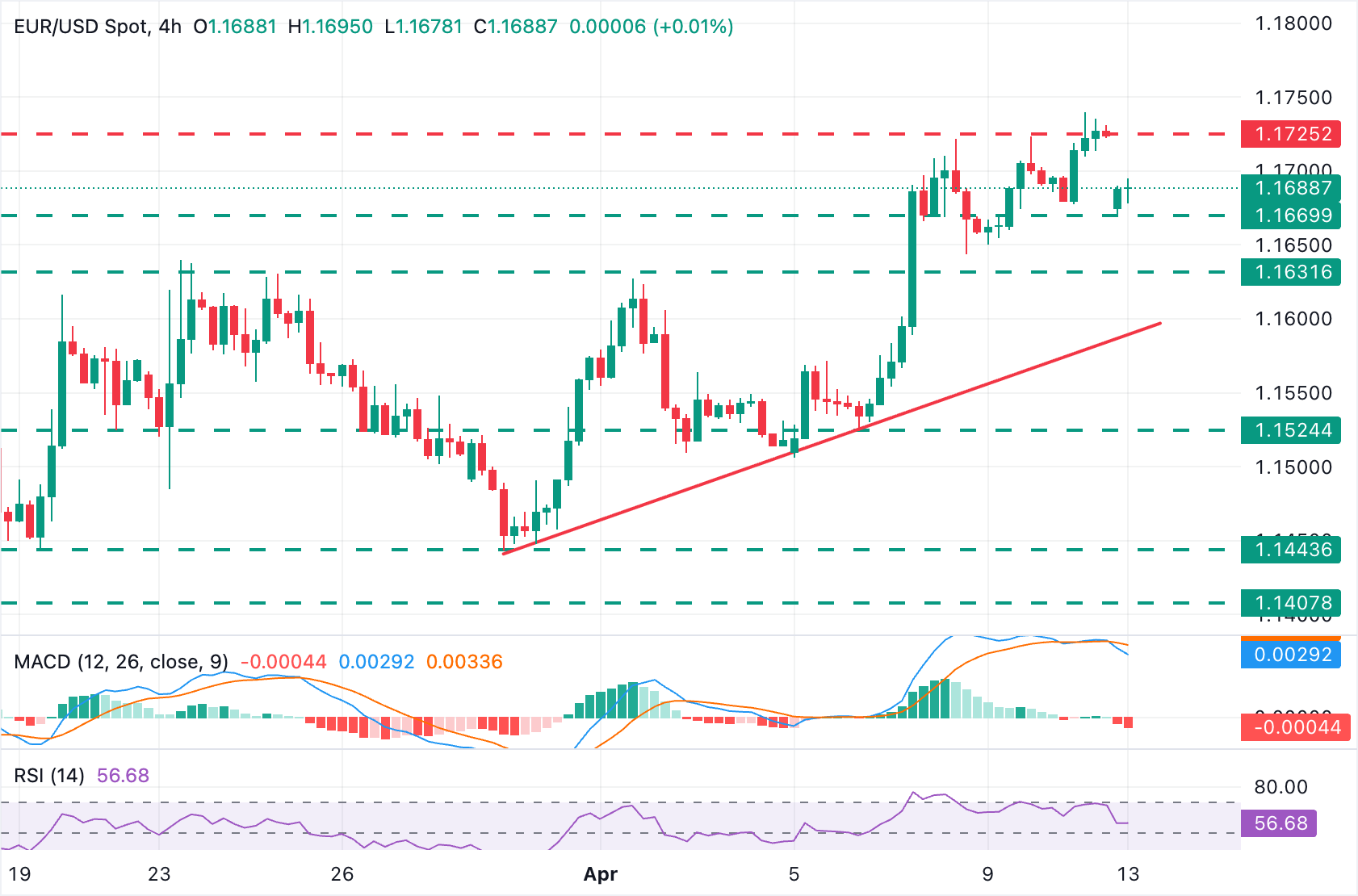
EUR/USD is holding a mildly bullish near-term bias as it consolidates above previous highs, in the area of 1.1630. Momentum is cooling from earlier overbought readings, with the Relative Strength Index around mid-50s and the Moving Average Convergence Divergence (MACD) hovering close to the zero line, hinting at a pause rather than a full reversal of the recent advance.
On the topside, immediate resistance is located in the 1.1725 -1.1735 area, with further hurdles emerging at 1.1825 (February 26 and March 1 highs) ahead of the February 10 and 11 highs, near 1.1930.
On the downside, the session low at 1.1670 is likely to provide some support, followed by the mentioned 1.1630-1.1640 area (March 23, 25 highs and April 8 low). Further down, the most plausible target is the rising trend support from the March 30 low, now around 1.1590.
(The technical analysis of this story was written with the help of an AI tool.)
Risk sentiment FAQs
In the world of financial jargon the two widely used terms “risk-on” and “risk off'' refer to the level of risk that investors are willing to stomach during the period referenced. In a “risk-on” market, investors are optimistic about the future and more willing to buy risky assets. In a “risk-off” market investors start to ‘play it safe’ because they are worried about the future, and therefore buy less risky assets that are more certain of bringing a return, even if it is relatively modest.
Typically, during periods of “risk-on”, stock markets will rise, most commodities – except Gold – will also gain in value, since they benefit from a positive growth outlook. The currencies of nations that are heavy commodity exporters strengthen because of increased demand, and Cryptocurrencies rise. In a “risk-off” market, Bonds go up – especially major government Bonds – Gold shines, and safe-haven currencies such as the Japanese Yen, Swiss Franc and US Dollar all benefit.
The Australian Dollar (AUD), the Canadian Dollar (CAD), the New Zealand Dollar (NZD) and minor FX like the Ruble (RUB) and the South African Rand (ZAR), all tend to rise in markets that are “risk-on”. This is because the economies of these currencies are heavily reliant on commodity exports for growth, and commodities tend to rise in price during risk-on periods. This is because investors foresee greater demand for raw materials in the future due to heightened economic activity.
The major currencies that tend to rise during periods of “risk-off” are the US Dollar (USD), the Japanese Yen (JPY) and the Swiss Franc (CHF). The US Dollar, because it is the world’s reserve currency, and because in times of crisis investors buy US government debt, which is seen as safe because the largest economy in the world is unlikely to default. The Yen, from increased demand for Japanese government bonds, because a high proportion are held by domestic investors who are unlikely to dump them – even in a crisis. The Swiss Franc, because strict Swiss banking laws offer investors enhanced capital protection.
and














