

EUR/USD wavers in range ahead of US employment, factory data
작성자 Guillermo Alcala
게시일: 29 Jan 2026 | 수정일: 29 Jan 2026


인기 기사

The EUR/USD is trading at 1.1965 at the time of writing, down from session highs in the area of 1.200 ahead of the European session opening, but above Tuesday's lows near 1.1900.
- EUR/USD trades sideways, with upside attempts limited below 1.2000.
- Eurozone economic sentiment and industrial confidence figures beat expectations in January
- The US Dollar retreated on Thursday's early trade, as the impact of the Fed's hawkish stance waned.
The EUR/USD is trading at 1.1965 at the time of writing, down from session highs in the area of 1.200 ahead of the European session opening, but above Tuesday's lows near 1.1900. The pair is practically flat in the daily chart, despite bright Eurozone sentiment figures, with downside attempts limited, awaiting the release of US Initial Jobless Claims, Factory Orders, and international trade numbers.
On Wednesday, the Federal Reserve (Fed) left interest rates on hold, with Chairman Jerome Powell showing more confidence about the economy and the labor market, adding to the case for a steady monetary policy in the coming months. The market, however, keeps pricing two rate cuts this year, according to data by the CME Group's Fed Watch Tool
Apart from that, US Treasury Secretary Scott Bessent mended US President Donald Trump's remarks, and assured that Washington pursues a "strong-Dollar" policy. These comments provided some support to the Greenback, but failed to trigger a solid recovery.
In the Eurozone, the sharp Euro appreciation has started to ring the alarm bells. Marin Kocher, a committee member of the European Central Bank (ECB) and Austrian Central Bank governor, raised the topic of a further rate cut, adding bearish pressure to the common currency.
Euro Price Today
The table below shows the percentage change of Euro (EUR) against listed major currencies today. Euro was the strongest against the British Pound.
| USD | EUR | GBP | JPY | CAD | AUD | NZD | CHF | |
|---|---|---|---|---|---|---|---|---|
| USD | -0.01% | 0.05% | -0.02% | -0.04% | -0.19% | -0.12% | -0.16% | |
| EUR | 0.01% | 0.06% | 0.00% | -0.02% | -0.17% | -0.10% | -0.14% | |
| GBP | -0.05% | -0.06% | -0.04% | -0.09% | -0.25% | -0.19% | -0.20% | |
| JPY | 0.02% | 0.00% | 0.04% | -0.04% | -0.18% | -0.15% | -0.15% | |
| CAD | 0.04% | 0.02% | 0.09% | 0.04% | -0.14% | -0.09% | -0.11% | |
| AUD | 0.19% | 0.17% | 0.25% | 0.18% | 0.14% | 0.06% | 0.04% | |
| NZD | 0.12% | 0.10% | 0.19% | 0.15% | 0.09% | -0.06% | -0.03% | |
| CHF | 0.16% | 0.14% | 0.20% | 0.15% | 0.11% | -0.04% | 0.03% |
The heat map shows percentage changes of major currencies against each other. The base currency is picked from the left column, while the quote currency is picked from the top row. For example, if you pick the Euro from the left column and move along the horizontal line to the US Dollar, the percentage change displayed in the box will represent EUR (base)/USD (quote).
Daily Digest Market Movers: Euro consolidates gains, the US Dollar remains vulnerable
- The US Dollar drew some support from Wednesday's Fed hawkish stance and US Treasury Secretary Bessent's comments. The Greenback's upside attempts, however, remain limited, with investors pricing further rate cuts from May on, when Trump replaces Powell with a more dovish Fed Chairman.
- The US Dollar Index, which measures the value of the Greenback against a basket of currencies, remains more than 2% down in 2026 so far, weighed by Trump's erratic trade policies and the attacks on the Fed's independence, two of the main pillars of the US Dollar's status as reserve currency.
- Eurozone Consumer Confidence met expectations with a steady -12.4 reading in January. The Economic Sentiment Index rose to 99.4 from 97.2 in December, beating expectations of a mild decline to 97.0. Likewise, Industrial Confidence improved to -6.8 from -8.1 in the previous month, and Services Sentiment jumped to 7.2, from 5.8, well above the 6,0 reading anticipated by the market.
- Regarding interest rates, ECB officials' view that monetary policy is in a good place is starting to show its first cracks. ECB member and Austrian central bank governor Martin Kocher mentioned interest rate cuts for the first time since June last year, and German Chancellor Friedrich Merz complained that USD weakness is a burden for German exports. If the stance of the European Central Bank changes, the Euro might see a deeper correction.
- In the US, Initial Jobless Claims are expected to have increased to 205K last week, from the 200K reading in the previous week.
- At a later time, US Factory Orders are expected to show a rebound to 1.6% in November, following a 1.3% contraction in October.
- The US Goods and Services Trade Balance, on the contrary, is forecasted to show a widening deficit of $40.5 billion in November, from the $29.4 billion trade gap seen in October.
Technical Analysis: EUR/USD consolidates between 1.1900 and 1.2000
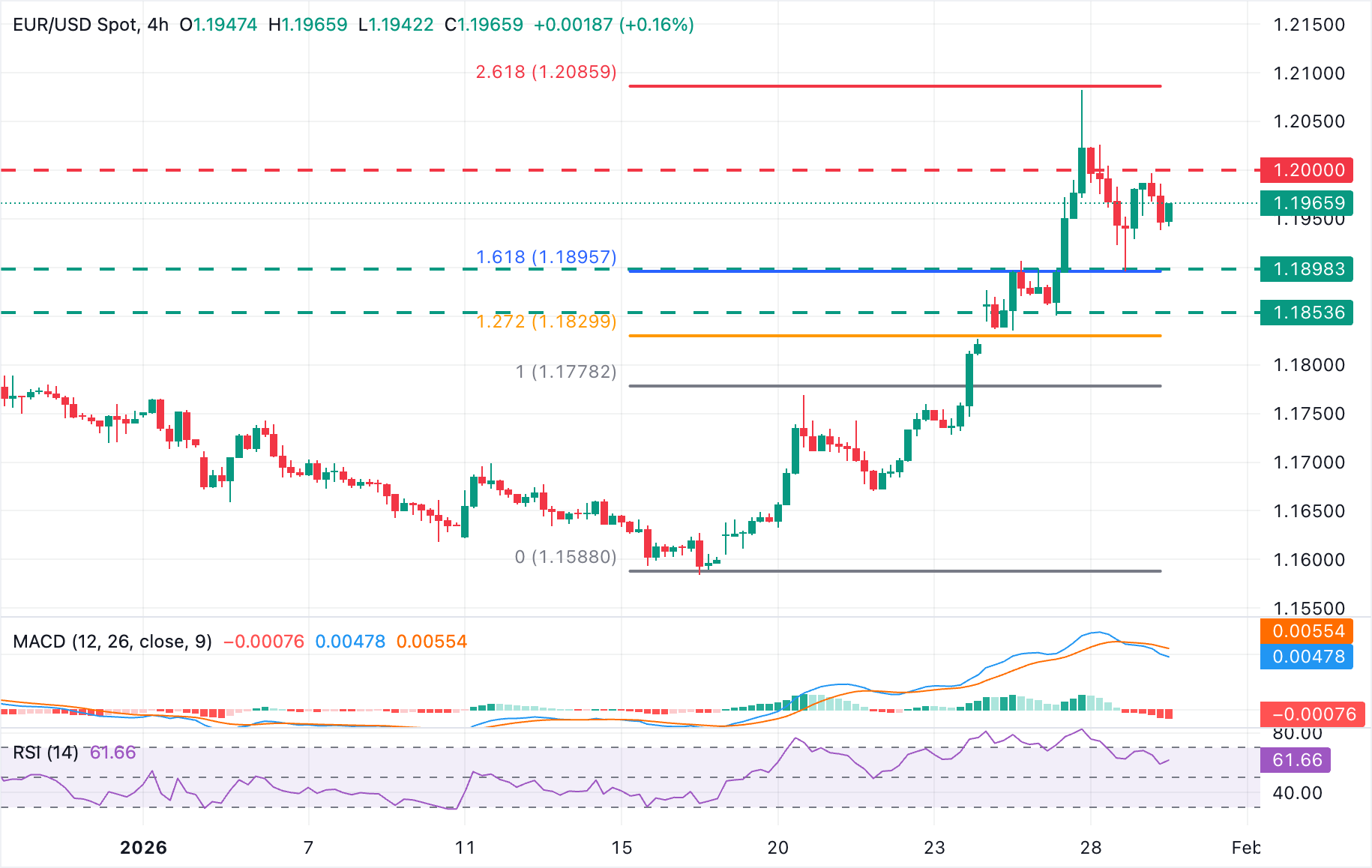
EUR/USD is in a consolidation phase after the reversal from the 261.8% Fibonacci extension of the January 16-20 uptrend, at 1.2085, was contained at the 1.1900 area.
Technical indicators are mixed. The Relative Strength Index (RSI) stands near 60 on the 4-hour chart, highlighting a moderately positive trend, although the Moving Average Convergence Divergence (MACD) has crossed below the signal line, with the histogram turning negative, which points to a fading upside momentum.
Support levels are at Wednesday's low in the area of 1.1900, and the January 27 low, at 1.1850. On the upside, the 1.2000 psychological level is holding bulls at the present time, ahead of the 1.2082 long-term high hit on Tuesday.
(The technical analysis of this story was written with the help of an AI tool.)
Economic Indicator
Initial Jobless Claims
The Initial Jobless Claims released by the US Department of Labor is a measure of the number of people filing first-time claims for state unemployment insurance. A larger-than-expected number indicates weakness in the US labor market, reflects negatively on the US economy, and is negative for the US Dollar (USD). On the other hand, a decreasing number should be taken as bullish for the USD.
Read more.Next release: Thu Jan 29, 2026 13:30
Frequency: Weekly
Consensus: 205K
Previous: 200K
Source: US Department of Labor
Every Thursday, the US Department of Labor publishes the number of previous week’s initial claims for unemployment benefits in the US. Since this reading could be highly volatile, investors may pay closer attention to the four-week average. A downtrend is seen as a sign of an improving labour market and could have a positive impact on the USD’s performance against its rivals and vice versa.
Economic Indicator
Factory Orders (MoM)
Factory orders, released by the United States (US) Census Bureau on a monthly basis, measures the change in the value of new purchased orders of manufactured goods at US factories. The data, which isn’t adjusted for inflation, is published in the monthly report on Manufacturers’ Shipments, Inventories and Orders. New orders are considered a forward-looking indicator as they hint at demand ahead for manufacturing goods and thus can be indicative of future production levels. Generally, a high reading is seen as bullish for the US Dollar (USD), while a low reading is seen as bearish.
Read more.Next release: Thu Jan 29, 2026 15:00
Frequency: Monthly
Consensus: 1.6%
Previous: -1.3%
Source: US Census Bureau

100만 명이 넘는 사용자가 FXStreet를 통해 실시간 시장 데이터, 차트 도구, 전문가 인사이트, 포렉스 뉴스를 이용합니다. 포괄적인 경제 캘린더와 교육 웨비나는 트레이더가 정보를 유지하고 신중한 결정을 내리도록 돕습니다. FXStreet는 바르셀로나 본사와 전 세계 지역에 걸쳐 약 60명의 팀으로 구성되어 있습니다.
더 읽기








