

Gold extends sell-off ahead of US CPI inflation data
- Gold falls to its lowest level since late March as traders brace for US inflation data.
- US CPI data due at 12:30 GMT could shape Fed interest-rate expectations and Gold's next move.
- A break below the 200-day SMA keeps the technical outlook firmly bearish.
Gold (XAU/USD) slides to fresh 11-week lows on Wednesday as mounting speculation that the Federal Reserve (Fed) could raise interest rates later this year weighs on demand for the non-yielding metal. At the time of writing, XAU/USD is trading around $4,163, down 2.30% on the day.

The sell-off has been amplified by technical selling after XAU/USD broke below its 200-day Simple Moving Average (SMA) at $4,444 following the release of the US May Nonfarm Payrolls report on Friday. The next major test for Gold comes with the release of US inflation data due at 12:30 GMT.
Economists expect the headline Consumer Price Index (CPI) to accelerate 4.2% YoY in May from 3.8% in April, while core CPI is forecast to edge up 2.9% from 2.8%.
The pickup in inflation comes after the US-Iran war triggered a sharp rise in energy prices, pouring cold water on the Fed's efforts to bring inflation back toward its 2% target.
Before the war began, markets were pricing in at least two rate cuts this year. Those bets have now disappeared, with traders increasingly expecting a rate hike by year-end.
If inflation comes in above expectations, markets could further increase bets on a Fed rate hike. That would likely add to downside pressure on Gold as higher interest rates increase the opportunity cost of holding non-yielding assets.
On the other hand, a softer inflation reading could prompt traders to scale back rate hike expectations and trigger a short-term rebound in the precious metal.
However, any rebound in Gold may prove limited as inflation risks remain elevated. The closure of the Strait of Hormuz continues to disrupt global Oil flows, keeping a geopolitical risk premium embedded in crude prices.
Hopes for a near-term peace deal between the United States and Iran appear slim after both sides launched renewed strikes on Tuesday. The geopolitical uncertainty has kept the US Dollar (USD) well bid, creating an additional headwind for Dollar-denominated Gold.
Technical analysis: XAU/USD eyes March low after decisive break below 200-day SMA
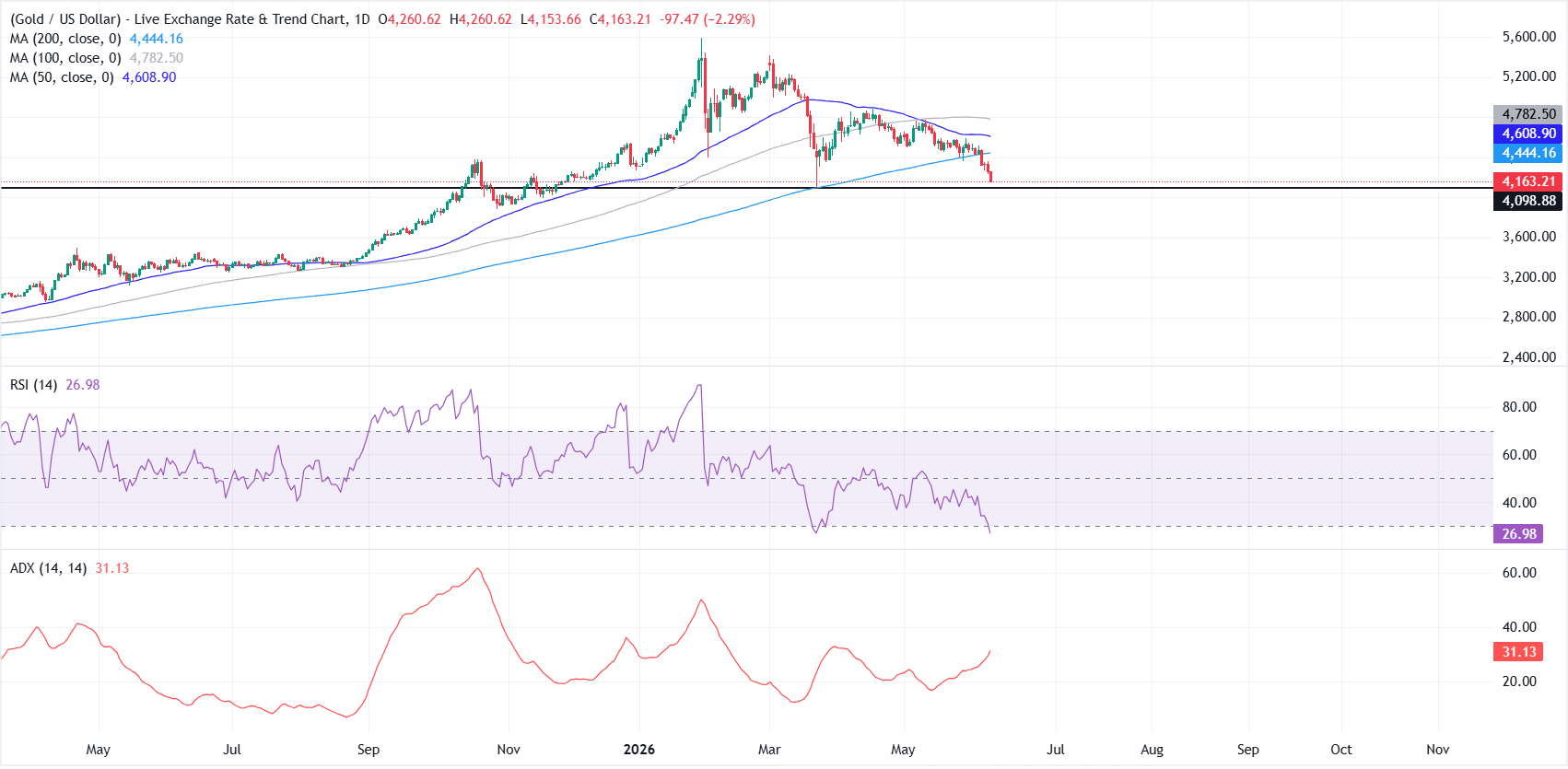
XAU/USD remains under heavy selling pressure after breaking below the key 200-day Simple Moving Average (SMA) at $4,444. The Relative Strength Index (RSI) has slipped to oversold territory near 27 on the daily chart, while the Average Directional Index (14) rises above 30, suggesting a strengthening downtrend despite stretched short-term conditions.
On the downside, the March low at $4,098 serves as the next key support level, where buyers may attempt to halt the decline. On the topside, any rebound would first confront the 200-day SMA at $4,444, followed by the 50-day SMA at $4,608 and then the 100-day SMA at $4,782, with the cluster of moving averages overhead likely to limit recovery attempts unless decisively reclaimed.
(The technical analysis of this story was written with the help of an AI tool.)
Gold FAQs
Gold has played a key role in human’s history as it has been widely used as a store of value and medium of exchange. Currently, apart from its shine and usage for jewelry, the precious metal is widely seen as a safe-haven asset, meaning that it is considered a good investment during turbulent times. Gold is also widely seen as a hedge against inflation and against depreciating currencies as it doesn’t rely on any specific issuer or government.
Central banks are the biggest Gold holders. In their aim to support their currencies in turbulent times, central banks tend to diversify their reserves and buy Gold to improve the perceived strength of the economy and the currency. High Gold reserves can be a source of trust for a country’s solvency. Central banks added 1,136 tonnes of Gold worth around $70 billion to their reserves in 2022, according to data from the World Gold Council. This is the highest yearly purchase since records began. Central banks from emerging economies such as China, India and Turkey are quickly increasing their Gold reserves.
Gold has an inverse correlation with the US Dollar and US Treasuries, which are both major reserve and safe-haven assets. When the Dollar depreciates, Gold tends to rise, enabling investors and central banks to diversify their assets in turbulent times. Gold is also inversely correlated with risk assets. A rally in the stock market tends to weaken Gold price, while sell-offs in riskier markets tend to favor the precious metal.
The price can move due to a wide range of factors. Geopolitical instability or fears of a deep recession can quickly make Gold price escalate due to its safe-haven status. As a yield-less asset, Gold tends to rise with lower interest rates, while higher cost of money usually weighs down on the yellow metal. Still, most moves depend on how the US Dollar (USD) behaves as the asset is priced in dollars (XAU/USD). A strong Dollar tends to keep the price of Gold controlled, whereas a weaker Dollar is likely to push Gold prices up.














