

Gold loses track of $4,000, drops as Oil shock revives Fed bets
- Gold tumbles as Middle East tensions keep July Oil gains near 13%.
- Solid Retail Sales and claims reinforce resilient US economy.
- Logan and Schmid comments keep Fed tightening risks alive.
Gold price drops over 1.80% as tensions between the US and Iran fuel fears of a possible Oil supply disruption, driving energy prices higher and potentially triggering another round of inflation. The XAU/USD trades at $3,994.
XAU/USD drops as energy risks lift Dollar and yields
The effects of the Middle East conflict are well reflected by the strength of the US Dollar. The Greenback is up some 0.24%, as measured by the US Dollar Index (DXY). The DXY, which tracks the buck’s value against its peers, is at 100.74, still shy of revisiting the 101.00 mark.

The US currency appreciates due to its positive correlation with the West Texas Intermediate (WTI) Oil price, which despite trading modestly lower during the day is up over 13% in July. This heightens speculation that the US Federal Reserve (Fed) could raise interest rates later this year.
US economic data was also positive during the day with Retail Sales expanding by 0.2% MoM in June, as expected, but below May’s 1% increase — driven mostly by higher gasoline prices. Control Group Retail Sales, used primarily in calculating the Gross Domestic Product (GDP), slowed from 0.8% to 0.5% as expected.
US jobs data was also solid, as Initial Jobless Claims for the week ending July 11 came at 208K, beneath forecasts of a 217K increase. The Fed’s Beige Book acknowledged that the labour market is strong, with some districts showing “modest, moderate or solid gains.”
US Treasury yields are drifting higher, with the US 10-year T-note rising by nearly 3 basis points (bps) to 4.577%.
Comments by Fed Regional Bank Presidents Lorie Logan and Jeffrey Schmid revealed that both lean hawkish on the Federal Open Market Committee (FOMC). Logan from the Dallas Fed calls for a modestly higher policy rate to better balance the outlook and risks. Meanwhile, the Kansas City Fed's Schmid said that the labour market seems to be roughly stable, but that he remains concerned as “inflation is proving persistent across a broad selection of goods and services.”
Money markets expect the Fed to hold rates unchanged at the July meeting, with odds of a hold at 73%. However, the chances for an October rate hike remain high, at 57%, according to Prime Terminal data.
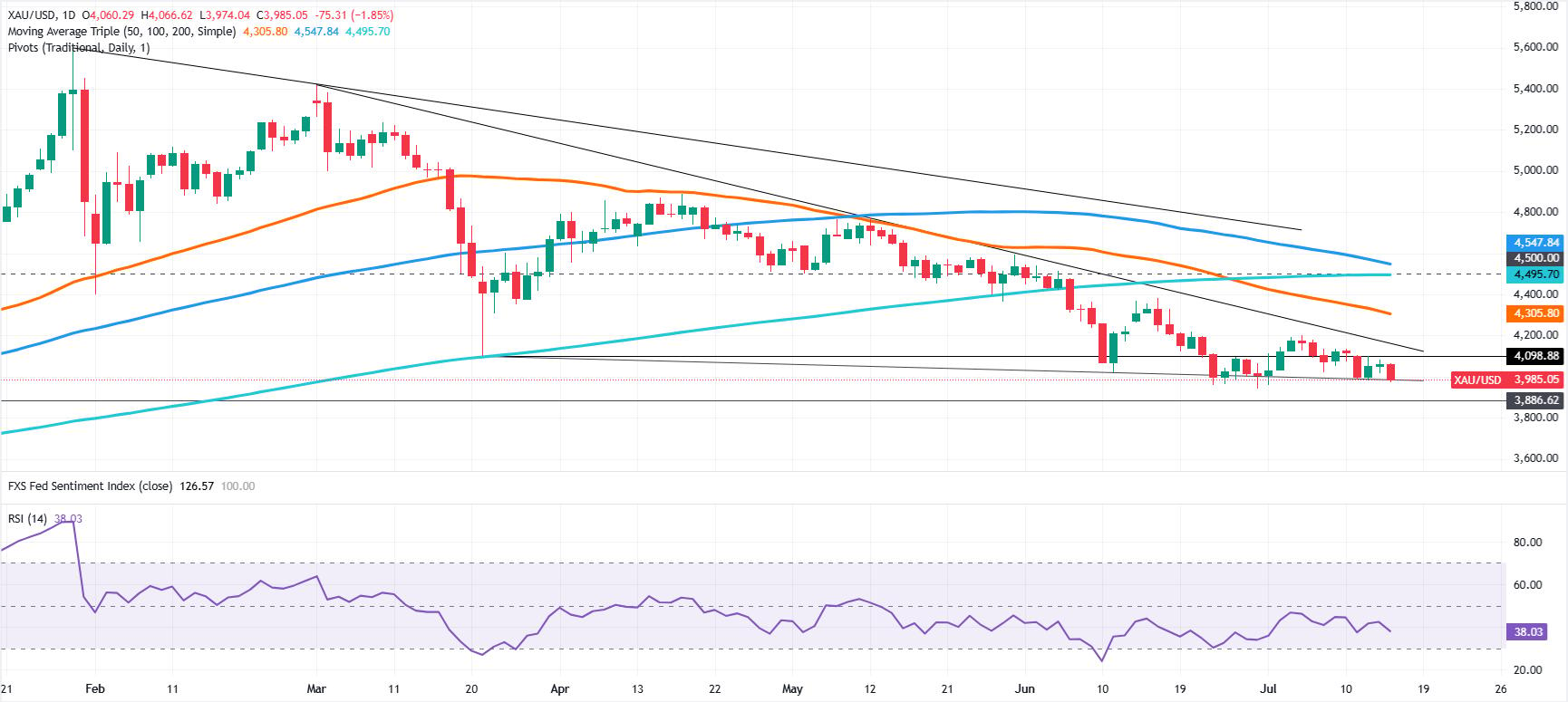
XAU/USD technical outlook: Gold’s downtrend extends, eyes on $3,900
Gold’s trend remains bearish, reaching a new 13-day low of $3,974, which if decisively cleared opens the door for a move toward the year-to-date low of $3,941. On further weakness, bears could drive XAU to test the $3,900 milestone before challenging the October 28, 2025 swing low at $3,886.
On the other hand, for a bullish reversal Bullion must clear a downslope resistance trendline between $4,125 and $4,175. Once cleared, a move to test the 50-day Simple Moving Average (SMA) at $4,305 is on the cards. Overhead lies the 200-day SMA at $4,495, which once hurdled clears the path to $4,500.
Gold FAQs
Gold has played a key role in human’s history as it has been widely used as a store of value and medium of exchange. Currently, apart from its shine and usage for jewelry, the precious metal is widely seen as a safe-haven asset, meaning that it is considered a good investment during turbulent times. Gold is also widely seen as a hedge against inflation and against depreciating currencies as it doesn’t rely on any specific issuer or government.
Central banks are the biggest Gold holders. In their aim to support their currencies in turbulent times, central banks tend to diversify their reserves and buy Gold to improve the perceived strength of the economy and the currency. High Gold reserves can be a source of trust for a country’s solvency. Central banks added 1,136 tonnes of Gold worth around $70 billion to their reserves in 2022, according to data from the World Gold Council. This is the highest yearly purchase since records began. Central banks from emerging economies such as China, India and Turkey are quickly increasing their Gold reserves.
Gold has an inverse correlation with the US Dollar and US Treasuries, which are both major reserve and safe-haven assets. When the Dollar depreciates, Gold tends to rise, enabling investors and central banks to diversify their assets in turbulent times. Gold is also inversely correlated with risk assets. A rally in the stock market tends to weaken Gold price, while sell-offs in riskier markets tend to favor the precious metal.
The price can move due to a wide range of factors. Geopolitical instability or fears of a deep recession can quickly make Gold price escalate due to its safe-haven status. As a yield-less asset, Gold tends to rise with lower interest rates, while higher cost of money usually weighs down on the yellow metal. Still, most moves depend on how the US Dollar (USD) behaves as the asset is priced in dollars (XAU/USD). A strong Dollar tends to keep the price of Gold controlled, whereas a weaker Dollar is likely to push Gold prices up.














