

Gold price climbs as weak NFP cool Fed hike bets
- Gold waits for the next catalyst, with FOMC minutes and US CPI up next.
- Weak NFP print trims expectations for year-end Fed tightening.
- US Dollar heads for a weekly loss after payrolls miss forecasts.
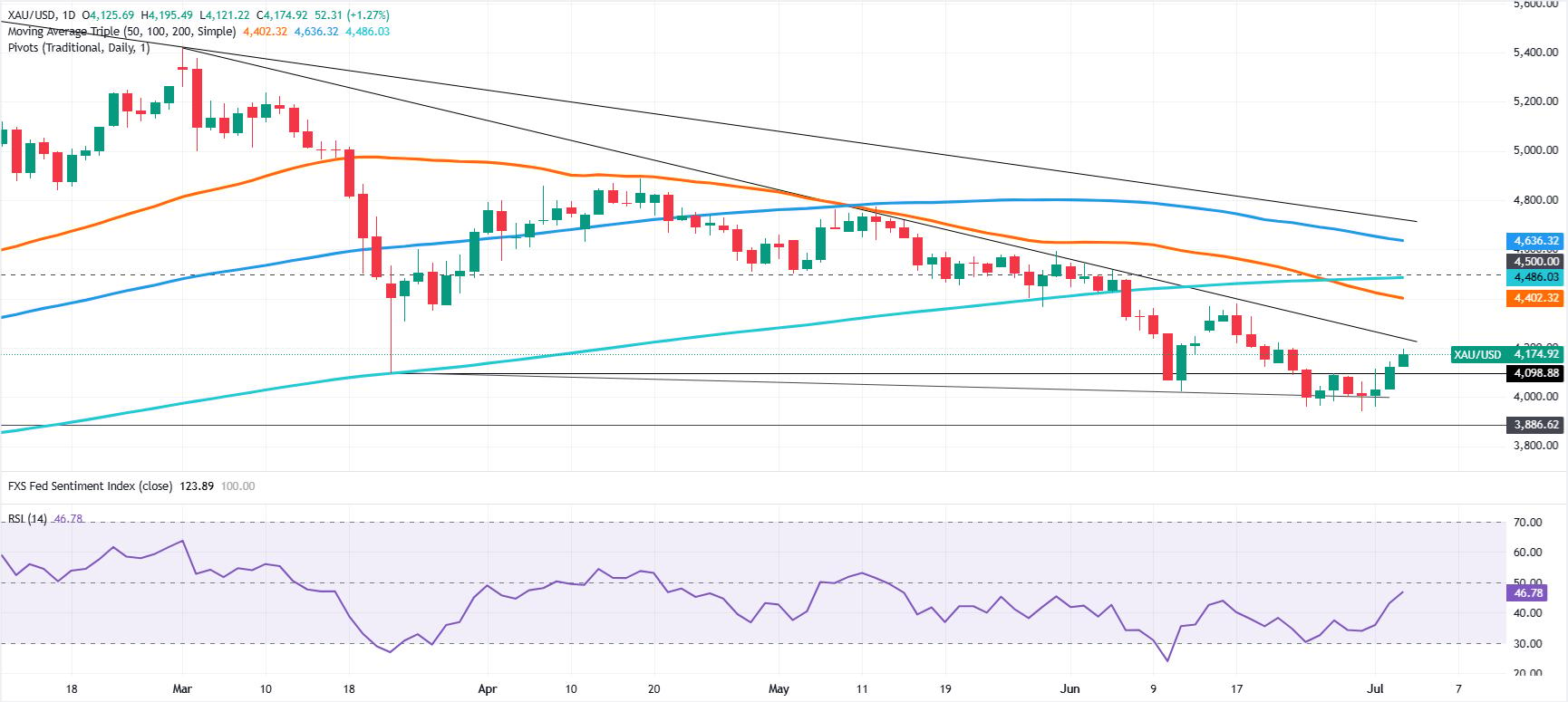
Gold (XAU/USD) price rises by more than 1% on Friday as investors digest a softer-than-expected US jobs report, trimming hawkish bets despite higher inflation. At the time of writing, the XAU/USD pair trades at $4,174, after bouncing off daily lows of $4,121.
Bullion rises as soft jobs data weighs on Dollar outlook
On Thursday, US Nonfarm Payrolls for June missed estimates by a large margin, coming in at 57K instead of 110 K. The Unemployment Rate edged lower, but mostly due to a lower participation rate, which hit 61.5, the lowest since March 2021.
Immediately, the swaps market adjusted interest rate expectations of the Federal Reserve (Fed), with investors now expecting a slim 46% chance of a rate increase toward the end of the year.
Consequently, the Greenback tanked, as depicted by the US Dollar Index (DXY), that is set to end the week with a 0.52% loss. The DXY, which measures the buck’s performance against six currencies, is flat at 100.83.
At the same time, the US 10-year Treasury yield is steady at 4.485%, increasing the appeal of the non-yielding metal, which fares well amid lower interest rate scenarios.
The new Fed Chair, Kevin Warsh, did not give forward guidance but reaffirmed the Fed’s dedication to controlling inflation.
Over the next week, traders will closely analyse the FOMC minutes, especially as they await the US inflation report on July 14. Further data is expected, including the release of the ISM Services PMI and Initial Jobless Claims for the week ending July 4, which are expected to rise from 215K to 219K.
Meanwhile, the World Gold Council said that central banks were back in buying mode in May, and, based on the latest reported data, official Gold reserves increased by a net 41 tons.
XAU/USD technical outlook: Gold reclaims $4,100 but remains bearish below the 200-SMA
Despite rising for the third straight day, Gold remains downwardly biased. Momentum shifted slightly bullish, short-term, according to the Relative Strength Index (RSI).
On the upside, Gold is poised to challenge the psychological $4,200 figure. Above this area, the next resistance is a downslope resistance trendline at around $4,225-$4,250, followed by the $4,300 mark. Overhead lies the 200-day Simple Moving Average (SMA) at $4,402.
For a bearish continuation, XAU/USD sellers need to drive spot prices below $4,100 ahead of testing the $4,050 and $4,000 psychological levels. A breach of the latter will expose the yearly low of $3,941, ahead of $3,900.
Gold FAQs
Gold has played a key role in human’s history as it has been widely used as a store of value and medium of exchange. Currently, apart from its shine and usage for jewelry, the precious metal is widely seen as a safe-haven asset, meaning that it is considered a good investment during turbulent times. Gold is also widely seen as a hedge against inflation and against depreciating currencies as it doesn’t rely on any specific issuer or government.
Central banks are the biggest Gold holders. In their aim to support their currencies in turbulent times, central banks tend to diversify their reserves and buy Gold to improve the perceived strength of the economy and the currency. High Gold reserves can be a source of trust for a country’s solvency. Central banks added 1,136 tonnes of Gold worth around $70 billion to their reserves in 2022, according to data from the World Gold Council. This is the highest yearly purchase since records began. Central banks from emerging economies such as China, India and Turkey are quickly increasing their Gold reserves.
Gold has an inverse correlation with the US Dollar and US Treasuries, which are both major reserve and safe-haven assets. When the Dollar depreciates, Gold tends to rise, enabling investors and central banks to diversify their assets in turbulent times. Gold is also inversely correlated with risk assets. A rally in the stock market tends to weaken Gold price, while sell-offs in riskier markets tend to favor the precious metal.
The price can move due to a wide range of factors. Geopolitical instability or fears of a deep recession can quickly make Gold price escalate due to its safe-haven status. As a yield-less asset, Gold tends to rise with lower interest rates, while higher cost of money usually weighs down on the yellow metal. Still, most moves depend on how the US Dollar (USD) behaves as the asset is priced in dollars (XAU/USD). A strong Dollar tends to keep the price of Gold controlled, whereas a weaker Dollar is likely to push Gold prices up.














