

Gold price crashes as Trump's strike threat sends Oil and yields higher
- Trump warns of hard attacks as Iran targets Gulf bases.
- US CPI reaches three-year high, keeping Fed hike bets alive.
- Oil rebound and rising yields deepen pressure on Gold.
Gold (XAU/USD) price collapses over 3% on Wednesday after the latest inflation report in the US showed prices remain elevated, reinforcing expectations that interest rates could remain higher-for-longer, a headwind for the non-yielding metal. The XAU/USD pair trades at $4,130 after testing two-month lows near $4,105.
XAU/USD sinks as hot CPI and retaliation fears hit bullion
Market mood shifted sour after US President Trump said that the US “will be attacking Iran hard” and that it has the right to resume attacks if Tehran doesn’t sign a deal. Meanwhile, Iran launched attacks on US bases established in the Gulf States, in Jordan, Kuwait and Bahrain.
US CPI above the 4% threshold, PPI up next
US inflation jumped to 4.2% YoY in May, its highest level in three years—aligned with estimates—, according to the Consumer Price Index (CPI), driven by energy prices, which rose 3.9%, up from April’s 3.8%. Underlying inflation, as reflected in the core CPI, came in at 2.9% YoY, as foreseen, up from 2.8% in the previous month.
After the data, money markets are still pricing in a Federal Reserve (Fed) rate hike towards the end of the year, yet expect 21 basis points (bps) of tightening, below the 25 bps hit on Monday.
Bullion is heading south, pressured by the recovery of Oil prices. After Trump’s remarks, the US crude Oil benchmark, WTI, is up 2.62% to $91.00 per barrel. As inflationary pressures build, US Treasury yields followed suit, with the 10-year T-note rising almost two basis points to 4.536%.
Traders' focus shifts to the May Producer Price Index (PPI) release, with both figures expected to rise modestly. Headline PPI is projected to hit 6.4% YoY, up from 6%, and Core PPI is foreseen to rise from 5.2% to 5.4% YoY. Furthermore, jobless claims are also expected to dip from 225K to 219K for the week ending June 6.
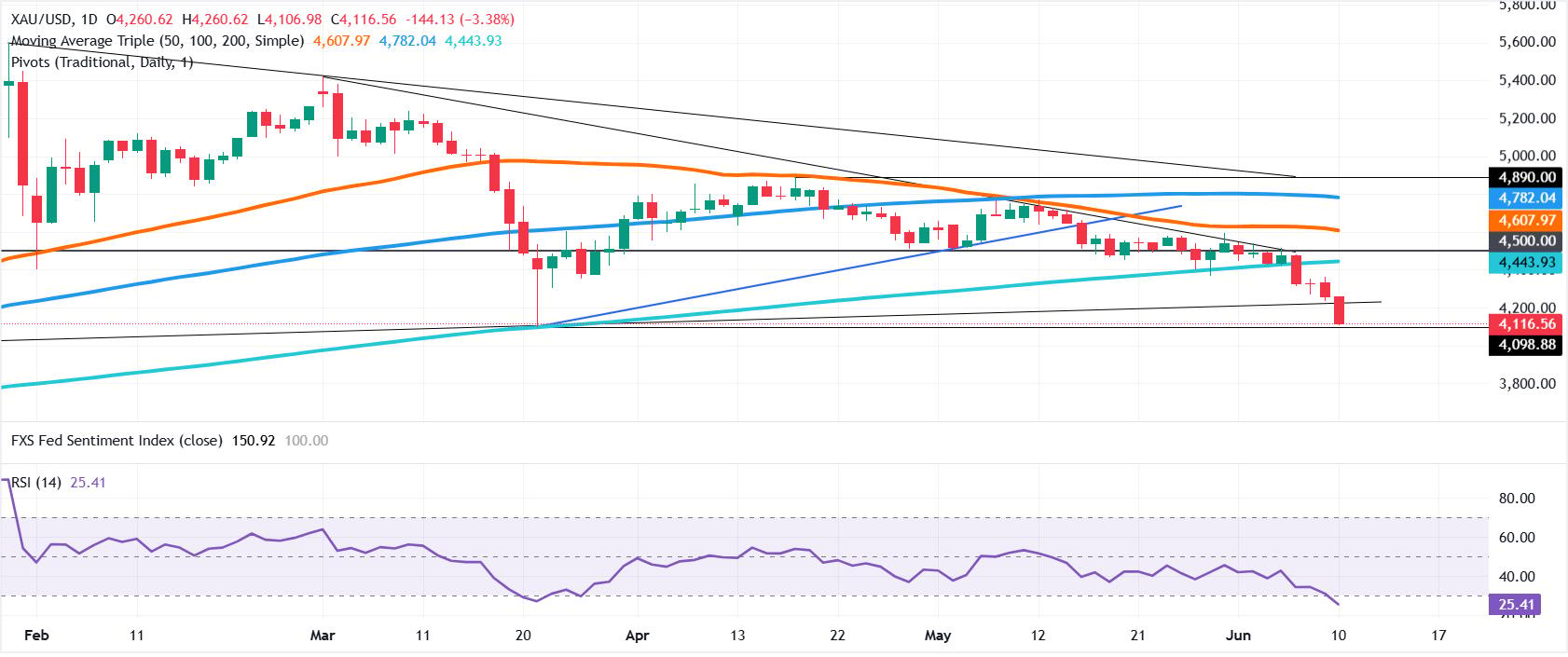
XAU/USD technical outlook: Gold tanks towards $4,100 as bears eye a YTD low
From a technical standpoint, Gold shifted bearishly, with sellers eyeing a clear break below the latest cycle low at $4,098, the March 23 yearly low. If broken, Bullion prices could collapse to $4,000, as the next area of interest from a supply/demand perspective would be the October 28, 2025, swing low at $3,886.
The Relative Strength Index (RSI) shifted into oversold territory, but it hasn’t reached the 20 level, considered the most extreme, which could trigger a consolidation in Gold prices.
For a bullish reversal, XAU/USD must climb above the 200-day Simple Moving Average (SMA) at $4,443, which opens the path to challenge $4,500.
Gold FAQs
Gold has played a key role in human’s history as it has been widely used as a store of value and medium of exchange. Currently, apart from its shine and usage for jewelry, the precious metal is widely seen as a safe-haven asset, meaning that it is considered a good investment during turbulent times. Gold is also widely seen as a hedge against inflation and against depreciating currencies as it doesn’t rely on any specific issuer or government.
Central banks are the biggest Gold holders. In their aim to support their currencies in turbulent times, central banks tend to diversify their reserves and buy Gold to improve the perceived strength of the economy and the currency. High Gold reserves can be a source of trust for a country’s solvency. Central banks added 1,136 tonnes of Gold worth around $70 billion to their reserves in 2022, according to data from the World Gold Council. This is the highest yearly purchase since records began. Central banks from emerging economies such as China, India and Turkey are quickly increasing their Gold reserves.
Gold has an inverse correlation with the US Dollar and US Treasuries, which are both major reserve and safe-haven assets. When the Dollar depreciates, Gold tends to rise, enabling investors and central banks to diversify their assets in turbulent times. Gold is also inversely correlated with risk assets. A rally in the stock market tends to weaken Gold price, while sell-offs in riskier markets tend to favor the precious metal.
The price can move due to a wide range of factors. Geopolitical instability or fears of a deep recession can quickly make Gold price escalate due to its safe-haven status. As a yield-less asset, Gold tends to rise with lower interest rates, while higher cost of money usually weighs down on the yellow metal. Still, most moves depend on how the US Dollar (USD) behaves as the asset is priced in dollars (XAU/USD). A strong Dollar tends to keep the price of Gold controlled, whereas a weaker Dollar is likely to push Gold prices up.













