

Gold price extends losses into fourth consecutive week: Is the safe-haven bid finally cracking?
Gold has fallen for a third consecutive week, dropping to its lowest level since mid-June as a stronger US Dollar and hawkish Federal Reserve expectations erode the metal's appeal. ING strategists and RoboForex analysts both highlight that higher-for-longer interest rates are now the dominant headwind, with Goldman Sachs also cutting its year-end price target in a sign that institutional sentiment is turning more cautious.
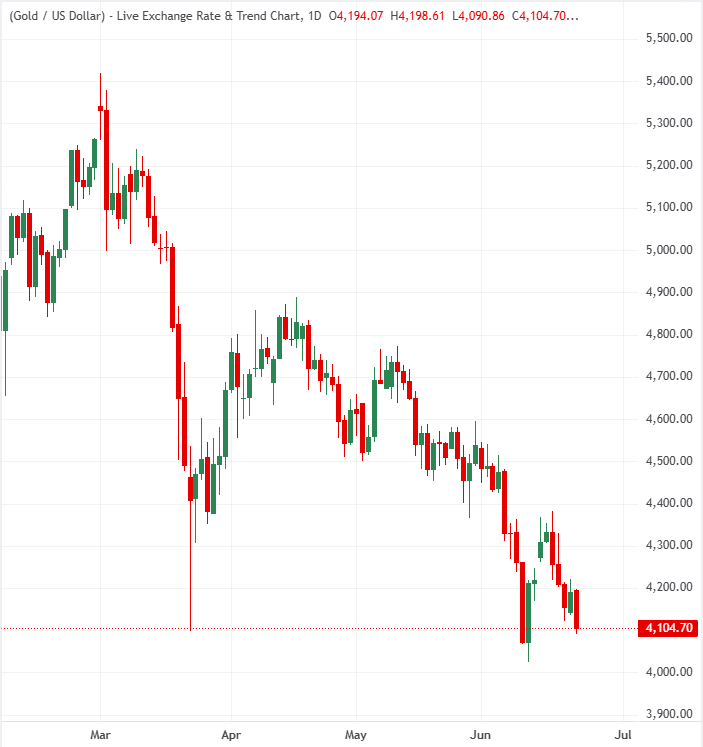
ING warns that higher-for-longer rates are overtaking geopolitical support
ING strategists acknowledge that while tensions in the Middle East remain elevated, the resumption of energy flows through the Strait of Hormuz has eased supply fears and undermined one of Gold's key pillars of support.
Even as inflation concerns recede, the rising opportunity cost of holding non-yielding assets still weighs on the precious metal.
Hawkish comments from Federal Reserve Chair Kevin Warsh reinforced expectations that US interest rates will remain higher for longer.
Goldman Sachs slashes year-end forecast to $4,900
According to analysis from RoboForex, Goldman Sachs has revised down its outlook for the precious metal, adding further selling pressure to an already fragile market.
The downgrade signals that even historically bullish institutional voices are capitulating to the reality of persistently elevated US rates and a resilient US Dollar.
Another negative factor for the gold market was Goldman Sachs’ decision to lower its year-end forecast for the metal from 5,400 to 4,900 USD per ounce. This added further pressure to quotes.
A bearish short-term outlook
Taken together, the outlook from ING and RoboForex, citing Goldman Sachs, paints a broadly bearish near-term picture for Gold. Both sources converge on the view that Fed policy and rate expectations are the primary drivers pressuring the metal, even if underlying geopolitical risks continue to offer a floor. With the market already pricing in a significant probability of further tightening and institutional forecasts being revised lower, Gold appears vulnerable to additional downside unless the Fed's stance shifts meaningfully.
(This article was created with the help of an Artificial Intelligence tool and reviewed by an editor.)













