

Gold rebounds from three-month lows as Trump delays Iran strikes
- Gold rebounds toward $4,370 after nearly testing the 200-day SMA near $4,071.
- Trump’s comments on productive Iran talks knocked Oil lower and weakened the US Dollar.
- Falling US yields and renewed Fed easing hopes helped bullion recover from session lows.
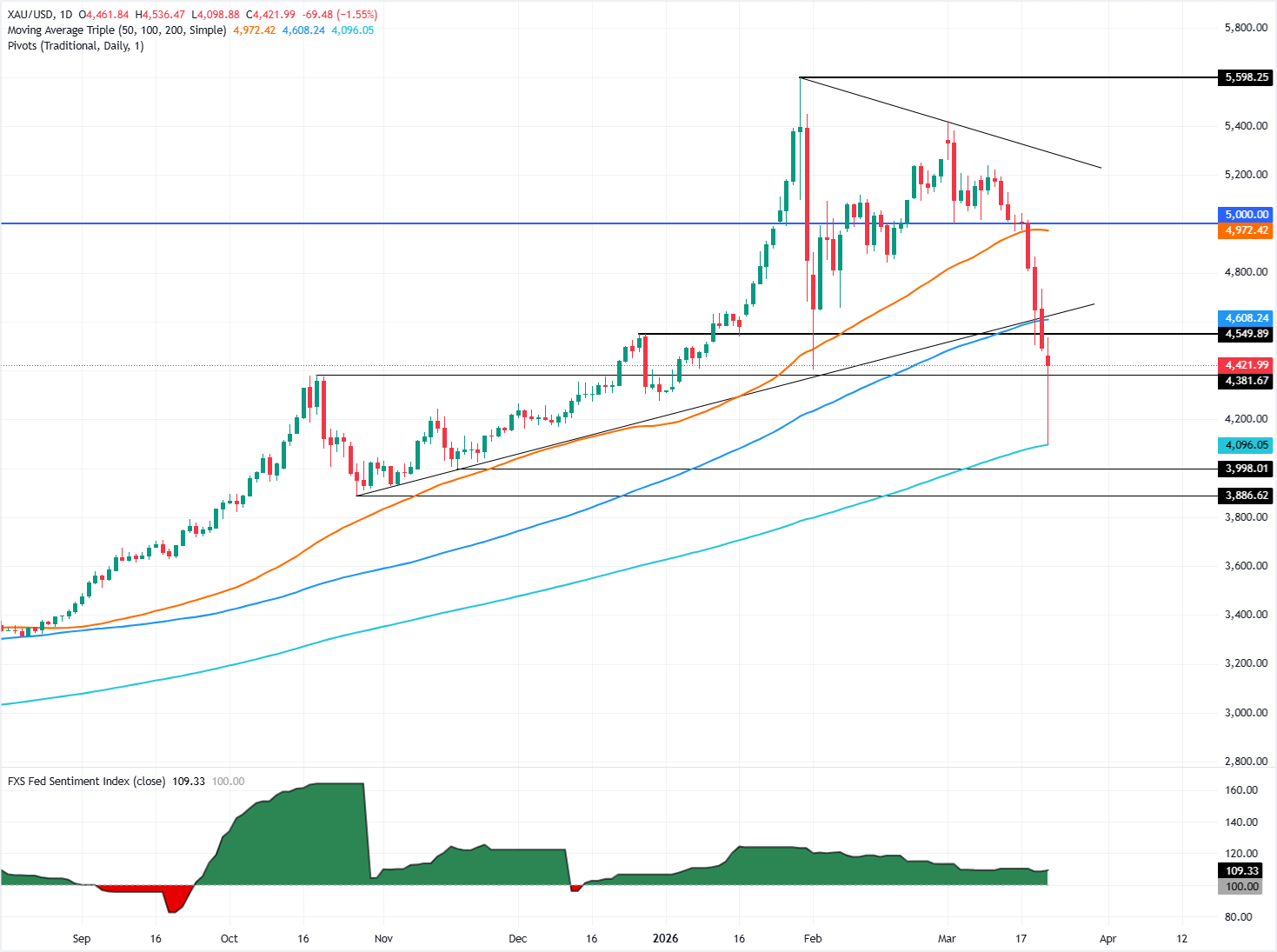
Gold (XAU/USD) trims some of its earlier losses on Monday but remains down nearly 3% after falling to $4,098, its lowest level since November and near the 200-day Simple Moving Average (SMA). US President Donald Trump's delay in attacks in Iran pushed Gold prices up towards the current spot value of around $4,370.

Trump’s peace talks comments lift Gold prices and weigh on Oil prices
Market mood remains positive after Trump posted on his social network that the US and Iran had "very good and productive" talks. Although Iran’s media disputed Trump’s statement, a reporter for Axios said that Turkey, Egypt and Pakistan met Trump’s special envoy Steve Witkoff and separately Iranian Foreign Minister Abbas Araghchi.
Trump’s de-escalation pushed Oil prices down by about 10% to a one-week low as risk appetite improved, triggering a positive open on Wall Street. Consequently, the Greenback, which in the short-term is closely correlated to WTI price, is down 0.18%, as revealed by the US Dollar Index (DXY).
The DXY, which measures the buck’s value against six currencies, recovers from daily lows of 98.88 and is at 99.32, still below its opening price.
US Treasury yields are also diving sharply, with the US 10-year T-note dropping nearly four and a half basis points to 4.34%, a tailwind for the yellow metal.
International Energy Agency (IEA) Director Fatih Birol commented that the current crisis in the Middle East has had a worse impact on energy prices than the other two Oil shocks of the 1970s combined, and the effects on gas markets from the Russia-Ukraine war.
Fed Goolsbee is concerned about inflation, Miran remains ultra-dovish
The US economic docket data-wise is absent, but Federal Reserve (Fed) officials crossed the wires.
Chicago Fed President Austan Goolsbee expressed continued optimism that interest rates may decrease by the end of 2026, contingent upon further evidence of progress on inflation. He emphasized that inflation currently presents a significant risk and stated that he is actively assessing the timeline for how elevated oil prices will affect the broader economy.
Federal Reserve Governor Stephen Miran stated on Monday that it is premature to determine the impact of the energy price shock resulting from the Iran conflict on inflation. He added that he continues to believe interest rate reductions are appropriate to bolster the labor market.
Global central banks keep rates steady on high geopolitical tensions
Last week, major central banks like the Federal Reserve, the Bank of Japan (BoJ), the Bank of England (BoE) and the European Central Bank (ECB) delivered hawkish holds, spurred by the jump in energy prices.
In the case of the Federal Reserve, the swaps markets scaled back dovish bets, and they’re not expecting a rate reduction this year. Meanwhile, the European ECB odds for a rate hike at the April 30 meeting are close to 64%, after Reutersreported that policymakers could discuss the chances for a rate increases if the Middle East conflict prolongs.
For the June meeting, the odds are higher at 74% as investors priced in nearly 35 basis points of increases, according to Prime Market Terminal.
XAU/USD technical outlook: Gold’s forms a hammer, as bulls target 100-day SMA
Gold’s technical picture remains bearish, but in the near-term the jump slightly above the 200-day SMA, it opened the door for a recovery, with traders eyeing key resistance levels.
The Relative Strength Index (RSI) remains bearish, entering deeper into oversold territory. Traders should remember that when a trend strengthens, the RSI could continue to aim lower, to reach extreme oversold territory towards the 20 level, which could indicate that a bottom could lie ahead.
If XAU/USD closes the day positive, the first resistance eyed would be the $4,500 mark ahead of the 100-day SMA at $4,586. On further strength, the next key resistance level would be the March 20 high at $4,736.
On further weakness, Gold’s first support would be the $4,400 mark, followed by the $4,200 figure ahead of testing the 200-day SMA at $4,071.
Gold FAQs
Gold has played a key role in human’s history as it has been widely used as a store of value and medium of exchange. Currently, apart from its shine and usage for jewelry, the precious metal is widely seen as a safe-haven asset, meaning that it is considered a good investment during turbulent times. Gold is also widely seen as a hedge against inflation and against depreciating currencies as it doesn’t rely on any specific issuer or government.
Central banks are the biggest Gold holders. In their aim to support their currencies in turbulent times, central banks tend to diversify their reserves and buy Gold to improve the perceived strength of the economy and the currency. High Gold reserves can be a source of trust for a country’s solvency. Central banks added 1,136 tonnes of Gold worth around $70 billion to their reserves in 2022, according to data from the World Gold Council. This is the highest yearly purchase since records began. Central banks from emerging economies such as China, India and Turkey are quickly increasing their Gold reserves.
Gold has an inverse correlation with the US Dollar and US Treasuries, which are both major reserve and safe-haven assets. When the Dollar depreciates, Gold tends to rise, enabling investors and central banks to diversify their assets in turbulent times. Gold is also inversely correlated with risk assets. A rally in the stock market tends to weaken Gold price, while sell-offs in riskier markets tend to favor the precious metal.
The price can move due to a wide range of factors. Geopolitical instability or fears of a deep recession can quickly make Gold price escalate due to its safe-haven status. As a yield-less asset, Gold tends to rise with lower interest rates, while higher cost of money usually weighs down on the yellow metal. Still, most moves depend on how the US Dollar (USD) behaves as the asset is priced in dollars (XAU/USD). A strong Dollar tends to keep the price of Gold controlled, whereas a weaker Dollar is likely to push Gold prices up.













