

Gold steadies after gap lower as markets assess US-Iran developments
- Gold steadies near $4,800 after a bearish weekly gap as US-Iran tensions keep markets volatile.
- Escalating tensions in the Strait of Hormuz cloud de-escalation hopes.
- XAU/USD maintains a mild bullish bias on the 4-hour chart, holding above the 200-period SMA.
Gold (XAU/USD) steadies on Monday after opening the week with a bearish gap as evolving geopolitical developments surrounding the US-Iran war keep volatility elevated across global financial markets. At the time of writing, XAU/USD is trading around $4,808, recovering from an intraday low near $4,737 touched during the Asian session.

Strait of Hormuz tensions cloud de-escalation hopes
Markets remain torn between hopes of de-escalation and renewed uncertainty, with a weekend flare-up around the Strait of Hormuz dampening expectations that the conflict will be resolved quickly. Iran has effectively closed the Strait again after a temporary reopening was announced, citing the ongoing US naval blockade of its ports as a breach of the current ceasefire terms.
Meanwhile, the US Navy intercepted and boarded an Iranian cargo vessel in the Gulf of Oman. Tehran condemned the move as “armed piracy” and has threatened retaliation.
The current two-week ceasefire is set to expire on Wednesday, keeping investors cautious as they await clearer signals on a potential second round of peace talks. US President Donald Trump said in a post on Truth Social, “My representatives are going to Islamabad, Pakistan.” Trump warned, “We’re offering a very fair and reasonable deal, and I hope they take it because, if they don’t, the United States is going to knock out every single power plant and every single bridge in Iran.”
Iran’s Foreign Ministry spokesperson Esmail Baghaei said there are currently no plans for a second round of negotiations with the United States. He added that Washington has shown it is “not serious” about pursuing the diplomatic process, accusing the US of committing “aggressive acts” and violating the terms of the ceasefire.
Oil rebound keeps inflation risks elevated, clouds Gold outlook
Crude prices are rebounding after last week’s sharp decline as the de-escalatory rhetoric seen in recent days appears to be fading. West Texas Intermediate (WTI) is trading around $86.50 at the time of writing, up roughly 3.20% on the day.
Against this backdrop, the near-term outlook for Gold remains uncertain, as rising energy prices keep inflation risks elevated and reinforce expectations that central banks, particularly the Federal Reserve (Fed), may maintain a tighter monetary policy stance for longer.
Despite its traditional role as an inflation hedge and safe-haven asset, Gold has struggled to attract sustained demand since the onset of the conflict, with the “higher-for-longer” interest rate narrative continuing to act as a key headwind for the non-yielding metal.
Looking ahead, traders will keep a close eye on geopolitical developments for fresh directional cues, while the US economic calendar remains relatively light this week. Key data releases include Retail Sales and the preliminary S&P Global Purchasing Managers Index (PMI) surveys.
Focus will also be on the confirmation hearing of Kevin Warsh, President Donald Trump’s nominee for Federal Reserve Chair, scheduled for Tuesday before the Senate Banking Committee.
Technical analysis: XAU/USD consolidates near 200-period SMA
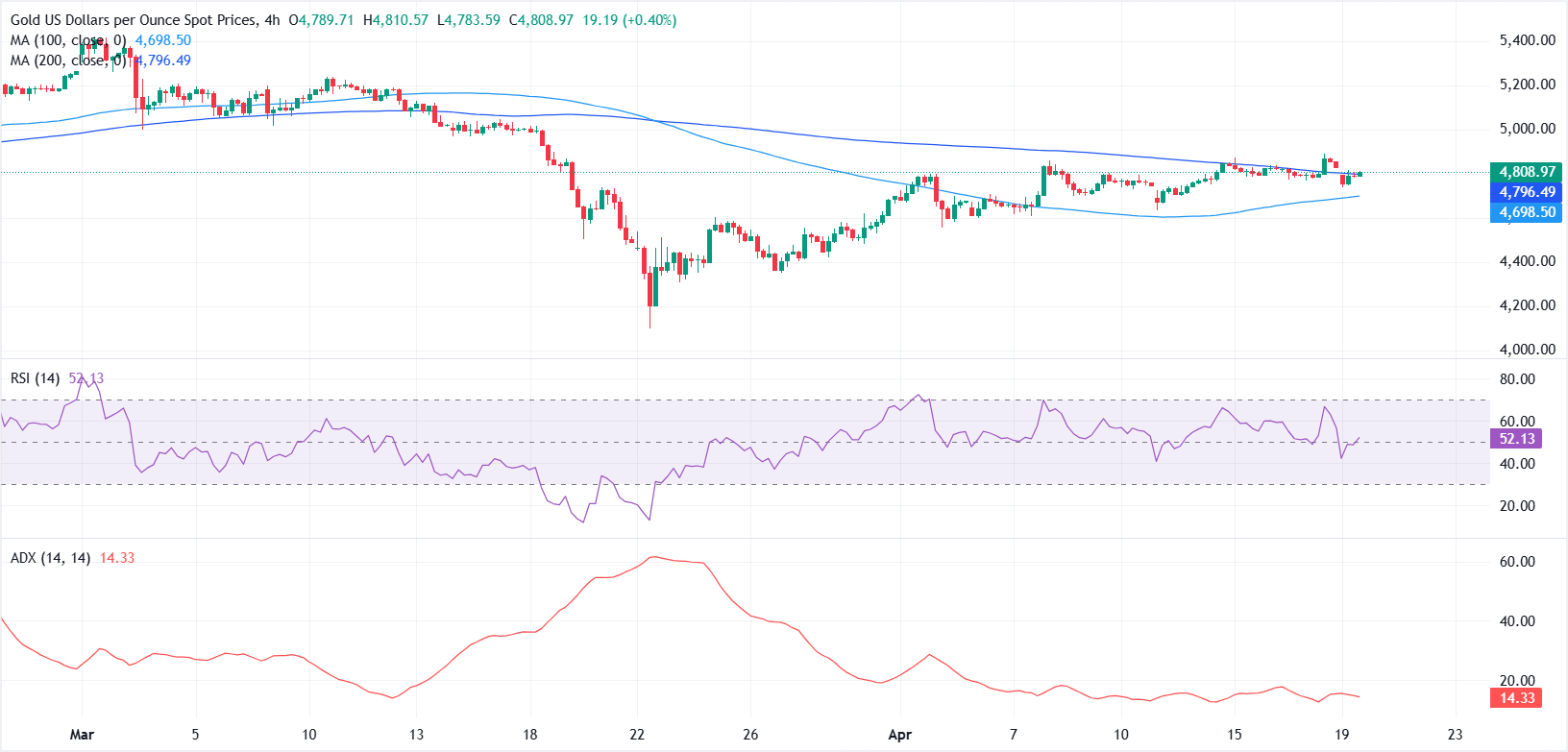
In the 4-hour chart, XAU/USD holds a mild bullish bias as it clings to a narrow support band defined by the 200-period Simple Moving Average (SMA) at $4,796, with the 100-period SMA much lower near $4,698, suggesting the broader uptrend structure remains intact despite the latest consolidation.
The Relative Strength Index (RSI) at 50.24 is neutral, while the subdued Average Directional Index (ADX) near 14.47 hints at a weakly trending environment, so immediate direction is likely to be driven by how price behaves around this tight 200-SMA floor.
On the downside, initial support is effectively anchored at the current price area around $4,800, reinforced immediately by the 200-period SMA at $4,796, while a deeper pullback would expose the next significant demand zone near the 100-period SMA at $4,698.
On the upside, a decisive move above the 200-period SMA could open the door for a test of last week’s high near $4,890, followed by the psychological $5,000 level.
Gold FAQs
Gold has played a key role in human’s history as it has been widely used as a store of value and medium of exchange. Currently, apart from its shine and usage for jewelry, the precious metal is widely seen as a safe-haven asset, meaning that it is considered a good investment during turbulent times. Gold is also widely seen as a hedge against inflation and against depreciating currencies as it doesn’t rely on any specific issuer or government.
Central banks are the biggest Gold holders. In their aim to support their currencies in turbulent times, central banks tend to diversify their reserves and buy Gold to improve the perceived strength of the economy and the currency. High Gold reserves can be a source of trust for a country’s solvency. Central banks added 1,136 tonnes of Gold worth around $70 billion to their reserves in 2022, according to data from the World Gold Council. This is the highest yearly purchase since records began. Central banks from emerging economies such as China, India and Turkey are quickly increasing their Gold reserves.
Gold has an inverse correlation with the US Dollar and US Treasuries, which are both major reserve and safe-haven assets. When the Dollar depreciates, Gold tends to rise, enabling investors and central banks to diversify their assets in turbulent times. Gold is also inversely correlated with risk assets. A rally in the stock market tends to weaken Gold price, while sell-offs in riskier markets tend to favor the precious metal.
The price can move due to a wide range of factors. Geopolitical instability or fears of a deep recession can quickly make Gold price escalate due to its safe-haven status. As a yield-less asset, Gold tends to rise with lower interest rates, while higher cost of money usually weighs down on the yellow metal. Still, most moves depend on how the US Dollar (USD) behaves as the asset is priced in dollars (XAU/USD). A strong Dollar tends to keep the price of Gold controlled, whereas a weaker Dollar is likely to push Gold prices up.














