

Gold trades at rare discount in India after tariff shock
- Gold prices in India have risen after the implementation of the import duty hike, but not as much as expected.
- Domestic Gold prices have not yet fully reflected the tariff increase amid weak demand and ample supply.
- Gold demand in India is expected to be hit this year amid higher import duties.
India’s Gold market shows an unusual disconnect after the government raised import duties on the precious metal. While the import duty hike indeed raised prices, these haven’t increased as much as expected, as the steep rise in duties takes time to filter through and clashes with already weakening demand.

Gold prices in India have risen by 4%-6% since the measure was taken, significantly below the 9% increase in import taxes, Kavita Chacko, India Research Head at the World Gold Council (WGC), writes in a recent report.
“Physical market prices do not fully or immediately mirror the increase in duty – rather they adjust to it with a lag, particularly when the change is as steep as the current 9%,” she said.
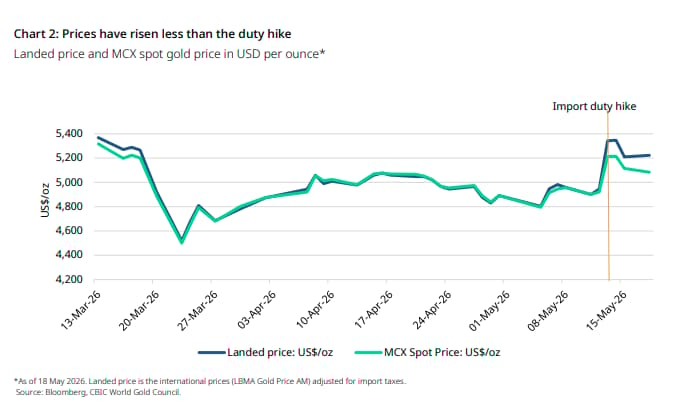
This lag means that Gold prices are currently trading at a discount of nearly $150 per ounce relative to official landed prices, a sharp widening from the roughly $14 average seen before the duty hike, the data showed.
Previous tariff hikes in 2019 and 2022 also resulted in discounts in the domestic market, but this episode has been significantly more pronounced due to the scale of the increase in duties.
Moreover, this time the duty hike arrived during a seasonally weak period for Gold purchases in India, once the peak wedding-buying season is over and during a traditionally inauspicious period for Gold demand between mid-May and mid-June.
“Market feedback indicates that there is ample supply from the exchange of old Gold jewellery for new, and the likely front-loading of imports, further limiting the rise in price,” Chacko said.
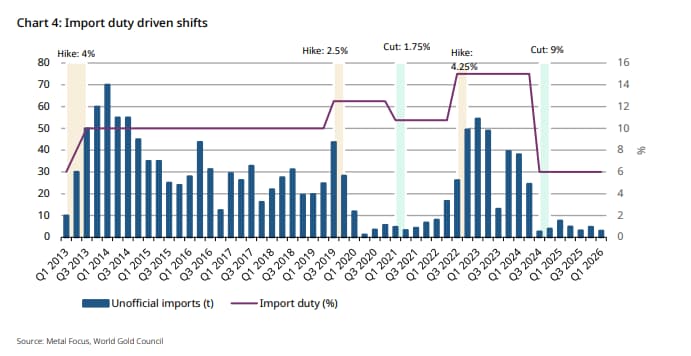
Historically, higher import duties in India have often distorted local Gold pricing dynamics and encouraged smuggling. The WGC report notes that previous duty hikes between 2013 and 2026 were mostly followed by higher levels of unofficial or smuggled Gold. “Higher import duties widen the domestic-international price gap and increase the incentive for smuggling, while lower duties reduce its attractiveness,” the report said.
The World Gold Council expects India’s Gold demand to fall in 2026 due to the hike in import duties. Combined jewelry and bar-and-coin demand could decline by 50 to 60 tonnes this year, roughly 10% below 2025 levels, as higher import costs weigh on investment demand and purchases. Given that India (along with China) is the world’s largest Gold consumer, a 10% fall in demand could be a headwind for prices.
Tariffs FAQs
Tariffs are customs duties levied on certain merchandise imports or a category of products. Tariffs are designed to help local producers and manufacturers be more competitive in the market by providing a price advantage over similar goods that can be imported. Tariffs are widely used as tools of protectionism, along with trade barriers and import quotas.
Although tariffs and taxes both generate government revenue to fund public goods and services, they have several distinctions. Tariffs are prepaid at the port of entry, while taxes are paid at the time of purchase. Taxes are imposed on individual taxpayers and businesses, while tariffs are paid by importers.
There are two schools of thought among economists regarding the usage of tariffs. While some argue that tariffs are necessary to protect domestic industries and address trade imbalances, others see them as a harmful tool that could potentially drive prices higher over the long term and lead to a damaging trade war by encouraging tit-for-tat tariffs.
During the run-up to the presidential election in November 2024, Donald Trump made it clear that he intends to use tariffs to support the US economy and American producers. In 2024, Mexico, China and Canada accounted for 42% of total US imports. In this period, Mexico stood out as the top exporter with $466.6 billion, according to the US Census Bureau. Hence, Trump wants to focus on these three nations when imposing tariffs. He also plans to use the revenue generated through tariffs to lower personal income taxes.














