

Indian Rupee bounces back as Trump sees Iran deal closure soon
- The Indian Rupee opens strongly against the US Dollar as fresh de-escalation in US-Iran tensions weakens oil prices.
- India’s Fiscal Budget is expected to widen to 4.8% of GDP this year amid Middle East crisis.
- Investors await India’s CPI data for May, which is seen arriving higher at 4% YoY.
The Indian Rupee (INR) opens sharply higher against the US Dollar (USD) on Friday. The USD/INR pair tumbles to near 95.25 as remarks from United States (US) President Donald Trump that he called off planned strikes on Iran and that both nations are close to finalizing the permanent peace deal have subsided fears of a prolonged Middle East war, resulting in a further decline in oil prices.

In the opening trade, the MCX Crude Oil contract expiring on June 18 bounces back after a weak opening, but is still 1.62% to near 8,207 from Thursday’s closing price.
The appeal of currencies from economies, such as India, which rely heavily on oil imports to meet their energy needs, improves when oil prices come under pressure.
Trump says Iran agreement is in final stage
On Thursday, US President Trump said in an event at the Oval Office that he has canceled planned military strikes on Iran, as negotiators from both sides are on “final elements of the deal”. Trump added, “Discussions and final points have been, in both concept and great detail, approved by all parties involved.” He further added that both parties will be signing the deal soon, and “Time and place of signing to be announced shortly.”
Meanwhile, Tehran has clarified that it has not yet agreed to any document for a memorandum of understanding (MoU) with the US.
The announcement of canceling planned strikes on Iran resulted in a broad risk rally and a significant decline in oil prices and the US Dollar.
Considering broader risk-on sentiment, Indian stock markets have opened on a strong note. Nifty 50 rises almost 250 points to near 23,400, and Sensex 30 jumps almost 1.4% to near 74,800.
FIIs keep paring stake in Indian stock market
So far in June, Foreign Institutional Investors (FIIs) have remained net sellers on all trading days of June, offloading their stake worth Rs. 64,641.43 crore. Overseas investors have been paring their stake in the Indian stock market due to uncertainty over India Inc.’s earnings projections in the wake of Middle East conflicts.
India’s Fiscal Deficit to widen to 4.8% of GDP this year
According to a report from Bloomberg, India is preparing for a wider-than-expected budget deficit this year, as the war in Iran drives up energy subsidy costs and adds pressure on government finances. However, it has not been confirmed by Indian authorities.
Authorities are willing to let the deficit widen by as much as 0.5% to 4.8% of Gross Domestic Product (GDP) compared with the 4.3% goal set in February.
India’s CPI data awaited
Later in the day, investors will pay close attention to the US Consumer Price Index (CPI) data for May, which will be published at 04:00 PM IST (10:30 GMT). India’s CPI data is expected to arrive at an annualized pace of 4%, higher than 3.48% in April.
The inflation data will influence market expectations for the Reserve Bank of India’s (RBI) monetary policy outlook.
Technical Analysis: USD/INR stays inside Symmetrical Triangle formation
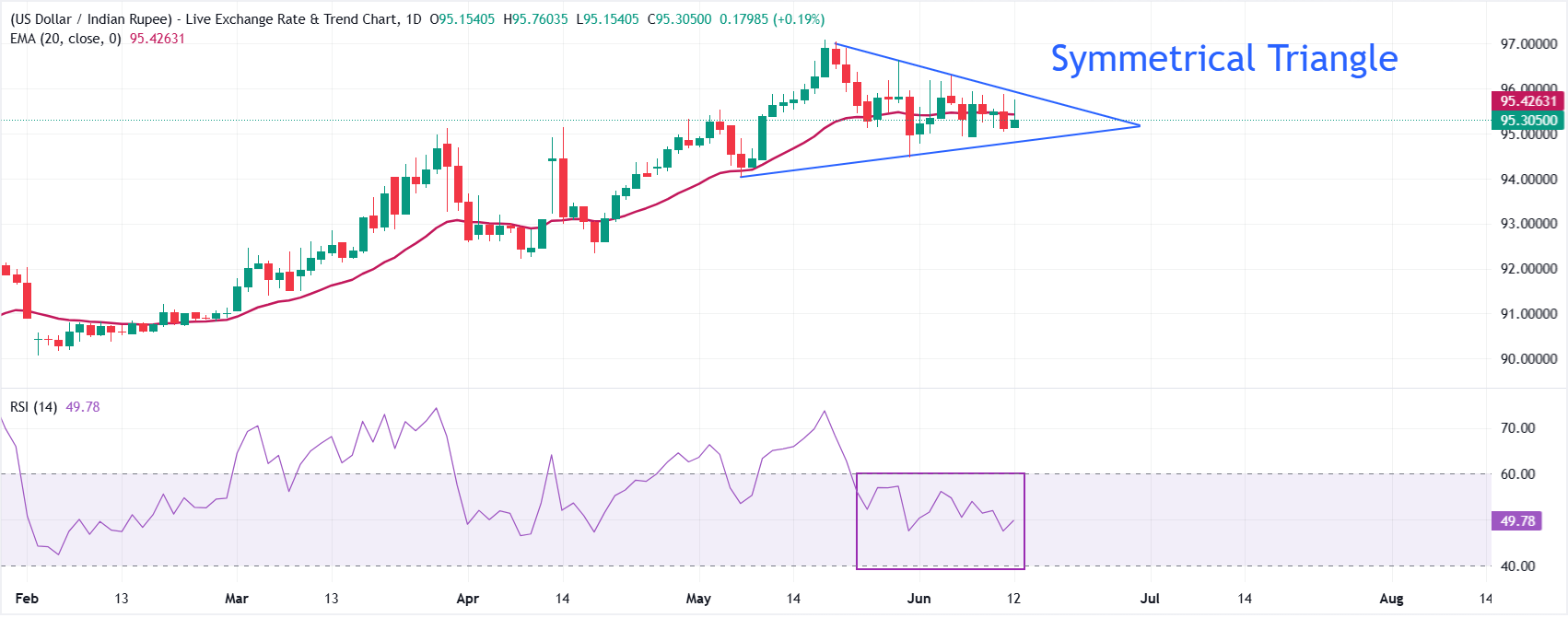
USD/INR trades lower at around 95.25 in the opening trade on Friday. The Symmetrical Triangle formation, along with spot's stickiness to the 20-day Exponential Moving Average (EMA) at 95.43, reflects that the overall trend has become sideways. The recent pullback has dragged the 14-day Relative Strength Index (RSI) toward a neutral 49.8 area, hinting at fading upside momentum rather than outright oversold conditions, which keeps the focus on overhead supply rather than a decisive bullish reversal.
On the topside, initial resistance is aligned at the 20-day EMA near 95.43, with a stronger barrier emerging at the prior trend-line break zone close to 95.97, where a daily close above would be needed to ease the current pressure and reopen the path toward the all-time high around 97.10. On the downside, immediate support is defined by the rising structural floor from the upward trend line near 94.79, where a break would likely signal a deeper corrective phase toward the May 7 low at 94.03.
(The technical analysis of this story was written with the help of an AI tool.)
Indian Rupee FAQs
The Indian Rupee (INR) is one of the most sensitive currencies to external factors. The price of Crude Oil (the country is highly dependent on imported Oil), the value of the US Dollar – most trade is conducted in USD – and the level of foreign investment, are all influential. Direct intervention by the Reserve Bank of India (RBI) in FX markets to keep the exchange rate stable, as well as the level of interest rates set by the RBI, are further major influencing factors on the Rupee.
The Reserve Bank of India (RBI) actively intervenes in forex markets to maintain a stable exchange rate, to help facilitate trade. In addition, the RBI tries to maintain the inflation rate at its 4% target by adjusting interest rates. Higher interest rates usually strengthen the Rupee. This is due to the role of the ‘carry trade’ in which investors borrow in countries with lower interest rates so as to place their money in countries’ offering relatively higher interest rates and profit from the difference.
Macroeconomic factors that influence the value of the Rupee include inflation, interest rates, the economic growth rate (GDP), the balance of trade, and inflows from foreign investment. A higher growth rate can lead to more overseas investment, pushing up demand for the Rupee. A less negative balance of trade will eventually lead to a stronger Rupee. Higher interest rates, especially real rates (interest rates less inflation) are also positive for the Rupee. A risk-on environment can lead to greater inflows of Foreign Direct and Indirect Investment (FDI and FII), which also benefit the Rupee.
Higher inflation, particularly, if it is comparatively higher than India’s peers, is generally negative for the currency as it reflects devaluation through oversupply. Inflation also increases the cost of exports, leading to more Rupees being sold to purchase foreign imports, which is Rupee-negative. At the same time, higher inflation usually leads to the Reserve Bank of India (RBI) raising interest rates and this can be positive for the Rupee, due to increased demand from international investors. The opposite effect is true of lower inflation.














