

New Zealand Dollar rides the RBNZ hawks into a payrolls week
- The New Zealand Dollar slipped on Monday as broad US Dollar firmness set the tone ahead of Friday's payrolls report.
- A hawkish RBNZ, now signalling rate hikes rather than cuts, is the Kiwi's main domestic support.
- US labor data dominates the week, with NFP the decisive catalyst.
The New Zealand Dollar (NZD) is in an odd spot: it has one of the few central banks in the developed world openly leaning toward higher rates, yet it still spent Monday on the back foot, down close to 1% on the day. That tells you most of what you need to know about whose week this is. With no first-tier data of its own until later, the Kiwi is largely a passenger and the US Dollar is driving. Broad greenback strength, helped by a stronger-than-expected Institute for Supply Management (ISM) manufacturing survey, pulled NZD/USD off its highs near 0.6000 and down toward the 0.5900 handle before a modest bounce back to around 0.5950.

A central bank actually talking hikes
The Reserve Bank of New Zealand (RBNZ) held the Official Cash Rate (OCR) at 2.25% on 27 May, but the framing was the real story. The decision split the committee evenly, and the updated projection path pointed to the OCR drifting up toward 2.8% by year-end, implying several hikes rather than the cuts most peers are still flirting with. The driver is uncomfortably familiar: the Middle East conflict and the resulting Crude Oil spike have kept New Zealand inflation above the target band, and the RBNZ has chosen to lean against it instead of looking through it. For the Kiwi, that is a genuine yield tailwind, even if the market keeps filing it under footnotes next to the US story.
The tape says payrolls, not Wellington
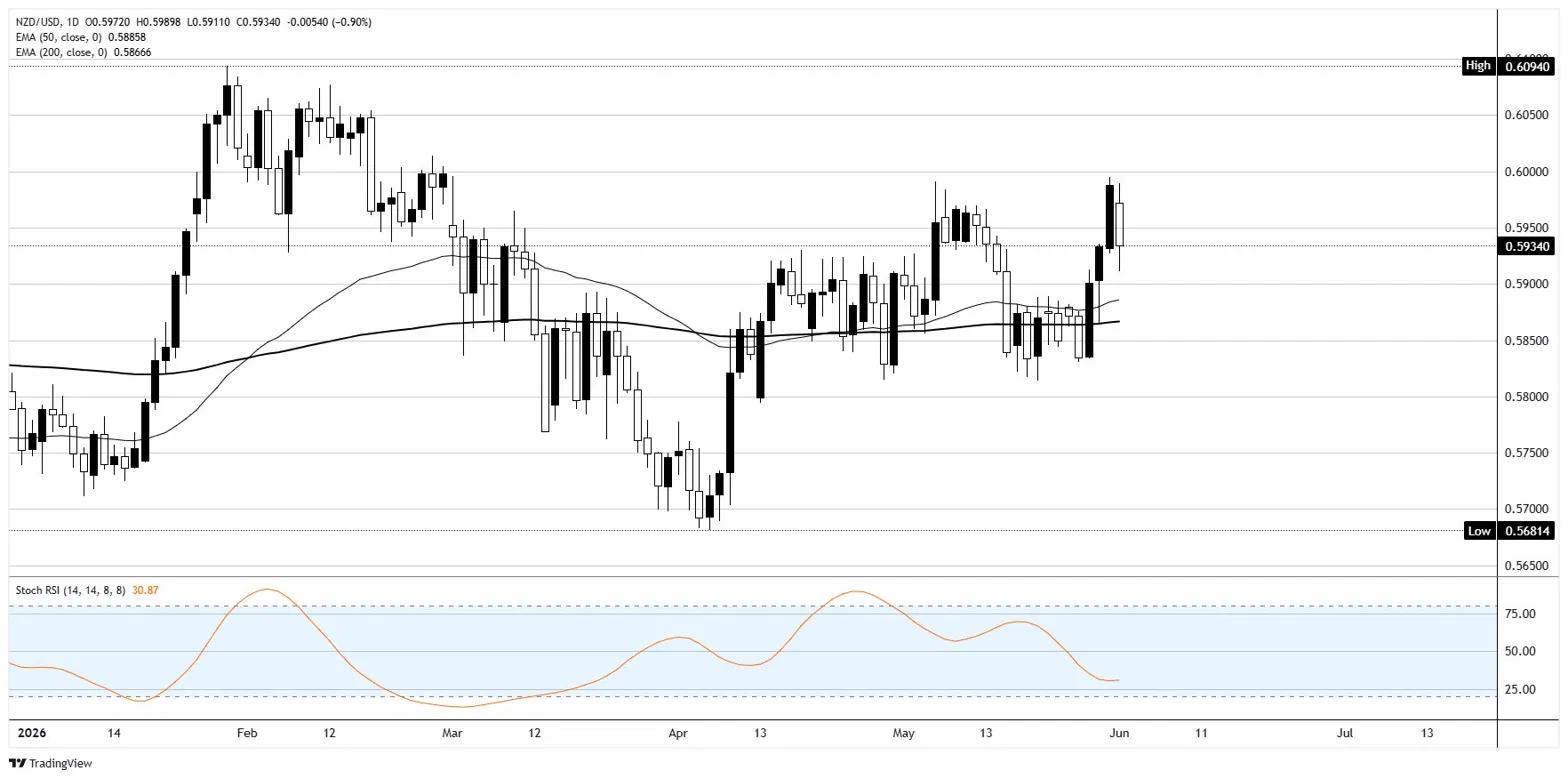
NZD/USD is still holding above both daily moving averages, with the 50-period Exponential Moving Average (EMA) near 0.5900 and the 200 EMA close to 0.5850, so the broader structure remains constructive. Momentum is another matter. The daily Stochastic Relative Strength Index (Stoch RSI) has rolled over from the upper band, and Monday's slide from just shy of 0.6000 back under 0.5950 looked like pre-event de-risking rather than any fundamental shift. The bounce off 0.5900 is encouraging, but this is a low-conviction tape waiting for a bigger number.
Levels and bias
The 0.5900 handle is the line in the sand, reinforced by the 50 EMA; a clean break below opens 0.5850 and the 200 EMA. Topside, 0.5950 is the immediate cap, with the 0.6000 handle the level bulls must reclaim to argue the RBNZ tailwind is finally winning the argument. Bias is neutral-to-constructive above 0.5900, but hostage to US data.
The US labor gauntlet
The week is front-loaded with US releases that will set the Kiwi's direction by proxy. The Job Openings and Labor Turnover Survey (JOLTS) lands Tuesday, the Automatic Data Processing (ADP) employment report Wednesday, and the main event, Nonfarm Payrolls (NFP), on Friday at 12:30 GMT, with consensus looking for roughly 85K jobs against 115K previously and the unemployment rate seen steady near 4.3%. A soft headline would revive Federal Reserve (Fed) rate-cut bets and finally let the RBNZ's relative hawkishness show through in NZD/USD. A beat, like April's, leaves the Kiwi leaning on its own central bank against a Dollar that refuses to fold. Australian Gross Domestic Product (GDP) on Wednesday is a secondary regional risk worth a glance.
NZD/USD daily chart
New Zealand Dollar FAQs
The New Zealand Dollar (NZD), also known as the Kiwi, is a well-known traded currency among investors. Its value is broadly determined by the health of the New Zealand economy and the country’s central bank policy. Still, there are some unique particularities that also can make NZD move. The performance of the Chinese economy tends to move the Kiwi because China is New Zealand’s biggest trading partner. Bad news for the Chinese economy likely means less New Zealand exports to the country, hitting the economy and thus its currency. Another factor moving NZD is dairy prices as the dairy industry is New Zealand’s main export. High dairy prices boost export income, contributing positively to the economy and thus to the NZD.
The Reserve Bank of New Zealand (RBNZ) aims to achieve and maintain an inflation rate between 1% and 3% over the medium term, with a focus to keep it near the 2% mid-point. To this end, the bank sets an appropriate level of interest rates. When inflation is too high, the RBNZ will increase interest rates to cool the economy, but the move will also make bond yields higher, increasing investors’ appeal to invest in the country and thus boosting NZD. On the contrary, lower interest rates tend to weaken NZD. The so-called rate differential, or how rates in New Zealand are or are expected to be compared to the ones set by the US Federal Reserve, can also play a key role in moving the NZD/USD pair.
Macroeconomic data releases in New Zealand are key to assess the state of the economy and can impact the New Zealand Dollar’s (NZD) valuation. A strong economy, based on high economic growth, low unemployment and high confidence is good for NZD. High economic growth attracts foreign investment and may encourage the Reserve Bank of New Zealand to increase interest rates, if this economic strength comes together with elevated inflation. Conversely, if economic data is weak, NZD is likely to depreciate.
The New Zealand Dollar (NZD) tends to strengthen during risk-on periods, or when investors perceive that broader market risks are low and are optimistic about growth. This tends to lead to a more favorable outlook for commodities and so-called ‘commodity currencies’ such as the Kiwi. Conversely, NZD tends to weaken at times of market turbulence or economic uncertainty as investors tend to sell higher-risk assets and flee to the more-stable safe havens.














