

NZD/USD hamstrung near 0.6050 with US NFP in the barrel
작성자 Joshua Gibson
게시일: 11 Feb 2026 | 수정일: 11 Feb 2026


인기 기사

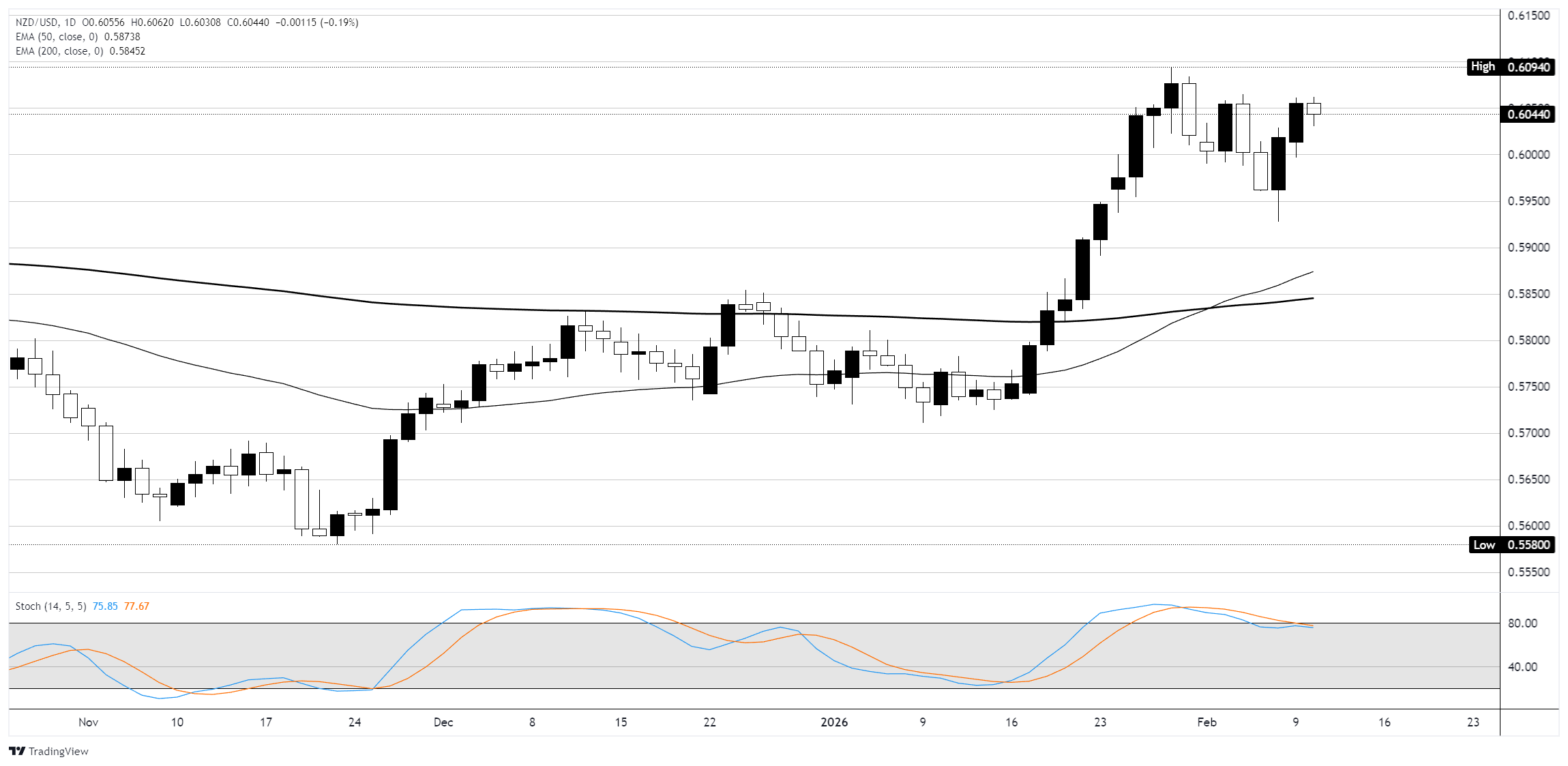
The New Zealand Dollar is trading in a well-defined uptrend on the daily chart, with price holding above both the 50 Exponential Moving Average (EMA) at 0.5874 and the 200 EMA at 0.5845 after a strong rally from the late November low near 0.5580.
- NZD/USD churned the charts on Tuesday as markets brace for a midweek data hit.
- A fresh push into the bullish side will see Kiwi knocking on six-month highs north of 0.6100.
The New Zealand Dollar is trading in a well-defined uptrend on the daily chart, with price holding above both the 50 Exponential Moving Average (EMA) at 0.5874 and the 200 EMA at 0.5845 after a strong rally from the late November low near 0.5580. NZD/USD posted a high of 0.6094 in late January before entering a consolidation phase between roughly 0.6000 and 0.6094 over the past two weeks, with Monday's session closing at 0.6043, down 0.21% on the day.
The pair has been carving out a series of higher lows since early December, with the 50 EMA crossing above the 200 EMA to confirm bullish trend structure. A mixed New Zealand employment report last week, showing unemployment rising to a decade high at 5.4% while employment growth beat expectations at 0.5%, has kept the Reserve Bank of New Zealand (RBNZ) rate hike timeline uncertain, with markets now pricing the first move no earlier than October. The RBNZ meets next Wednesday, February 18, for its first Monetary Policy Statement under new Governor Anna Breman, with the Official Cash Rate (OCR) widely expected to hold at 2.25%.
The Stochastic Oscillator (14, 5, 5) is sitting just below the overbought threshold at 80, suggesting upside momentum is stalling near the top of the recent range. Immediate resistance sits at the 2026 high of 0.6094, with a clean break above that level opening the door toward the 52-week high near 0.6122. On the downside, the 0.6000 psychological level serves as the first support, followed by 0.5950 and the 50 EMA at 0.5874.
The key near-term catalyst for this pair arrives Wednesday with the delayed release of January Non-Farm Payrolls (NFP) data from the Bureau of Labor Statistics (BLS), originally scheduled for February 6 but postponed to February 11 following the partial government shutdown. Consensus expects a 70K gain versus December's 50K, alongside the annual benchmark revision, unemployment rate data (consensus 4.4%), and average hourly earnings (consensus 0.3% MoM, 3.6% YoY). Three Federal Reserve (Fed) speakers (Schmid, Bowman, Hammack) are also on the calendar Wednesday, amplifying the potential for sharp US Dollar moves that could push NZD/USD toward either end of its current 0.6000 to 0.6094 range.
NZD/USD daily chart
New Zealand Dollar FAQs
The New Zealand Dollar (NZD), also known as the Kiwi, is a well-known traded currency among investors. Its value is broadly determined by the health of the New Zealand economy and the country’s central bank policy. Still, there are some unique particularities that also can make NZD move. The performance of the Chinese economy tends to move the Kiwi because China is New Zealand’s biggest trading partner. Bad news for the Chinese economy likely means less New Zealand exports to the country, hitting the economy and thus its currency. Another factor moving NZD is dairy prices as the dairy industry is New Zealand’s main export. High dairy prices boost export income, contributing positively to the economy and thus to the NZD.
The Reserve Bank of New Zealand (RBNZ) aims to achieve and maintain an inflation rate between 1% and 3% over the medium term, with a focus to keep it near the 2% mid-point. To this end, the bank sets an appropriate level of interest rates. When inflation is too high, the RBNZ will increase interest rates to cool the economy, but the move will also make bond yields higher, increasing investors’ appeal to invest in the country and thus boosting NZD. On the contrary, lower interest rates tend to weaken NZD. The so-called rate differential, or how rates in New Zealand are or are expected to be compared to the ones set by the US Federal Reserve, can also play a key role in moving the NZD/USD pair.
Macroeconomic data releases in New Zealand are key to assess the state of the economy and can impact the New Zealand Dollar’s (NZD) valuation. A strong economy, based on high economic growth, low unemployment and high confidence is good for NZD. High economic growth attracts foreign investment and may encourage the Reserve Bank of New Zealand to increase interest rates, if this economic strength comes together with elevated inflation. Conversely, if economic data is weak, NZD is likely to depreciate.
The New Zealand Dollar (NZD) tends to strengthen during risk-on periods, or when investors perceive that broader market risks are low and are optimistic about growth. This tends to lead to a more favorable outlook for commodities and so-called ‘commodity currencies’ such as the Kiwi. Conversely, NZD tends to weaken at times of market turbulence or economic uncertainty as investors tend to sell higher-risk assets and flee to the more-stable safe havens.

100만 명이 넘는 사용자가 FXStreet를 통해 실시간 시장 데이터, 차트 도구, 전문가 인사이트, 포렉스 뉴스를 이용합니다. 포괄적인 경제 캘린더와 교육 웨비나는 트레이더가 정보를 유지하고 신중한 결정을 내리도록 돕습니다. FXStreet는 바르셀로나 본사와 전 세계 지역에 걸쳐 약 60명의 팀으로 구성되어 있습니다.
더 읽기








