

Pound Sterling sleepwalks toward Bailey, not PCE
- The Fed and BoE now sit at the same policy rate, neutralizing the usual rate-differential lever.
- Thursday's PCE print is the loud event, but Friday's Bailey speech carries the asymmetric risk.
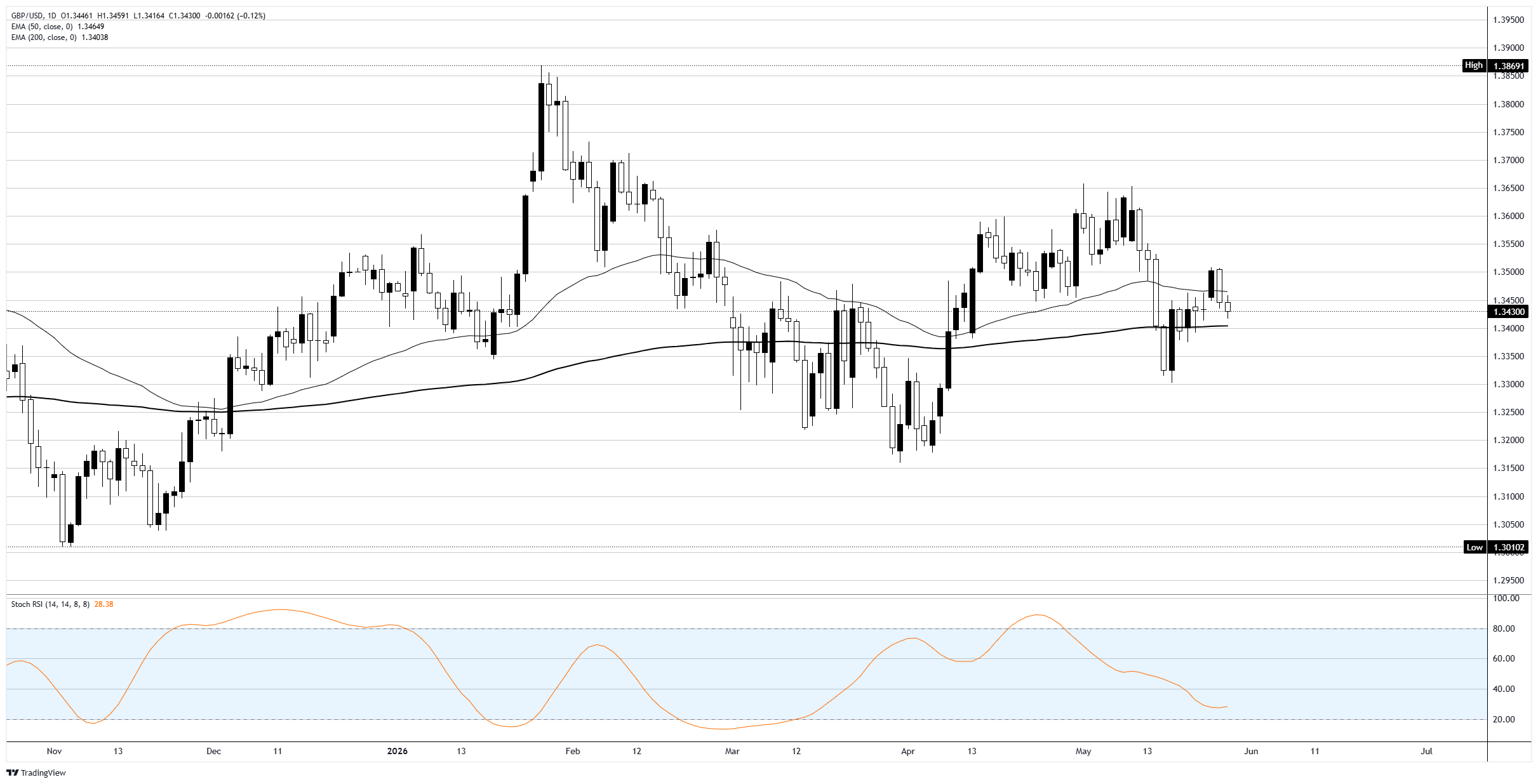
- Sterling trades near the 200 EMA on dailies, with Stoch RSI hinting at exhaustion in the slide.
Sterling traders are spending the week parsing the wrong calendar. The pair has drifted from around 1.3500 down toward 1.3400, and the consensus has tied that move to Thursday's US Core Personal Consumption Expenditures Price Index (PCE) print and the wall of Federal Reserve (Fed) speakers in between. The framing is convenient, but it misses what is actually on the table. The Fed's policy rate sits at 3.50-3.75%; the Bank of England (BoE) at 3.75%. Both central banks closed their April meetings with hawkish dissent. Both are absorbing the same energy-import shock out of the Middle East. Whatever rate-differential narrative usually drives the Pound has, for now, gone flat.
A policy mirror nobody is pricing
The Federal Open Market Committee (FOMC) split 8-4 in April, with three members opposing any easing bias and one preferring a cut. The BoE's Monetary Policy Committee (MPC) went 8-1 the same week, with the lone dissent voting to hike. Two committees, same direction of friction, same reluctance to commit. Rate-cut pricing into year-end has narrowed on both sides of the Atlantic, and the spread between the two policy paths is barely worth modelling. If Sterling has been bleeding lower, it is not because the Fed has out-hawked the BoE. It is because the UK runs a deeper energy import bill, and the market has decided that is a Pound problem rather than a Dollar one. Whether that judgement holds is the actual question this week.
Speakers who cannot move the curve
Kashkari and Logan headline the Fed roster Wednesday and Thursday, with Cook, Jefferson, Goolsbee, Williams and Musalem filling out the rest. The market will parse every word. The market probably should not bother. Kashkari and Logan were two of the three April dissenters who pushed back against any easing bias, so any hawkish lean this week just rehydrates what is already in the futures curve. Cook tilts dovish but has been respectful of the inflation data. There is no version of this week where a Fed speaker meaningfully shifts the December dot. CME FedWatch already shows the path baked in, and the analyst consensus has stopped expecting fireworks from individual speeches.
PCE is the loud event, not the decisive one
Headline PCE consensus sits close to 3.8% YoY, core near 3.3% YoY, both lifted by the Iran-related Crude Oil shock that has been bleeding into the Consumer Price Index (CPI) for three months running. A hot print is the consensus expectation, which is precisely why a hot print is priced. An in-line read is the path of least resistance. The asymmetric move sits on Friday morning, when Governor Bailey takes the microphone. If Bailey acknowledges sticky service inflation and tacitly validates the April hike dissent, Sterling gets its first credible bid in weeks. If he pivots dovish to lean against the hawkish vote split, the 200 EMA breaks and the trend extends. That is the real fork.
Trade setup
Near 1.3400 sits the daily 200-period Exponential Moving Average (EMA), the practical floor of this drift. A clean break below 1.3350 opens 1.3300 and revives the bearish trend. Above 1.3450, momentum stalls into the 50 EMA, with 1.3500 the breakout trigger. The actionable bias into Thursday is range-trade-then-react: fade extension on an in-line PCE, keep powder dry for Bailey on Friday. The Stochastic Relative Strength Index (Stoch RSI) close to 28 on the daily argues the easy downside is behind, not ahead.
GBP/USD daily chart
Pound Sterling FAQs
The Pound Sterling (GBP) is the oldest currency in the world (886 AD) and the official currency of the United Kingdom. It is the fourth most traded unit for foreign exchange (FX) in the world, accounting for 12% of all transactions, averaging $630 billion a day, according to 2022 data. Its key trading pairs are GBP/USD, also known as ‘Cable’, which accounts for 11% of FX, GBP/JPY, or the ‘Dragon’ as it is known by traders (3%), and EUR/GBP (2%). The Pound Sterling is issued by the Bank of England (BoE).
The single most important factor influencing the value of the Pound Sterling is monetary policy decided by the Bank of England. The BoE bases its decisions on whether it has achieved its primary goal of “price stability” – a steady inflation rate of around 2%. Its primary tool for achieving this is the adjustment of interest rates. When inflation is too high, the BoE will try to rein it in by raising interest rates, making it more expensive for people and businesses to access credit. This is generally positive for GBP, as higher interest rates make the UK a more attractive place for global investors to park their money. When inflation falls too low it is a sign economic growth is slowing. In this scenario, the BoE will consider lowering interest rates to cheapen credit so businesses will borrow more to invest in growth-generating projects.
Data releases gauge the health of the economy and can impact the value of the Pound Sterling. Indicators such as GDP, Manufacturing and Services PMIs, and employment can all influence the direction of the GBP. A strong economy is good for Sterling. Not only does it attract more foreign investment but it may encourage the BoE to put up interest rates, which will directly strengthen GBP. Otherwise, if economic data is weak, the Pound Sterling is likely to fall.
Another significant data release for the Pound Sterling is the Trade Balance. This indicator measures the difference between what a country earns from its exports and what it spends on imports over a given period. If a country produces highly sought-after exports, its currency will benefit purely from the extra demand created from foreign buyers seeking to purchase these goods. Therefore, a positive net Trade Balance strengthens a currency and vice versa for a negative balance.













