

Silver Price Forecast: XAG/USD sees fresh down leg below $55.60 amid firm Fed rate hike bets
- Silver price plunges to near $56.50 as Fed’s Williams warns of persistent inflationary pressures.
- The US core PCE inflation arrives higher at 3.4% YoY, as expected.
- The Fed is highly anticipated to deliver at least one interest rate hike this year.
Silver price (XAG/USD) is down 2.5% to near $56.50 during the Asian trading session on Friday. The white metal has been under pressure for the past few months as Middle East war-led elevated energy prices have pushed the United States (US) headline and core inflation, a scenario that encourages the Federal Reserve (Fed) to tighten monetary policy conditions, which bodes poorly for non-yielding assets, such as Silver.
The latest Consumer Price Index (CPI) report showed that the headline and the core inflation accelerated to 4.2% and 2.9% Year-on-Year (YoY) in May, respectively. The US headline inflation at 4.2% YoY is the highest level seen since April 2023.
On Thursday, the US core Personal Consumption Expenditure Price Index (PCE), which is the Fed’s preferred inflation gauge, also arrived higher at 3.4% YoY in May, as expected, from 3.3% in April.
New York Fed Bank President John Williams also said in a speech on Thursday that the monetary policy is “well-positioned” given high inflationary pressures. Williams stated that he expects “inflation to moderate to around 3.5% this year” and pushed back hopes of price pressures returning to the 2% target before 2028.
A significant price rise has prompted hopes of Fed interest rate hikes this year. According to the CME FedWatch tool, the odds of the Fed raising interest rates at least once this year are 81.7%, a sharp turnaround from the anticipation of two interest rate cuts before the Middle East war started.
Silver technical analysis
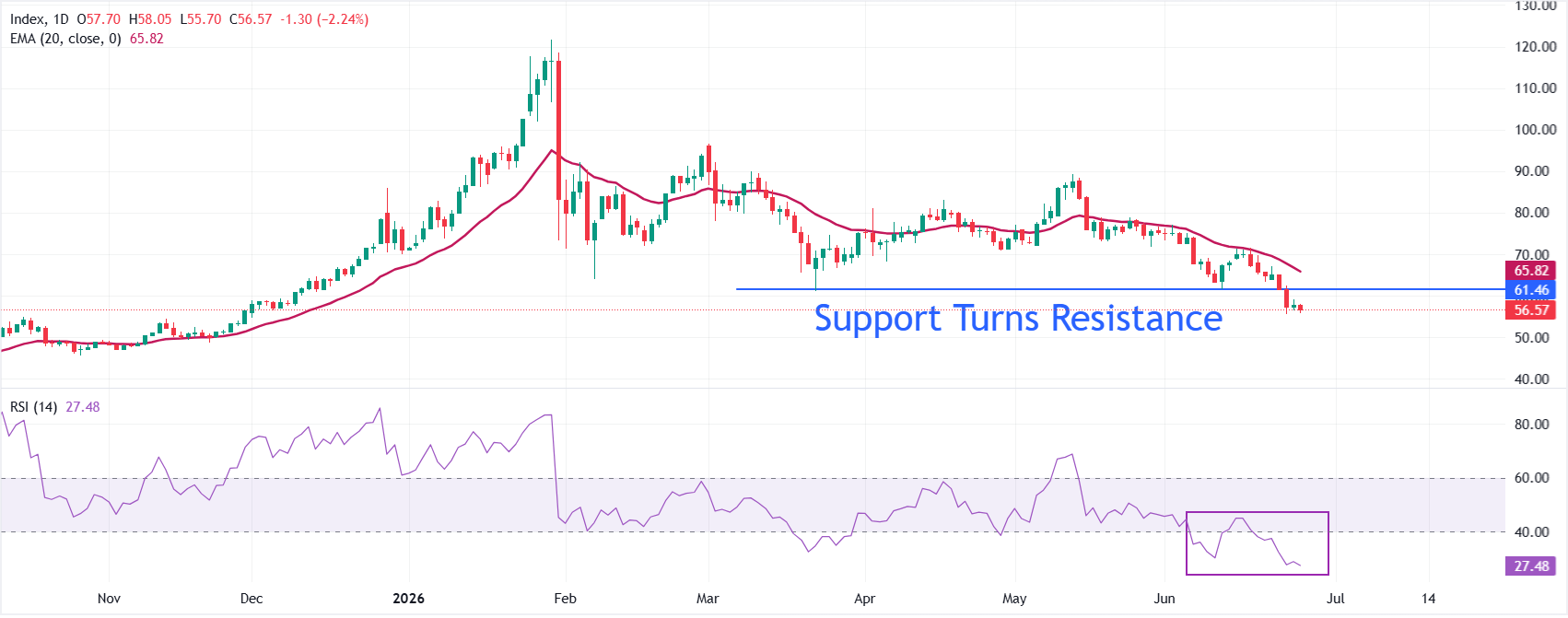
Bias: XAG/USD trades sharply lower at around $56.50, keeping a clear bearish near-term bias as price holds well beneath the 20-period exponential moving average (EMA) at $65.82. The metal has retreated sharply from prior highs, and the 20-day EMA now acts as an overhead cap that suggests rallies are likely to be sold while below this barrier.
Momentum: The Relative Strength Index (RSI) at 27.45 sits in oversold territory, hinting that while downside pressure dominates, the pace of the decline could slow and allow for intermittent corrective bounces.
Support: Looking down, the Silver price could slide towards the November 28 low at $53.35 if it extends its decline below the June 24 low at $55.63. A breakdown below $53.35 would expose the Silver price to the psychological level of $50.00.
Resistance: On the topside, the March 23 low at $61.01 is the key hurdle for Silver price bulls, followed by the 20-day EMA at $65.82.
(The technical analysis of this story was written with the help of an AI tool.)
Silver FAQs
Silver is a precious metal highly traded among investors. It has been historically used as a store of value and a medium of exchange. Although less popular than Gold, traders may turn to Silver to diversify their investment portfolio, for its intrinsic value or as a potential hedge during high-inflation periods. Investors can buy physical Silver, in coins or in bars, or trade it through vehicles such as Exchange Traded Funds, which track its price on international markets.
Silver prices can move due to a wide range of factors. Geopolitical instability or fears of a deep recession can make Silver price escalate due to its safe-haven status, although to a lesser extent than Gold's. As a yieldless asset, Silver tends to rise with lower interest rates. Its moves also depend on how the US Dollar (USD) behaves as the asset is priced in dollars (XAG/USD). A strong Dollar tends to keep the price of Silver at bay, whereas a weaker Dollar is likely to propel prices up. Other factors such as investment demand, mining supply – Silver is much more abundant than Gold – and recycling rates can also affect prices.
Silver is widely used in industry, particularly in sectors such as electronics or solar energy, as it has one of the highest electric conductivity of all metals – more than Copper and Gold. A surge in demand can increase prices, while a decline tends to lower them. Dynamics in the US, Chinese and Indian economies can also contribute to price swings: for the US and particularly China, their big industrial sectors use Silver in various processes; in India, consumers’ demand for the precious metal for jewellery also plays a key role in setting prices.
Silver prices tend to follow Gold's moves. When Gold prices rise, Silver typically follows suit, as their status as safe-haven assets is similar. The Gold/Silver ratio, which shows the number of ounces of Silver needed to equal the value of one ounce of Gold, may help to determine the relative valuation between both metals. Some investors may consider a high ratio as an indicator that Silver is undervalued, or Gold is overvalued. On the contrary, a low ratio might suggest that Gold is undervalued relative to Silver.














