


Top 3 Price Prediction: Bitcoin, Ethereum, Ripple – BTC recovers from support, ETH and XRP eyes bullish breakout
- Bitcoin price extends its recovery on Friday after finding support around the key level earlier this week.
- Ethereum nears the 23.6% Fibonacci retracement level at $2,138, a close above would suggest an upside move.
- XRP approaches the upper boundary of its falling channel, signaling a potential bullish breakout.
Bitcoin (BTC), Ethereum (ETH), and Ripple (XRP) extend their recovery on Friday after recent corrective moves. BTC is trading above $77,700 after finding support around major levels, and ETH is near the key resistance zone, where a breakout could trigger further rebounds. Meanwhile, XRP approaches its upper boundary of the falling channel; a close above signals a bullish move.

Bitcoin's major support holds strong
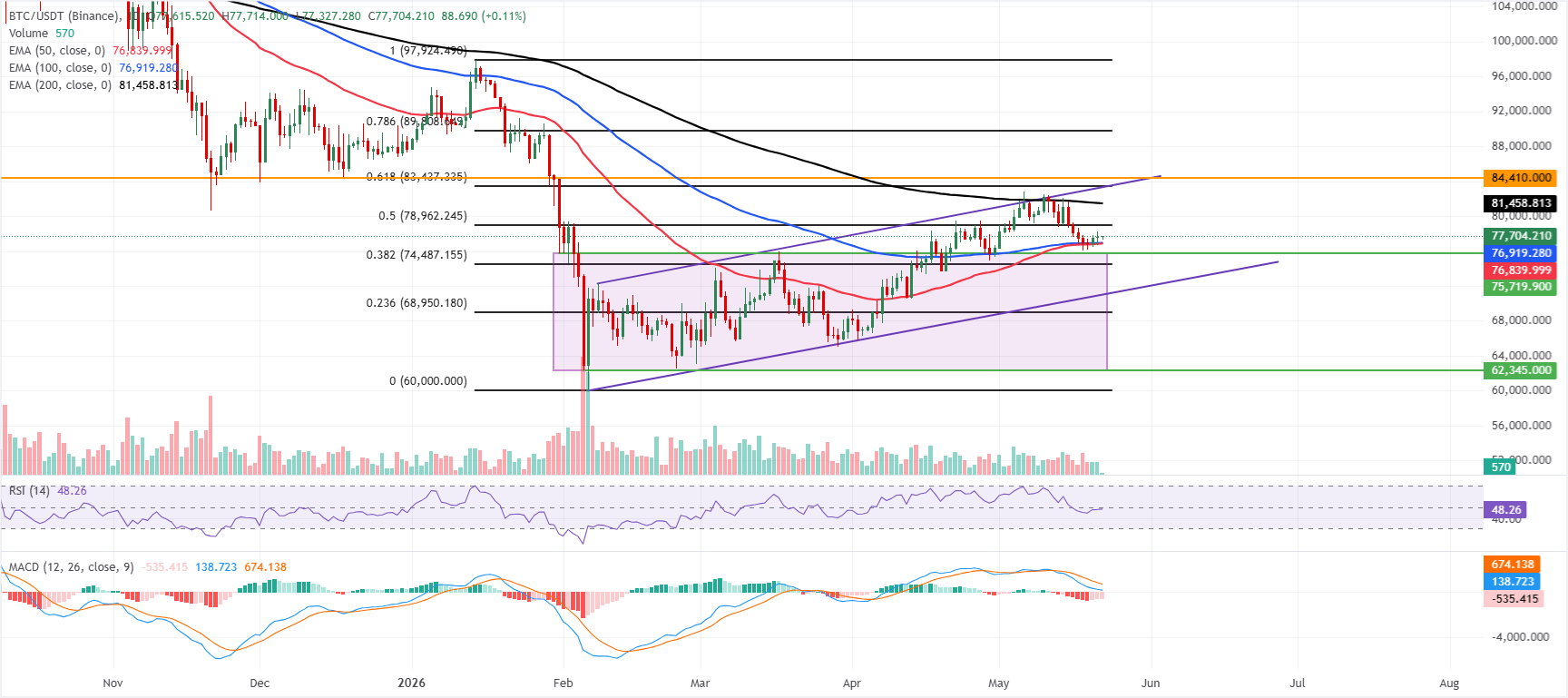
Bitcoin price extends its recovery, trading above $77,704 and holding above the 50- and 100-day Exponential Moving Averages (EMAs) near $76,840–$76,920, suggesting underlying dip-buying interest despite a dense topside cap.
The Crypto King is still pinned below the 200-day EMA at $81,458 and the 50% Fibonacci retracement of the latest swing at $78,962, leaving the broader structure in consolidation rather than in a clear breakout phase. The Relative Strength Index (RSI) hovers just below the 50 mark, while the Moving Average Convergence Divergence (MACD) remains in negative territory, suggesting that momentum is subdued and rallies could face selling pressure into overhead levels.
On the topside, initial resistance is located at the 50% Fibonacci retracement at $78,962, followed by the 200-day EMA at $81,458; a sustained move above these would open the way toward the 61.8% retracement at $83,437 and the horizontal barrier around $84,410.
On the downside, immediate support comes from the cluster of the 100-day EMA at $76,919 and the 50-day EMA at $76,840, with the 38.2% Fibonacci retracement at $74,487 next in line if those levels give way. A deeper slide would expose the former trendline break area around $70,995 and the 23.6% retracement near $68,950, where stronger medium-term demand would be expected to emerge.
Ethereum tests key resistance
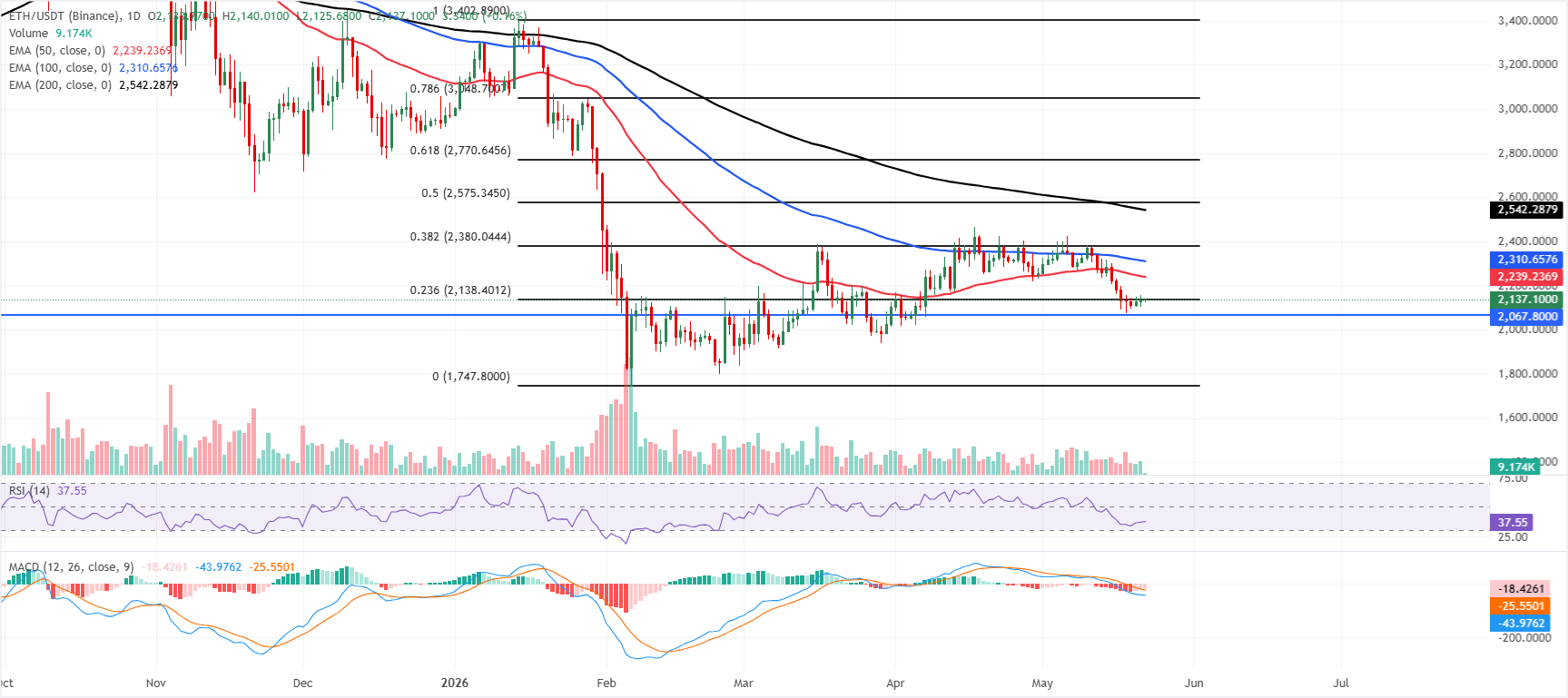
Ethereum trades at $2,137. Price remains below the 50-, 100-, and 200-day EMAs, which fan out well above the market and reinforce an overarching downtrend.
ETH is also capped almost immediately by the 23.6% Fibonacci retracement at roughly $2,138, underscoring the lack of topside traction after the recent slide. The RSI hovers just above 37, suggesting weak but not extreme downside pressure, while the negative MACD still hints at prevailing bearish momentum, though it has moderated from prior extremes.
On the upside, initial resistance is at the 23.6% Fibonacci retracement near $2,138, with further hurdles at the 50-day EMA near $2,239 and the 100-day EMA near $2,310. Above these, the 38.2% retracement near $2,380 and the distant 200-day EMA near the $2,542 mark are progressively stronger supply zones within the broader corrective structure.
On the downside, immediate support is seen at the horizontal level around $2,067, ahead of the more distant cycle low anchor near $1,748; a clear break under the former would likely expose the latter and extend the current bearish phase.
XRP could extend gains if it breaks above the channel pattern
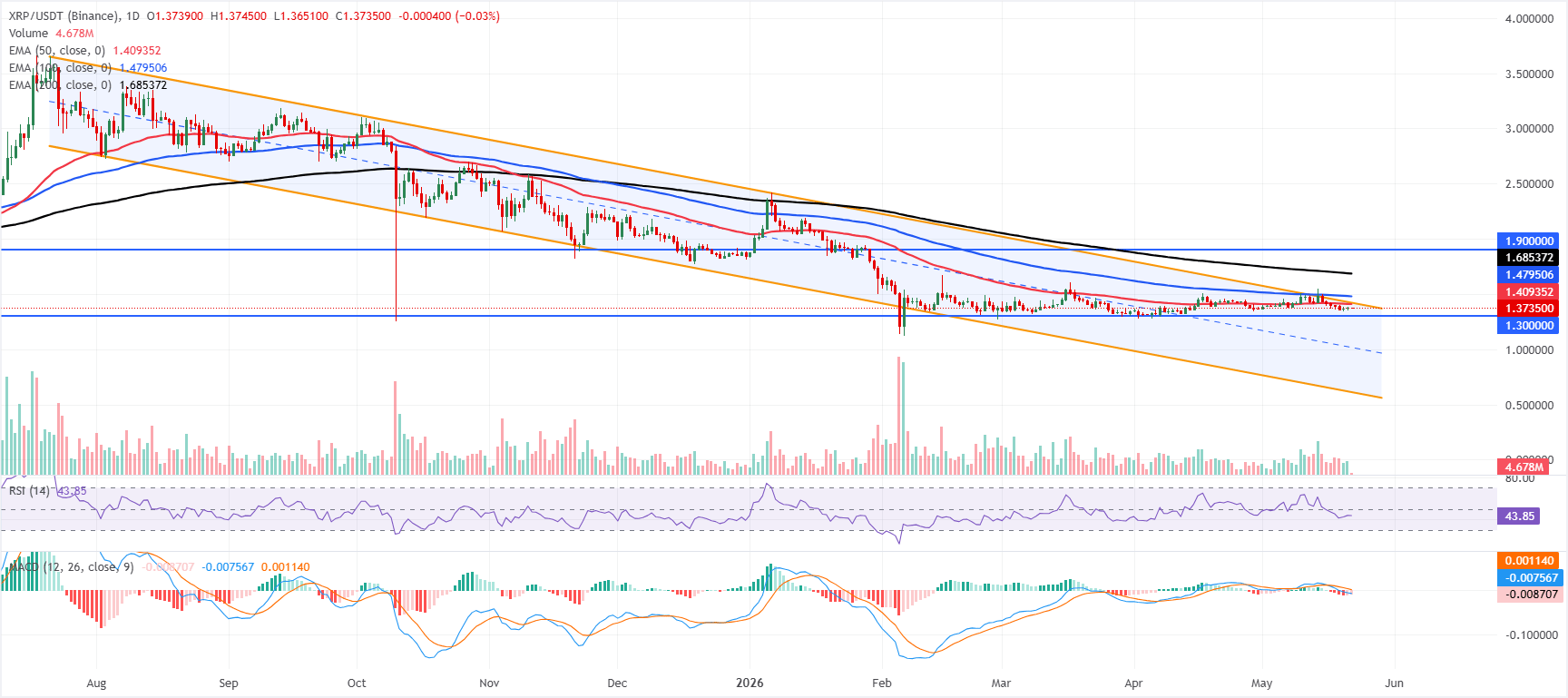
XRP price trades at $1.373, maintaining a bearish near-term bias as it holds below a stack of EMAs. The 50-day EMA at $1.409 is the first cap, reinforced by the upper boundary of the prevailing downward channel near $1.420, while the 100-day and 200-day EMAs at $1.479 and $1.685 sit higher and underscore a broader corrective phase.
Momentum backs this downward tone, with the RSI hovering around 43 in negative territory and the MACD below zero, hinting that rallies are likely to face selling pressure.
On the topside, immediate resistance is located at the 50-day EMA around $1.409, followed by the channel boundary near $1.420; a daily close above this area would be needed to ease the current pressure and expose the 100-day EMA at $1.479, ahead of the more distant 200-day EMA near $1.685 and the horizontal barrier at $1.900.
On the downside, initial support is seen at the horizontal level of $1.300, where a break lower would signal a continuation of the decline and open the door to deeper losses within the broader downtrend channel.
(The technical analysis of this story was written with the help of an AI tool.)
Cryptocurrency metrics FAQs
The developer or creator of each cryptocurrency decides on the total number of tokens that can be minted or issued. Only a certain number of these assets can be minted by mining, staking or other mechanisms. This is defined by the algorithm of the underlying blockchain technology. On the other hand, circulating supply can also be decreased via actions such as burning tokens, or mistakenly sending assets to addresses of other incompatible blockchains.
Market capitalization is the result of multiplying the circulating supply of a certain asset by the asset’s current market value.
Trading volume refers to the total number of tokens for a specific asset that has been transacted or exchanged between buyers and sellers within set trading hours, for example, 24 hours. It is used to gauge market sentiment, this metric combines all volumes on centralized exchanges and decentralized exchanges. Increasing trading volume often denotes the demand for a certain asset as more people are buying and selling the cryptocurrency.
Funding rates are a concept designed to encourage traders to take positions and ensure perpetual contract prices match spot markets. It defines a mechanism by exchanges to ensure that future prices and index prices periodic payments regularly converge. When the funding rate is positive, the price of the perpetual contract is higher than the mark price. This means traders who are bullish and have opened long positions pay traders who are in short positions. On the other hand, a negative funding rate means perpetual prices are below the mark price, and hence traders with short positions pay traders who have opened long positions.
인기 기사
1India Gold price today: Gold rises, according to FXStreet data2Ripple and Stellar outlook: Rebound from key technical supports as derivatives turn mildly bullish3GBP/USD Price Forecast: Defends 1.3200 as bears await two-week-old range breakdown4EUR/JPY Price Forecast: Remains below 177.00 as bearish bias prevails5Dogecoin Price Forecast: DOGE tests $0.0800 support level amid ETF outflows6Gold bounces off $4,150 amid modest USD pullback but stays in two-week-old range7Ripple-backed Evernorth goes live on Nasdaq with 473 million XRP treasury8Asian stock markets plunge, KOSPI faces bloodbath amid chip competition from China9Australian Dollar remains steady following RBA September Meeting Minutes
실시간 시세


TECHNICAL에 대한 모든 것
ICT 트레이딩이란 무엇인가요? 이너 서클 트레이더(Inner Circle Trader) 개념 설명
지지선과 저항선: 의미, 유형, 레벨을 그리는 방법 및 트레이딩 전략
유동성이란 무엇인가요? 트레이딩 및 금융시장에서의 의미
유동성 스윕: 의미, 예시 및 트레이딩 전략
트레이딩의 시장 구조: 완벽 가이드 (상승장, 하락장, 횡보장)
캐릭터 변화 (CHoCH): 정의, 예시 및 전략
강세 키커 패턴이란 무엇이며, 어떻게 트레이딩에 활용할 수 있을까요?
역망치형 캔들스틱 패턴이란 무엇이며, 이를 어떻게 트레이딩하나요?
강세형 버려진 아기형 패턴(Bullish Abandoned Baby Pattern)이란 무엇이며, 어떻게 트레이딩하나요?

소셜 미디어












이 웹사이트에 제공된 정보는 일반적인 성격의 정보일 뿐이며 개인 맞춤형 금융 자문을 구성하지 않습니다. 이 웹사이트의 정보를 바탕으로 행동하기 전에, 귀하의 목표, 재정 상황 및 필요에 비추어 해당 정보의 적합성을 고려해야 합니다. CFD 및 FX 마진 계약에 대한 투자는 상당한 위험을 수반하며 모든 투자자에게 적합하지 않을 수 있습니다. 귀하는 최초 예치금보다 더 큰 손실을 입을 수 있습니다. 귀하는 기초자산에 대한 소유권이나 어떠한 이해관계도 보유하지 않습니다. 거래를 시작하기 전에 독립적인 자문을 구하고 관련 위험을 충분히 이해하시기를 권장합니다. 웹사이트에 기재된 상품을 취득하기 전에 공시 문서를 읽고 검토하는 것이 중요합니다. 이 웹사이트에서 제공되는 정보 및 광고는 그러한 사용이 현지 법률 및 규정에 위배되는 국가 또는 관할권의 개인이 사용하도록 의도된 것이 아닙니다. 이 웹사이트에서 제공되는 상품 및 서비스는 미국, 말레이시아 및 태국 거주자를 대상으로 하지 않습니다.
TMGM은 다양한 관할권에서 승인 및 규제를 받고 있습니다.
TMGM으로 거래하는 Trademax Australia Limited는 호주 증권투자위원회(ASIC)의 규제를 받으며, AFSL 번호 436416이고 Level 28, One International Tower, 100 Barangaroo Avenue, 2000 Sydney, NSW Australia에 위치하고 있습니다.
이메일: support@tmgm.com.au
TMGM으로 거래하는 Trademax Global Limited는 바누아투 금융서비스위원회(VFSC)의 승인 및 규제를 받으며, 등록 번호 40356이고 1276, Kumul Highway, Port Vila, Vanuatu, Republic of Vanuatu에 등록되어 있습니다.
이메일: support@tmgm.com
Trademax Global Markets (SE) Limited(이하 TMGM)는 세이셸 금융청(FSA)의 인가 및 규제를 받으며, 허가 번호는 SD224입니다. 회사는 세이셸 마헤, 프로비던스 에스테이트 ABIS 센터, 사무실 번호 13에 등록되어 있습니다.
이메일: support@tmgm.com
TMGM으로 거래하는 Trademax Global Markets (International) Pty Ltd는 모리셔스 금융서비스위원회(FSC)의 승인 및 규제를 받으며 라이선스 번호 GB22201012이고, 33, Edith Cavell Street C/o IQ EQ Fund Services (Mauritius) Ltd Port Louis, 11324 Mauritius에 등록되어 있습니다.
이메일: support@tmgm.com
Copyright © TMGM. All rights reserved