

USD/CAD Price Forecast: Bears remain in control below 1.3700
- USD/CAD trades in a narrow range as softer Oil prices and a firm USD weigh on the Canadian Dollar.
- Technically, the pair maintains a bearish outlook, but momentum shows signs of stabilization.
- Markets await the US and Canada employment data due later this week for fresh direction.
The USD/CAD pair trades in a narrow range on Tuesday, with choppy price action as a mild pullback in Oil prices puts modest pressure on the commodity-linked Canadian Dollar (CAD). At the time of writing, the pair is trading around 1.3619 after hitting an intraday low of 1.3604.

Meanwhile, the US Dollar (USD) is holding firm, with ongoing tensions in the Middle East helping limit deeper declines in the Greenback and keeping the USD/CAD range-bound near recent lows. The US Dollar Index (DXY), which tracks the Greenback’s value against a basket of six major currencies, is trading around 98.45, virtually unchanged on the day.
The pair has remained under steady downside pressure since early April, with price action largely driven by the interplay between US Dollar dynamics and Oil prices. While the broader bias remains tilted to the downside, technical indicators point to a possible near-term consolidation or corrective bounce.
Traders now await employment data from both the US and Canada due on Friday, which could influence interest rate expectations and provide fresh direction for USD/CAD.
Technical Analysis:
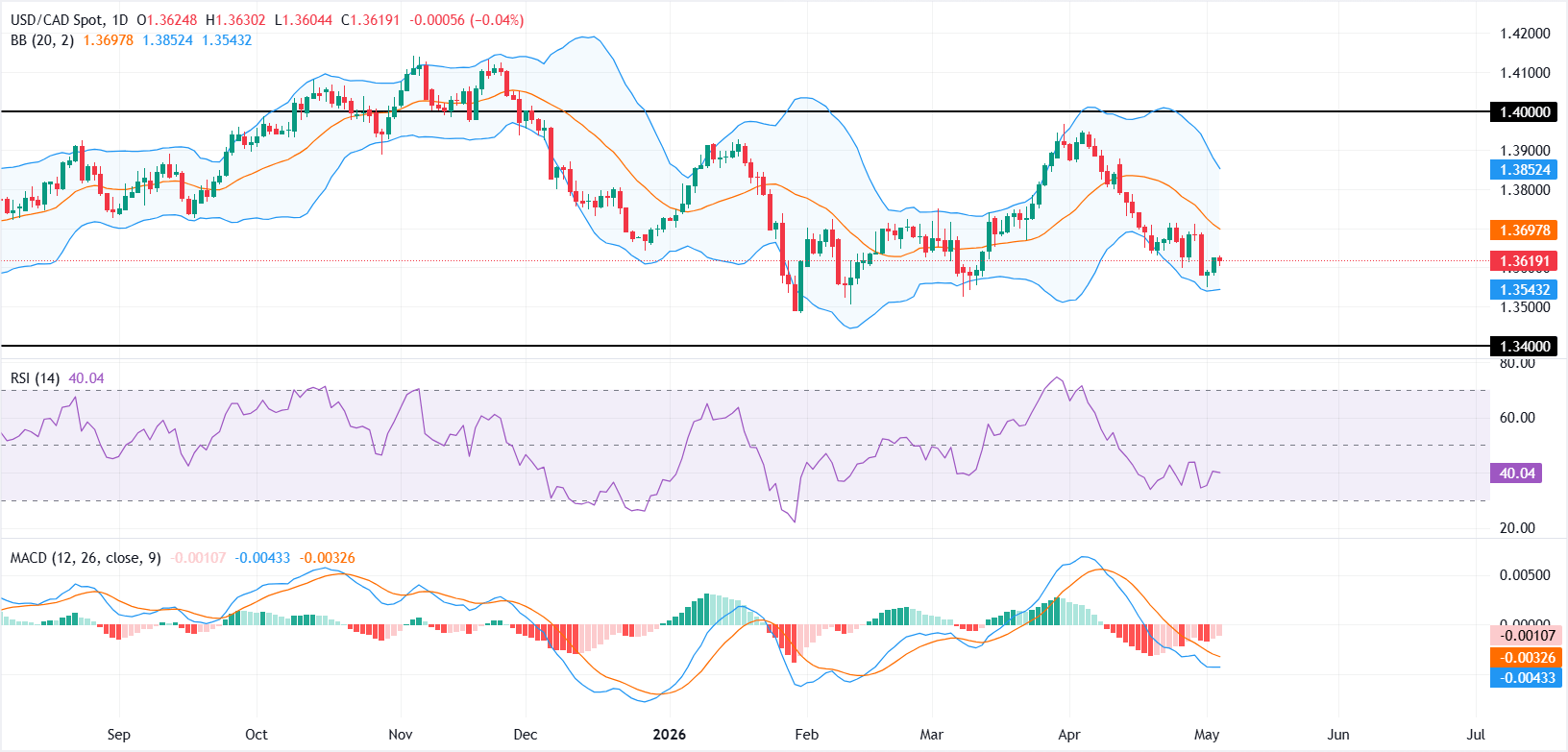
In the daily chart, USD/CAD trades with a bearish near-term tone as spot holds below the 20-day Simple Moving Average (SMA), aligned with the Bollinger Bands mid-line at 1.3697.
Momentum indicators are mixed, with the Relative Strength Index (RSI) hovering near 40, suggesting consolidation and weak momentum without entering oversold territory, while the Moving Average Convergence Divergence (MACD) remains in negative territory, with fading red histogram bars indicating easing bearish momentum.
On the topside, initial resistance is aligned with the Bollinger mid-line at 1.3697, ahead of the upper band near 1.3852, with a more substantial cap at the horizontal barrier around 1.4000.
On the downside, immediate support emerges at the lower Bollinger Band at 1.3543, with a break exposing the more distant horizontal floor at 1.3400, where stronger buying interest could reappear.
Canadian Dollar FAQs
The key factors driving the Canadian Dollar (CAD) are the level of interest rates set by the Bank of Canada (BoC), the price of Oil, Canada’s largest export, the health of its economy, inflation and the Trade Balance, which is the difference between the value of Canada’s exports versus its imports. Other factors include market sentiment – whether investors are taking on more risky assets (risk-on) or seeking safe-havens (risk-off) – with risk-on being CAD-positive. As its largest trading partner, the health of the US economy is also a key factor influencing the Canadian Dollar.
The Bank of Canada (BoC) has a significant influence on the Canadian Dollar by setting the level of interest rates that banks can lend to one another. This influences the level of interest rates for everyone. The main goal of the BoC is to maintain inflation at 1-3% by adjusting interest rates up or down. Relatively higher interest rates tend to be positive for the CAD. The Bank of Canada can also use quantitative easing and tightening to influence credit conditions, with the former CAD-negative and the latter CAD-positive.
The price of Oil is a key factor impacting the value of the Canadian Dollar. Petroleum is Canada’s biggest export, so Oil price tends to have an immediate impact on the CAD value. Generally, if Oil price rises CAD also goes up, as aggregate demand for the currency increases. The opposite is the case if the price of Oil falls. Higher Oil prices also tend to result in a greater likelihood of a positive Trade Balance, which is also supportive of the CAD.
While inflation had always traditionally been thought of as a negative factor for a currency since it lowers the value of money, the opposite has actually been the case in modern times with the relaxation of cross-border capital controls. Higher inflation tends to lead central banks to put up interest rates which attracts more capital inflows from global investors seeking a lucrative place to keep their money. This increases demand for the local currency, which in Canada’s case is the Canadian Dollar.
Macroeconomic data releases gauge the health of the economy and can have an impact on the Canadian Dollar. Indicators such as GDP, Manufacturing and Services PMIs, employment, and consumer sentiment surveys can all influence the direction of the CAD. A strong economy is good for the Canadian Dollar. Not only does it attract more foreign investment but it may encourage the Bank of Canada to put up interest rates, leading to a stronger currency. If economic data is weak, however, the CAD is likely to fall.













