

USD/CAD Price Forecast: Remains broadly sideways below 1.3800
작성자 Sagar Dua
게시일: 19 Dec 2025 | 수정일: 19 Dec 2025


인기 기사

The USD/CAD pair trades higher around 1.3790 in the early European trading session on Friday. The Loonie pair edges up as the US Dollar (USD) regains ground after being jolted by soft United States (US) Consumer Price Index (CPI) data for November.
- USD/CAD ticks up to near 1.3790 as the US Dollar trades higher.
- The US inflation grew at a moderate pace in November.
- Investors await the Canadian Retail Sales data for October.
The USD/CAD pair trades higher around 1.3790 in the early European trading session on Friday. The Loonie pair edges up as the US Dollar (USD) regains ground after being jolted by soft United States (US) Consumer Price Index (CPI) data for November.
As of writing, the US Dollar Index (DXY), which tracks the Greenback’s value against six major currencies, trades higher to near 98.60.
As measured by the CPI, the US headline inflation surprisingly came in lower at 2.7% year-on-year (YoY) on Thursday from 3% in October. Economists expected the inflation data to come in higher at 3.1%. The so-called core reading, which excludes volatile food and energy items, decelerated to 2.6% from estimates and the prior reading of 3%.
Meanwhile, the Canadian Dollar (CAD) trades cautiously ahead of the Retail Sales data for October, which will be published at 13:30 GMT. The Retail Sales data is expected to have remained flat on a monthly basis after contracting 0.7% in September.
USD/CAD technical analysis
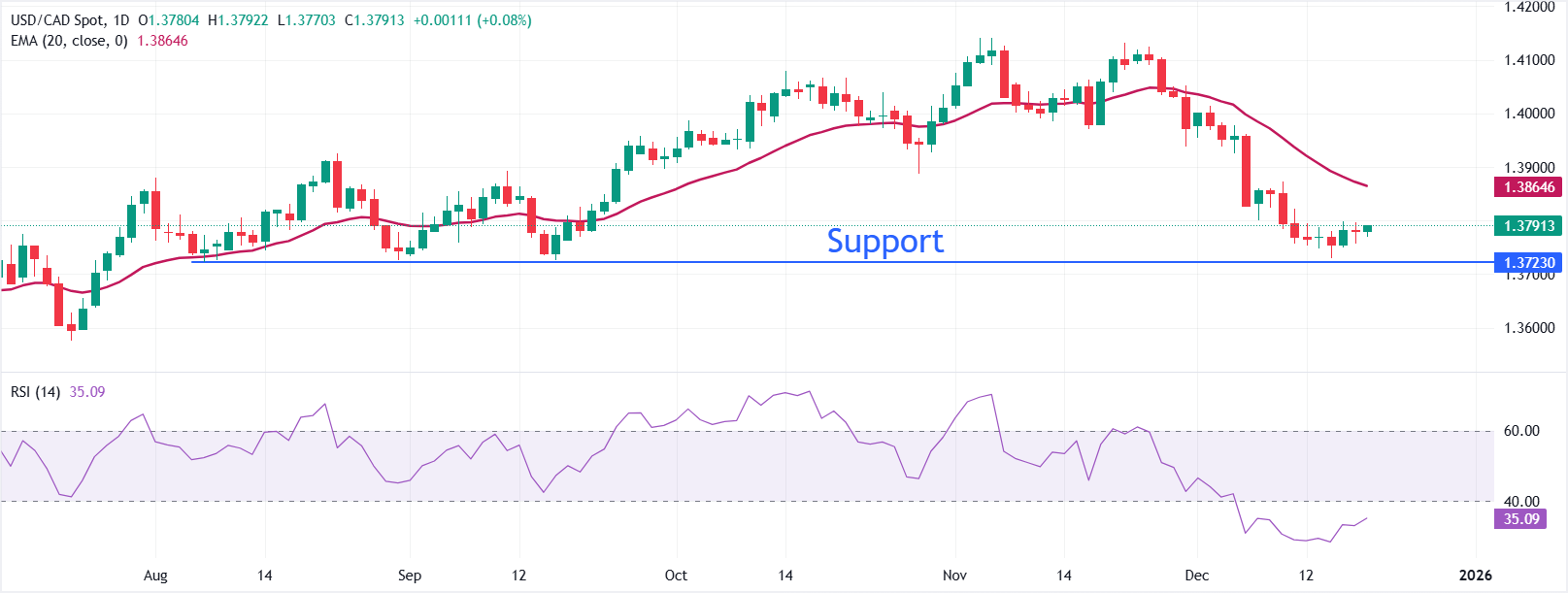
USD/CAD trades slightly higher to near 1.3790on Friday. The pair holds beneath a descending 20-day Exponential Moving Average (EMA), keeping the short-term bias tilted lower as bounces remain contained by the average. The EMA’s steady downturn underscores persistent supply on upticks. The 14-day Relative Strength Index (RSI) sits at 35.09, near oversold after a modest bounce from last week’s extremes, while momentum remains fragile.
A sustained recovery would require a daily close above the 20-day EMA to ease downside pressure that could increase the odds of an upside move towards the round-level figure of 1.3900. Until then, the downbeat setup persists and could strengthen if the spot breaks below the August 7 low of 1.3720.
(The technical analysis of this story was written with the help of an AI tool.)
US Dollar FAQs
The US Dollar (USD) is the official currency of the United States of America, and the ‘de facto’ currency of a significant number of other countries where it is found in circulation alongside local notes. It is the most heavily traded currency in the world, accounting for over 88% of all global foreign exchange turnover, or an average of $6.6 trillion in transactions per day, according to data from 2022. Following the second world war, the USD took over from the British Pound as the world’s reserve currency. For most of its history, the US Dollar was backed by Gold, until the Bretton Woods Agreement in 1971 when the Gold Standard went away.
The most important single factor impacting on the value of the US Dollar is monetary policy, which is shaped by the Federal Reserve (Fed). The Fed has two mandates: to achieve price stability (control inflation) and foster full employment. Its primary tool to achieve these two goals is by adjusting interest rates. When prices are rising too quickly and inflation is above the Fed’s 2% target, the Fed will raise rates, which helps the USD value. When inflation falls below 2% or the Unemployment Rate is too high, the Fed may lower interest rates, which weighs on the Greenback.
In extreme situations, the Federal Reserve can also print more Dollars and enact quantitative easing (QE). QE is the process by which the Fed substantially increases the flow of credit in a stuck financial system. It is a non-standard policy measure used when credit has dried up because banks will not lend to each other (out of the fear of counterparty default). It is a last resort when simply lowering interest rates is unlikely to achieve the necessary result. It was the Fed’s weapon of choice to combat the credit crunch that occurred during the Great Financial Crisis in 2008. It involves the Fed printing more Dollars and using them to buy US government bonds predominantly from financial institutions. QE usually leads to a weaker US Dollar.
Quantitative tightening (QT) is the reverse process whereby the Federal Reserve stops buying bonds from financial institutions and does not reinvest the principal from the bonds it holds maturing in new purchases. It is usually positive for the US Dollar.

100만 명이 넘는 사용자가 FXStreet를 통해 실시간 시장 데이터, 차트 도구, 전문가 인사이트, 포렉스 뉴스를 이용합니다. 포괄적인 경제 캘린더와 교육 웨비나는 트레이더가 정보를 유지하고 신중한 결정을 내리도록 돕습니다. FXStreet는 바르셀로나 본사와 전 세계 지역에 걸쳐 약 60명의 팀으로 구성되어 있습니다.
더 읽기








