

USD/CHF tests key technical level as Swiss Franc look for the next leg
작성자 Joshua Gibson
게시일: 11 Feb 2026 | 수정일: 11 Feb 2026


인기 기사

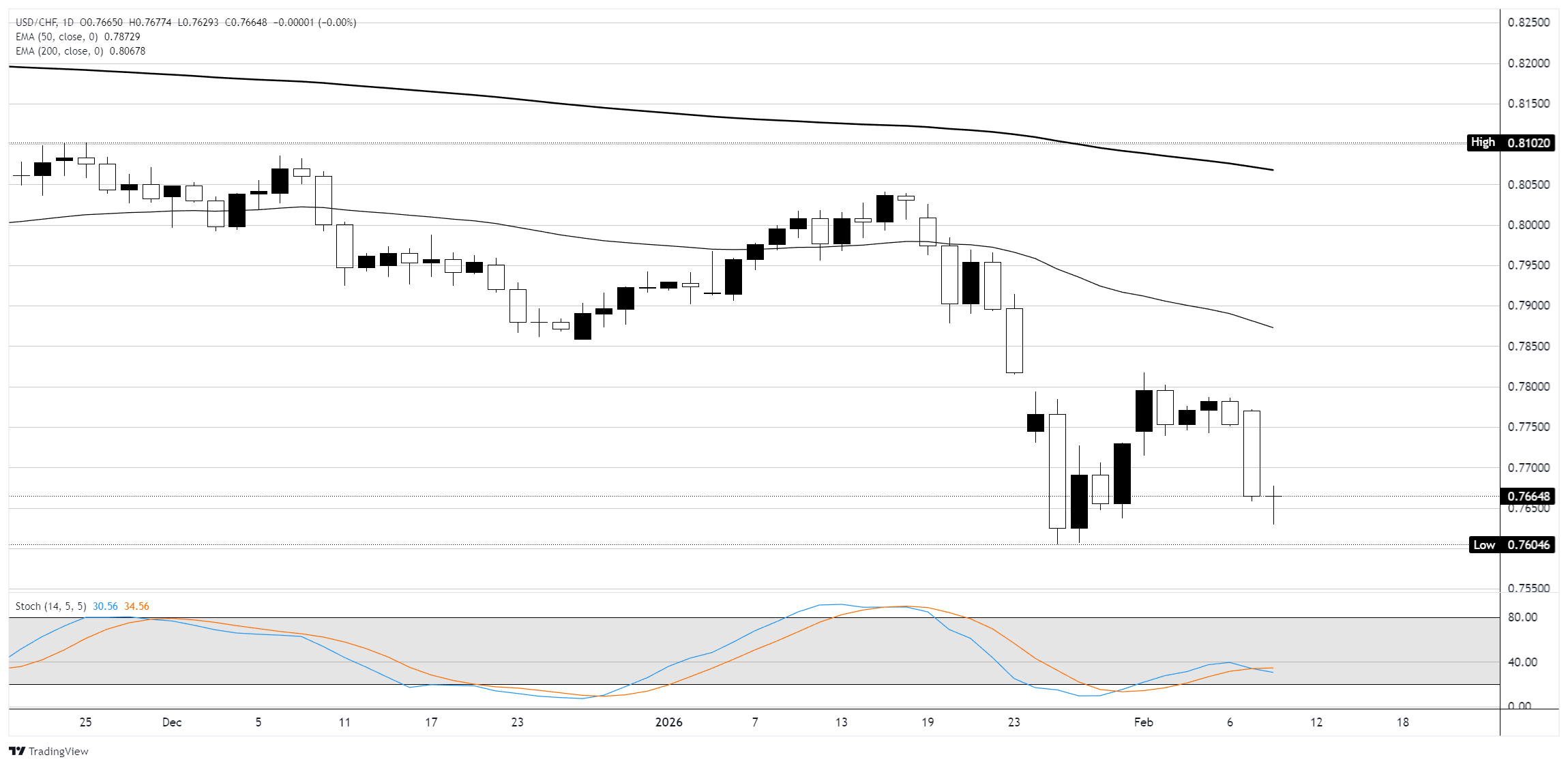
The US Dollar is continuing its slide against the Swiss Franc, with the daily chart showing a well-defined downtrend of lower highs and lower lows since the late November 2025 peak near 0.8102.
- USD/CHF bounced from 0.7650 as Swiss Franc bulls hit a brief stop.
- The Swiss Franc remains steeply higher against the US Dollar overall.
The US Dollar is continuing its slide against the Swiss Franc, with the daily chart showing a well-defined downtrend of lower highs and lower lows since the late November 2025 peak near 0.8102. Price is trading well below both the 50-day Exponential Moving Average (EMA) at 0.7873 and the 200-day EMA at 0.8068, confirming strong bearish structure across the higher timeframes. The pair fell to a low of 0.7605 in late January before staging a corrective bounce that carried price back toward the 0.7800 zone in early February. That recovery failed to hold, and selling pressure resumed as the pair rolled over from the 0.7950 area, which now acts as a key resistance zone aligned with the descending 50 EMA. Support at the January swing low near 0.7600 remains the critical floor for the broader downtrend.
On the shorter timeframes, USD/CHF slipped to 0.7629 on February 10 before bouncing back to close near 0.7665, printing a test and rejection of the 0.7650 area that has acted as a pivot through late January and early February price action. The Stochastic Oscillator (14, 5, 5) is reading 30.56/34.56, hovering just above oversold territory and showing no clear bullish crossover yet, suggesting downside momentum still holds the upper hand. A sustained break below 0.7600 would open the door toward the projected target at 0.7382, derived from the measured move of the larger decline from the 2022 highs. On the upside, any recovery attempt faces layered resistance at 0.7790 (prior support turned resistance) and the 50 EMA near 0.7873. Swiss Consumer Price Index (CPI) data due February 13 could inject fresh volatility, with the Swiss National Bank (SNB) closely watching inflation after Chairman Schlegel flagged potential foreign exchange intervention to manage Franc strength.
USD/CHF daily chart
Swiss Franc FAQs
The Swiss Franc (CHF) is Switzerland’s official currency. It is among the top ten most traded currencies globally, reaching volumes that well exceed the size of the Swiss economy. Its value is determined by the broad market sentiment, the country’s economic health or action taken by the Swiss National Bank (SNB), among other factors. Between 2011 and 2015, the Swiss Franc was pegged to the Euro (EUR). The peg was abruptly removed, resulting in a more than 20% increase in the Franc’s value, causing a turmoil in markets. Even though the peg isn’t in force anymore, CHF fortunes tend to be highly correlated with the Euro ones due to the high dependency of the Swiss economy on the neighboring Eurozone.
The Swiss Franc (CHF) is considered a safe-haven asset, or a currency that investors tend to buy in times of market stress. This is due to the perceived status of Switzerland in the world: a stable economy, a strong export sector, big central bank reserves or a longstanding political stance towards neutrality in global conflicts make the country’s currency a good choice for investors fleeing from risks. Turbulent times are likely to strengthen CHF value against other currencies that are seen as more risky to invest in.
The Swiss National Bank (SNB) meets four times a year – once every quarter, less than other major central banks – to decide on monetary policy. The bank aims for an annual inflation rate of less than 2%. When inflation is above target or forecasted to be above target in the foreseeable future, the bank will attempt to tame price growth by raising its policy rate. Higher interest rates are generally positive for the Swiss Franc (CHF) as they lead to higher yields, making the country a more attractive place for investors. On the contrary, lower interest rates tend to weaken CHF.
Macroeconomic data releases in Switzerland are key to assessing the state of the economy and can impact the Swiss Franc’s (CHF) valuation. The Swiss economy is broadly stable, but any sudden change in economic growth, inflation, current account or the central bank’s currency reserves have the potential to trigger moves in CHF. Generally, high economic growth, low unemployment and high confidence are good for CHF. Conversely, if economic data points to weakening momentum, CHF is likely to depreciate.
As a small and open economy, Switzerland is heavily dependent on the health of the neighboring Eurozone economies. The broader European Union is Switzerland’s main economic partner and a key political ally, so macroeconomic and monetary policy stability in the Eurozone is essential for Switzerland and, thus, for the Swiss Franc (CHF). With such dependency, some models suggest that the correlation between the fortunes of the Euro (EUR) and the CHF is more than 90%, or close to perfect.

100만 명이 넘는 사용자가 FXStreet를 통해 실시간 시장 데이터, 차트 도구, 전문가 인사이트, 포렉스 뉴스를 이용합니다. 포괄적인 경제 캘린더와 교육 웨비나는 트레이더가 정보를 유지하고 신중한 결정을 내리도록 돕습니다. FXStreet는 바르셀로나 본사와 전 세계 지역에 걸쳐 약 60명의 팀으로 구성되어 있습니다.
더 읽기








