

USD/MXN jumps above 17.70 as Middle East war spurs risk-off
- USD/MXN surges nearly 1% as geopolitical tensions lift the US Dollar.
- US Initial Jobless Claims steady at 213K while layoffs drop to 48.3K.
- Fed easing bets trimmed to 35 bps ahead of Friday’s US Nonfarm Payrolls.
The Mexican Peso (MXN) depreciates sharply on Thursday as hostilities intensify in the Middle East, triggering a flight to safety, which underpinned the US Dollar (USD). Additionally, solid jobs data in the US decreased the chances that the Federal Reserve (Fed) might cut rates twice this year. At the time of writing, the USD/MXN pair trades at 17.72, up more than 0.95%.

Flight to safety and strong US jobs data pressure the Mexican Peso
Market mood remains dismal as the US–Iran conflict entered its sixth day with no signs of a de-escalation. Tehran forces attacked two vessels on Thursday, while US President Donald Trump rejected the son of the Ayatollah to lead Iran.
Trump added that he would be involved in deciding Iran’s new leadership, Axios reported, while sirens heard in multiple Gulf nations paint a gloomy geopolitical scenario, which favors further US Dollar appreciation to the detriment of the Mexican currency.
The US Labor Department reported that Initial Jobless Claims totaled 213K for the week ending February 28, below the expected 215K, suggesting ongoing strength in the labor market.
Data from Challenger, Gray & Christmas indicated that announced layoffs dropped to 48,300 in February, a 55% decrease from January’s 108,435. Digging into the report, hiring plans soared 140% from January but were down 63% compared to last February.
Investors trimmed Fed dovish bets
Following the data, Richmond Fed President Thomas Barkin said inflation remains sticky and that recent labor market data was solid. He added that the balance of risks could change as recent inflation data raises questions about whether the central bank has fully won the battle against higher prices.
Money markets had priced in a less-dovish Fed, according to Prime Market Terminal data. A day ago, traders priced in 40 basis points (bps) of easing towards the year’s end, but it fell to 35 bps as of writing.
The Fed Beige Book highlighted those economic expectations “were optimistic” with most districts expecting “moderate growth.” Regarding the labor market, officials find conditions “generally stable,” yet the low-hiring, low-firing scenario persists.
Across the southern border, Gross Fixed Investment in Mexico was unchanged in December, after a -6.5% decline in November, but exceeded forecasts for a 2.8% drop, and was 0.5%, little changed.
Next week, traders will eye the release of Mexican inflation figures. In the US, Friday’s Nonfarm Payrolls for February is awaited, along with the unemployment rate.
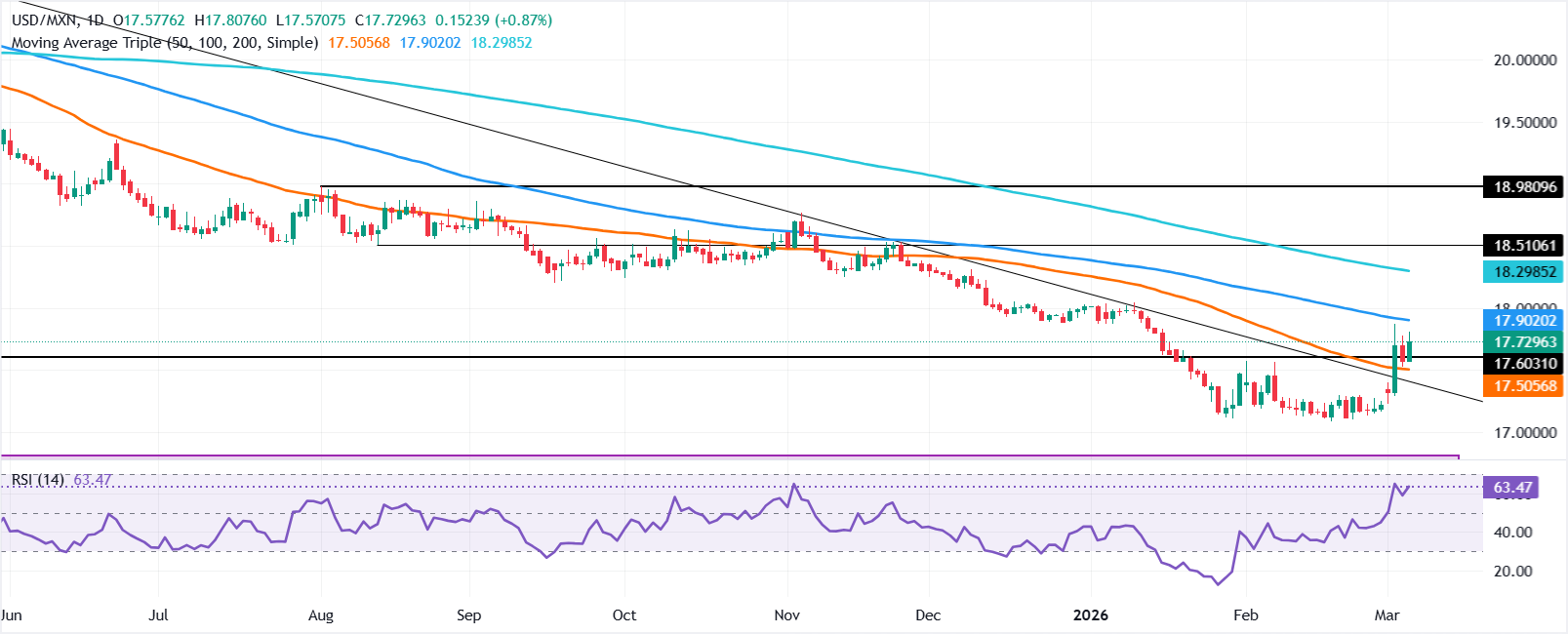
USD/MXN Price Forecast: Downtrend intact unless bulls reclaim 18.00
The USD/MXN technical picture is mixed. Although price action is respecting the market structure of lower-highs and lower-lows, the break of a resistance trendline drawn from around April’s 2025 highs near 21.07 broke on March 3, increasing speculation of an upward correction.
The Relative Strength Index (RSI) has been bullish, after spending time below its 50-neutral level since the end of November 2025, a sign that sellers are losing some strength. In addition to this, if the index clears the latest peak at 64.88, it will mean that buyers are stepping in.
For a bullish resumption, traders must clear the 100-day SMA at 17.90. If surpassed, the next key resistance is 18.00, followed by the 200-day SMA at 18.30. Downwards lies the 50- and 20-day SMAs, each at 17.49 and 17.26, respectively. On further weakness, the 17.00 figure is up next.
Mexican Peso FAQs
The Mexican Peso (MXN) is the most traded currency among its Latin American peers. Its value is broadly determined by the performance of the Mexican economy, the country’s central bank’s policy, the amount of foreign investment in the country and even the levels of remittances sent by Mexicans who live abroad, particularly in the United States. Geopolitical trends can also move MXN: for example, the process of nearshoring – or the decision by some firms to relocate manufacturing capacity and supply chains closer to their home countries – is also seen as a catalyst for the Mexican currency as the country is considered a key manufacturing hub in the American continent. Another catalyst for MXN is Oil prices as Mexico is a key exporter of the commodity.
The main objective of Mexico’s central bank, also known as Banxico, is to maintain inflation at low and stable levels (at or close to its target of 3%, the midpoint in a tolerance band of between 2% and 4%). To this end, the bank sets an appropriate level of interest rates. When inflation is too high, Banxico will attempt to tame it by raising interest rates, making it more expensive for households and businesses to borrow money, thus cooling demand and the overall economy. Higher interest rates are generally positive for the Mexican Peso (MXN) as they lead to higher yields, making the country a more attractive place for investors. On the contrary, lower interest rates tend to weaken MXN.
Macroeconomic data releases are key to assess the state of the economy and can have an impact on the Mexican Peso (MXN) valuation. A strong Mexican economy, based on high economic growth, low unemployment and high confidence is good for MXN. Not only does it attract more foreign investment but it may encourage the Bank of Mexico (Banxico) to increase interest rates, particularly if this strength comes together with elevated inflation. However, if economic data is weak, MXN is likely to depreciate.
As an emerging-market currency, the Mexican Peso (MXN) tends to strive during risk-on periods, or when investors perceive that broader market risks are low and thus are eager to engage with investments that carry a higher risk. Conversely, MXN tends to weaken at times of market turbulence or economic uncertainty as investors tend to sell higher-risk assets and flee to the more-stable safe havens.














