

WTI Oil rises to $98.00 with the US-Iran peace process stalled
- WTI Oil prices rally to two-week highs around $98.00 on Tuesday.
- The deadlocked US-Iran conflict is pushing Crude prices higher.
- UN chief Antonio Guterres warned about a global food emergency if the Strait of Hormuz remains closed.
Crude prices appreciated for the second consecutive day on Tuesday, with the US benchmark West Texas Intermediate (WTI) barrel changing hands at $98.00 at the time of writing, its highest price since April 13. Meanwhile, some reports say that US President Donald Trump disliked the peace proposal sent by Iran, which leaves the Middle East conflict deadlocked and the Strait of Hormuz closed for its ninth week.

News reported by Reuters, and citing a US official, explains that Trump was not satisfied with Iran’s peace plan as it does not address the nuclear program issue. US Secretary of Energy Chris Wright, however, affirmed earlier on Tuesday that the US president is focused on getting the right trade deal with Tehran and that they will announce “historic agreements today in Europe.”
Meanwhile, a waterway for 20% of global crude supply remains closed, pushing the price of the WTI barrel closer towards the $100 level, while the Brent trades at $111.21 at the time of writing. This has prompted several nations to call for a reopening of Hormuz, while the UN Secretary-General, Antonio Guterres, has warned of a global food emergency if the closure lasts long
Technical Analysis: Bulls are testing resistance around $98.00
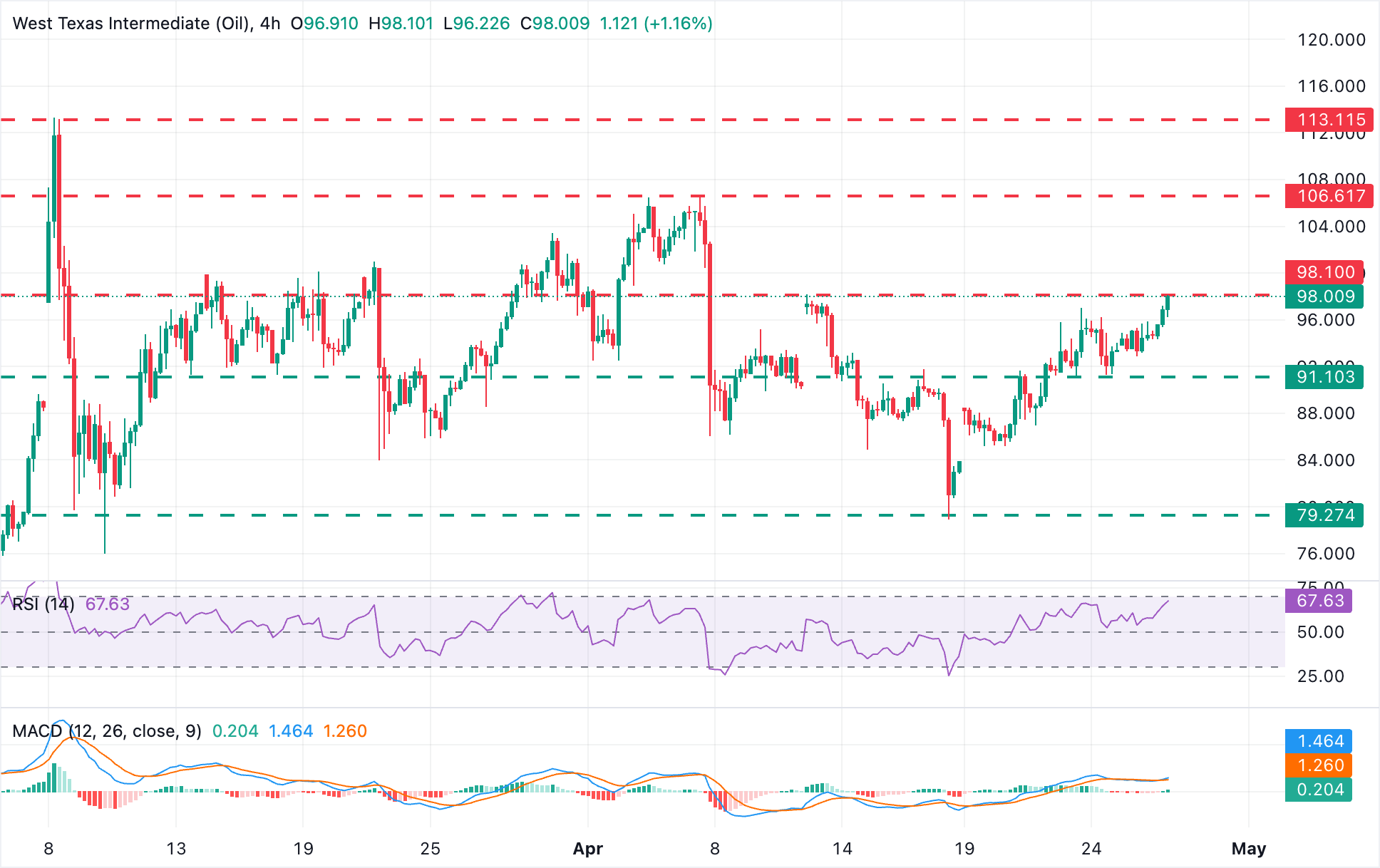
WTI US Oil keeps a firm bullish bias from mid-April lows below $80, with bulls testing levels at the $98.00 area. Technical indicators on the 4-hour chart support the bullish view as the Relative Strength Index (RSI) advances to 67, just below overbought territory, while the Moving Average Convergence Divergence (MACD) remains in positive territory, together suggesting persistent upside momentum.
A confirmation above April 12 highs at $98.15 would bring the $100.00 psychological level into focus. Further up, the next target emerges at the $106.60 area, where price action was capped on April 7.
On the downside, initial support is now aligned with the horizontal base at $91.10, which contained downside attempts on Thursday. A bearish reaction below here would expose last week's lows, near $85.20 ahead of the April 17 low, at $78.88.
(The technical analysis of this story was written with the help of an AI tool.)
WTI Oil FAQs
WTI Oil is a type of Crude Oil sold on international markets. The WTI stands for West Texas Intermediate, one of three major types including Brent and Dubai Crude. WTI is also referred to as “light” and “sweet” because of its relatively low gravity and sulfur content respectively. It is considered a high quality Oil that is easily refined. It is sourced in the United States and distributed via the Cushing hub, which is considered “The Pipeline Crossroads of the World”. It is a benchmark for the Oil market and WTI price is frequently quoted in the media.
Like all assets, supply and demand are the key drivers of WTI Oil price. As such, global growth can be a driver of increased demand and vice versa for weak global growth. Political instability, wars, and sanctions can disrupt supply and impact prices. The decisions of OPEC, a group of major Oil-producing countries, is another key driver of price. The value of the US Dollar influences the price of WTI Crude Oil, since Oil is predominantly traded in US Dollars, thus a weaker US Dollar can make Oil more affordable and vice versa.
The weekly Oil inventory reports published by the American Petroleum Institute (API) and the Energy Information Agency (EIA) impact the price of WTI Oil. Changes in inventories reflect fluctuating supply and demand. If the data shows a drop in inventories it can indicate increased demand, pushing up Oil price. Higher inventories can reflect increased supply, pushing down prices. API’s report is published every Tuesday and EIA’s the day after. Their results are usually similar, falling within 1% of each other 75% of the time. The EIA data is considered more reliable, since it is a government agency.
OPEC (Organization of the Petroleum Exporting Countries) is a group of 12 Oil-producing nations who collectively decide production quotas for member countries at twice-yearly meetings. Their decisions often impact WTI Oil prices. When OPEC decides to lower quotas, it can tighten supply, pushing up Oil prices. When OPEC increases production, it has the opposite effect. OPEC+ refers to an expanded group that includes ten extra non-OPEC members, the most notable of which is Russia.













