

Trade The World
AUDUSD Price Forecast: Momentum improves as AUDUSD tests the 50- and 100-day SMA cluster
작성자 Vishal Chaturvedi
게시일: 28 Nov 2025 | 수정일: 28 Nov 2025


POPULAR ARTICLES

The Australian Dollar (AUD) remains on the front foot against the US Dollar (USD) on Thursday, as traders lean into expectations that the Reserve Bank of Australia (RBA) will keep policy steady at its December meeting while maintaining a hawkish bias.
- The Aussie continues to outperform the US Dollar, with AUD/USD hovering near two-week highs as bullish momentum holds firm.
- Technically, AUD/USD is pressing into the top of its descending channel, where the 50-day and 100-day SMAs converge to cap upside attempts.
- Momentum improves as the MACD turns positive and the RSI holds comfortably in the mid-50s.
The Australian Dollar (AUD) remains on the front foot against the US Dollar (USD) on Thursday, as traders lean into expectations that the Reserve Bank of Australia (RBA) will keep policy steady at its December meeting while maintaining a hawkish bias. At the time of writing, AUD/USD is trading around 0.6530, extending gains for the sixth straight day.
Renewed upside momentum comes as markets scale back rate-cut bets after Australia’s latest inflation readings surprised to the upside, reinforcing expectations that the RBA will keep interest rates on hold again after leaving the official cash rate unchanged at 3.60% at its November meeting.
Against this backdrop, the broader weakness in the Greenback is amplifying demand for the Aussie, with traders growing increasingly confident that the Federal Reserve (Fed) will lower interest rates at its December 9-10 meeting.
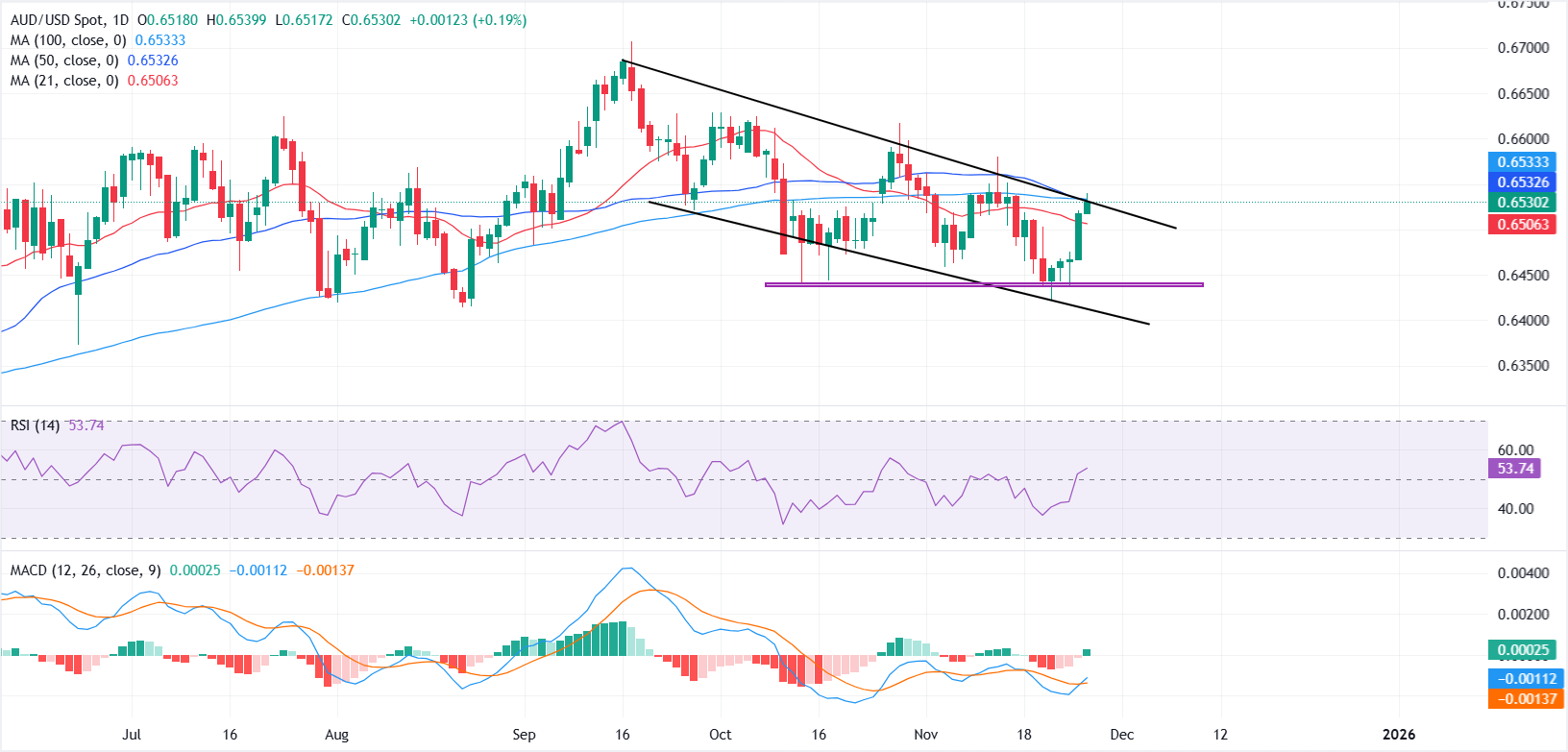
On the daily chart, AUD/USD continues to trade within a well-defined descending channel pattern, with the latest leg higher pressing firmly against the pattern’s upper boundary. This zone has now become a significant technical barrier, reinforced by the confluence of the 50-day and 100-day Simple Moving Averages (SMAs), both of which have repeatedly capped upside attempts throughout November.
A decisive breakout above this cluster would mark a meaningful shift in structure, effectively invalidating the broader bearish channel and opening the door toward the November 13 swing high at 0.6580, followed by the 0.6600 psychological mark.
Momentum indicators are turning increasingly supportive. The Moving Average Convergence Divergence (MACD) shows a bullish crossover near the zero line as the histogram turns positive. The Relative Strength Index (RSI) sits near 53, neutral-to-firm, backing an improving but still cautious momentum backdrop.
On the downside, the 21-day SMA near 0.6506 is positioned as immediate support and could cushion any pullbacks in the short term. A break below this level would expose 0.6450 as the next significant support area, ahead of a potential retest of the channel’s lower boundary.
RBA FAQs
The Reserve Bank of Australia (RBA) sets interest rates and manages monetary policy for Australia. Decisions are made by a board of governors at 11 meetings a year and ad hoc emergency meetings as required. The RBA’s primary mandate is to maintain price stability, which means an inflation rate of 2-3%, but also “..to contribute to the stability of the currency, full employment, and the economic prosperity and welfare of the Australian people.” Its main tool for achieving this is by raising or lowering interest rates. Relatively high interest rates will strengthen the Australian Dollar (AUD) and vice versa. Other RBA tools include quantitative easing and tightening.
While inflation had always traditionally been thought of as a negative factor for currencies since it lowers the value of money in general, the opposite has actually been the case in modern times with the relaxation of cross-border capital controls. Moderately higher inflation now tends to lead central banks to put up their interest rates, which in turn has the effect of attracting more capital inflows from global investors seeking a lucrative place to keep their money. This increases demand for the local currency, which in the case of Australia is the Aussie Dollar.
Macroeconomic data gauges the health of an economy and can have an impact on the value of its currency. Investors prefer to invest their capital in economies that are safe and growing rather than precarious and shrinking. Greater capital inflows increase the aggregate demand and value of the domestic currency. Classic indicators, such as GDP, Manufacturing and Services PMIs, employment, and consumer sentiment surveys can influence AUD. A strong economy may encourage the Reserve Bank of Australia to put up interest rates, also supporting AUD.
Quantitative Easing (QE) is a tool used in extreme situations when lowering interest rates is not enough to restore the flow of credit in the economy. QE is the process by which the Reserve Bank of Australia (RBA) prints Australian Dollars (AUD) for the purpose of buying assets – usually government or corporate bonds – from financial institutions, thereby providing them with much-needed liquidity. QE usually results in a weaker AUD.
Quantitative tightening (QT) is the reverse of QE. It is undertaken after QE when an economic recovery is underway and inflation starts rising. Whilst in QE the Reserve Bank of Australia (RBA) purchases government and corporate bonds from financial institutions to provide them with liquidity, in QT the RBA stops buying more assets, and stops reinvesting the principal maturing on the bonds it already holds. It would be positive (or bullish) for the Australian Dollar.

FXStreet
100만 명이 넘는 사용자가 FXStreet를 통해 실시간 시장 데이터, 차트 도구, 전문가 인사이트, 포렉스 뉴스를 이용합니다. 포괄적인 경제 캘린더와 교육 웨비나는 트레이더가 정보를 유지하고 신중한 결정을 내리도록 돕습니다. FXStreet는 바르셀로나 본사와 전 세계 지역에 걸쳐 약 60명의 팀으로 구성되어 있습니다.
Read More








