

Trade The World
Banxico minutes: Board turns cautious on future rate moves
작성자 Christian Borjon Valencia
게시일: 9 Jan 2026 | 수정일: 9 Jan 2026


POPULAR ARTICLES
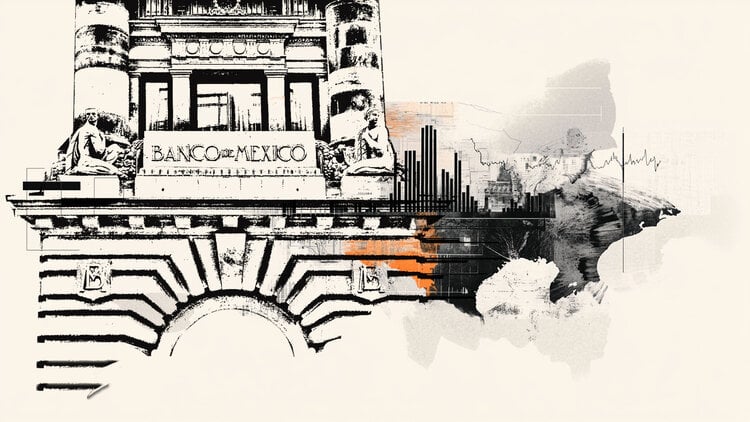
The Mexican central bank also known as Banxico, revealed the December meeting minutes on Thursday, and cautioned that they will adopt a gradual approach on future monetary policy decisions.
The Mexican central bank also known as Banxico, revealed the December meeting minutes on Thursday, and cautioned that they will adopt a gradual approach on future monetary policy decisions.
In December, Banxico cut interest rates by 25 basis points to 7% on a 4 to 1 vote split as the Deputy Governor Jonathan Heath voted to hold rates unchanged at 7.25%, arguing that inflation convergence towards the 3% plus or minus 1% remains uncertain, and noted that core inflation trend is still rising.
The board’s majority justified its decision based on a strong Peso, a weak economy and the recent progress on inflation. However, it turned cautious due to new taxes and tariff increases on imports into Mexico, exerting upwards pressure on prices.
Mexico imposed 50% tariffs on Chinese and other Asian countries, with which it does not have a trade agreement, aimed at boosting local industry, while also complying with US President Donald Trump demands to fortify the relations of the three north American countries.
Despite this, governors see the inflationary effects as temporary, but some flagged caution is required in case the effects put longer-term pressure on prices.
Regarding the economy, the minutes cited that economic activity remained weak in Q4 2025, and that GDP contracted -0.29% QoQ in Q3 2025.
Banxico FAQs
The Bank of Mexico, also known as Banxico, is the country’s central bank. Its mission is to preserve the value of Mexico’s currency, the Mexican Peso (MXN), and to set the monetary policy. To this end, its main objective is to maintain low and stable inflation within target levels – at or close to its target of 3%, the midpoint in a tolerance band of between 2% and 4%.
The main tool of the Banxico to guide monetary policy is by setting interest rates. When inflation is above target, the bank will attempt to tame it by raising rates, making it more expensive for households and businesses to borrow money and thus cooling the economy. Higher interest rates are generally positive for the Mexican Peso (MXN) as they lead to higher yields, making the country a more attractive place for investors. On the contrary, lower interest rates tend to weaken MXN. The rate differential with the USD, or how the Banxico is expected to set interest rates compared with the US Federal Reserve (Fed), is a key factor.
Banxico meets eight times a year, and its monetary policy is greatly influenced by decisions of the US Federal Reserve (Fed). Therefore, the central bank’s decision-making committee usually gathers a week after the Fed. In doing so, Banxico reacts and sometimes anticipates monetary policy measures set by the Federal Reserve. For example, after the Covid-19 pandemic, before the Fed raised rates, Banxico did it first in an attempt to diminish the chances of a substantial depreciation of the Mexican Peso (MXN) and to prevent capital outflows that could destabilize the country.

FXStreet
100만 명이 넘는 사용자가 FXStreet를 통해 실시간 시장 데이터, 차트 도구, 전문가 인사이트, 포렉스 뉴스를 이용합니다. 포괄적인 경제 캘린더와 교육 웨비나는 트레이더가 정보를 유지하고 신중한 결정을 내리도록 돕습니다. FXStreet는 바르셀로나 본사와 전 세계 지역에 걸쳐 약 60명의 팀으로 구성되어 있습니다.
Read More








