

Trade The World
Dow Jones Industrial Average falls 400 points as market tensions rise
작성자 Joshua Gibson
게시일: 3 Sep 2025 | 수정일: 3 Sep 2025


POPULAR ARTICLES

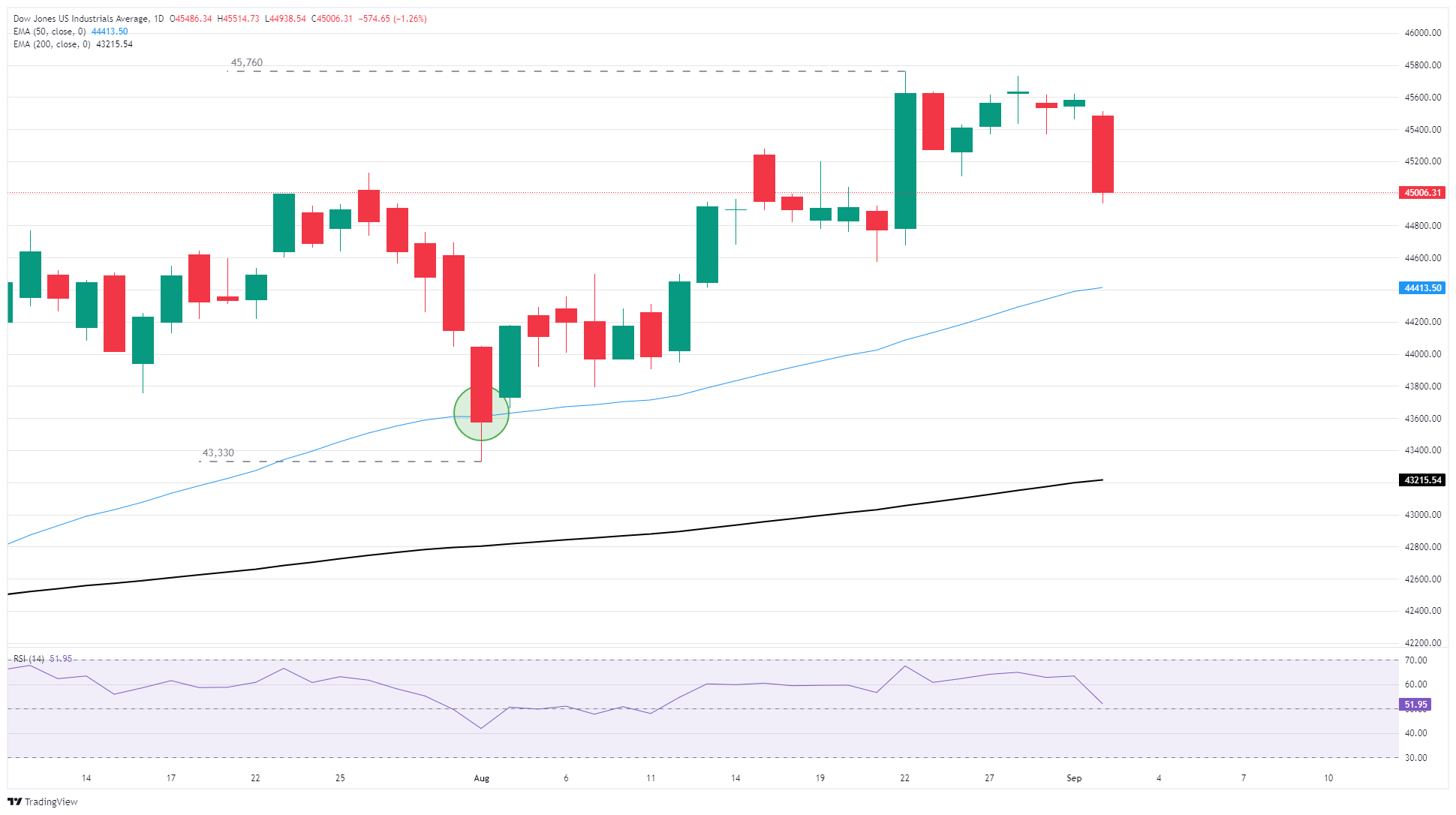
The Dow Jones Industrial Average (DJIA) shed around 550 points on Tuesday, with American markets returning from a long weekend with renewed selling pressure. Rising bond yields, government funding concerns, and fresh inflation concerns pummel investor sentiment through the overnight session.
- The Dow Jones declined heading into the first American market session of September.
- Renewed broad-market bond, government financing, and inflation concerns weigh on investors.
- US Manufacturing PMI figures showed a sixth straight month below 50 as tariffs weigh on companies.
The Dow Jones Industrial Average (DJIA) shed around 550 points on Tuesday, with American markets returning from a long weekend with renewed selling pressure. Rising bond yields, government funding concerns, and fresh inflation concerns pummel investor sentiment through the overnight session. US markets flubbed an attempt to right the equities ship after Institute for Supply Management (ISM) Manufacturing Purchasing Managers Index (PMI) figures showed a sixth straight month of contraction fears as firms continue to grapple with trade uncertainty.
Stocks shudder to start September
Equity markets took a hit through the overnight session after global bond markets saw rising yields, driven in no small part by fresh concerns about government financing and debt levels across most of the developed world. Bearish momentum extended into the American market session, dragging US equity indexes lower across the board. September is historically a bad month for equities, and the trend appears to be intact at the outset.
The ISM’s latest Manufacturing PMI rose to 48.7 in August, rebounding from the previous month’s 48 but still falling just shy of the expected 49. The PMI posted its sixth straight month below the investor-eyed 50.0 level. Digging into the details of the report, gains are mostly being driven by price increases as inventories empty faster than they can be refilled. Manufacturing companies are broadly avoiding extra hiring in the face of tumultuous trade policies from the Trump administration, crimping supply chain stability. Inventories that surged to multi-year highs in the first half of the year are beginning to run dry, and companies are competing for limited goods as manufacturers continue to throttle back output capacity.
ISM PMI respondents target tariffs
Respondents to ISM’s PMI survey specifically noted that tariff impacts are still looming over the horizon. Unexpected import tariff increases targeting Brazil and India, as well as the elimination of sugar quotas and the rapidly rising cost of construction goods, were specifically highlighted as causes for a growing dry-up in new order growth. Trucking backlogs are declining rapidly, with respondents noting that activity levels are now worse than they were during the 2008 global financial crisis.
JOLTS Job Openings from July are due on Wednesday, and will be followed by the ISM’s Services PMI component on Thursday, with US Nonfarm Payrolls (NFP) due on Friday. JOLTS have had a rough run as of late, with a poor correlation to US NFP figures over the past two years, but the private payroll estimator is set to take on renewed importance to investors who are rapidly losing faith in official figures. The Trump administration has been fast-tracking its strategy of sacking officials who allow unfavorable economic data to be published, putting pressure on investors to consider where they will get accurate data in the future.
Dow Jones daily chart
Economic Indicator
Nonfarm Payrolls
The Nonfarm Payrolls release presents the number of new jobs created in the US during the previous month in all non-agricultural businesses; it is released by the US Bureau of Labor Statistics (BLS). The monthly changes in payrolls can be extremely volatile. The number is also subject to strong reviews, which can also trigger volatility in the Forex board. Generally speaking, a high reading is seen as bullish for the US Dollar (USD), while a low reading is seen as bearish, although previous months' reviews and the Unemployment Rate are as relevant as the headline figure. The market's reaction, therefore, depends on how the market assesses all the data contained in the BLS report as a whole.
Read more.Next release: Fri Sep 05, 2025 12:30
Frequency: Monthly
Consensus: 75K
Previous: 73K
Source: US Bureau of Labor Statistics
America’s monthly jobs report is considered the most important economic indicator for forex traders. Released on the first Friday following the reported month, the change in the number of positions is closely correlated with the overall performance of the economy and is monitored by policymakers. Full employment is one of the Federal Reserve’s mandates and it considers developments in the labor market when setting its policies, thus impacting currencies. Despite several leading indicators shaping estimates, Nonfarm Payrolls tend to surprise markets and trigger substantial volatility. Actual figures beating the consensus tend to be USD bullish.

FXStreet
100만 명이 넘는 사용자가 FXStreet를 통해 실시간 시장 데이터, 차트 도구, 전문가 인사이트, 포렉스 뉴스를 이용합니다. 포괄적인 경제 캘린더와 교육 웨비나는 트레이더가 정보를 유지하고 신중한 결정을 내리도록 돕습니다. FXStreet는 바르셀로나 본사와 전 세계 지역에 걸쳐 약 60명의 팀으로 구성되어 있습니다.
Read More








