

Trade The World
EUR/CAD Price Forecast: Retains bullish bias above 1.6200
작성자 Lallalit Srijandorn
게시일: 9 Oct 2025 | 수정일: 9 Oct 2025


POPULAR ARTICLES

The EUR/CAD cross holds steady near 1.6225 during the early European session on Thursday. The political crisis in France after the shock resignation of France’s Prime Minister Sebastien Lecornu and his government could weigh on the Euro (EUR) against the Canadian Dollar (CAD).
- EUR/CAD trades flat around 1.6225 in Thursday’s early European session.
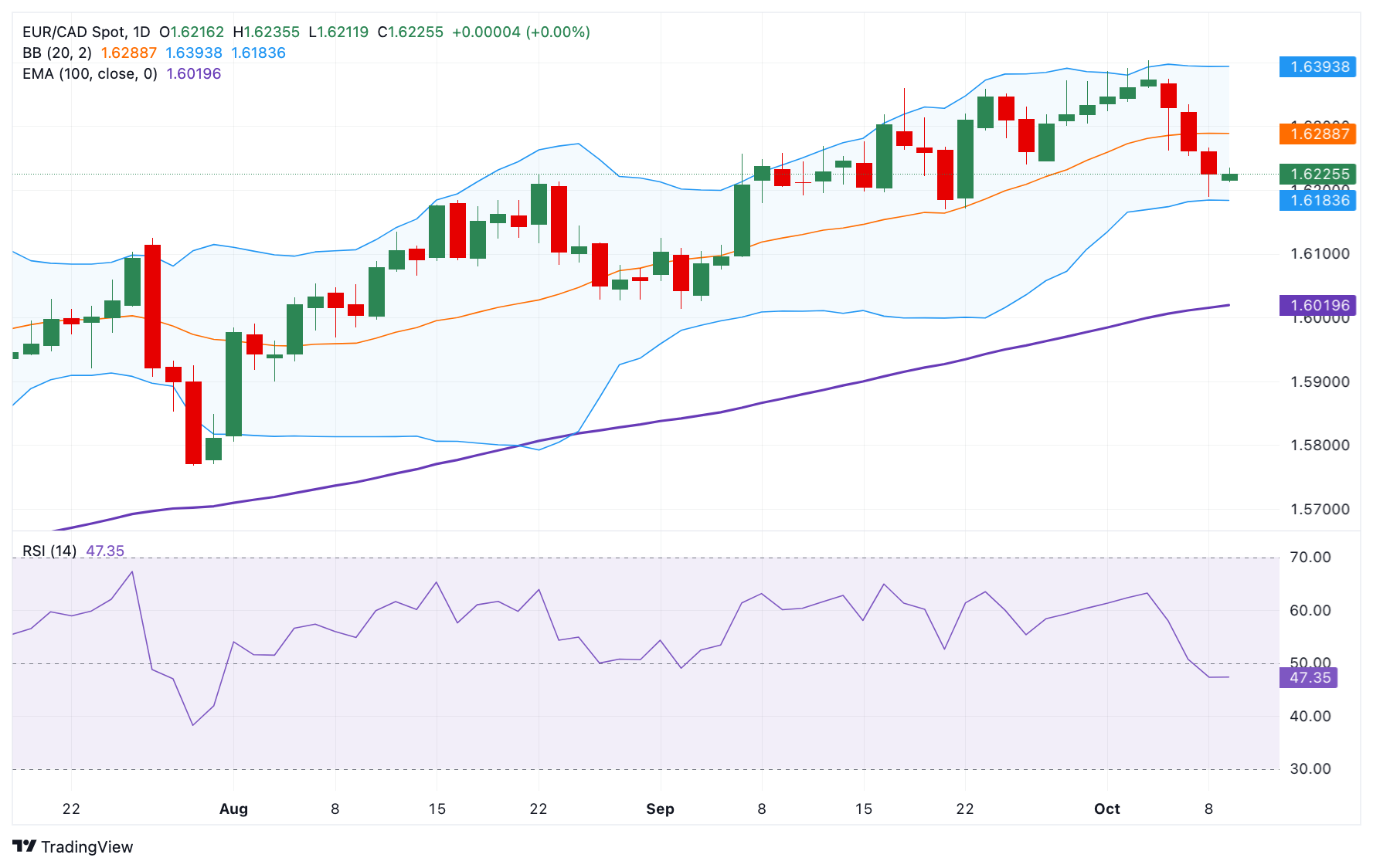
- Positive outlook of the cross prevails, but further consolidation cannot be ruled out with a neutral RSI indicator.
- The immediate resistance level is seen at 1.6266; the initial support level is located at 1.6184.
The EUR/CAD cross holds steady near 1.6225 during the early European session on Thursday. The political crisis in France after the shock resignation of France’s Prime Minister Sebastien Lecornu and his government could weigh on the Euro (EUR) against the Canadian Dollar (CAD).
Technically, EUR/CAD keeps the bullish vibe on the daily chart, with the price holding above the key 100-day Exponential Moving Average (EMA). Nonetheless, further consolidation cannot be ruled out as the 14-day Relative Strength Index (RSI) hovers around the midline. This suggests neutral momentum in the near term.
The first upside target to watch for the cross is seen at 1.6266, the high of October 8. Extended gains could see a rally to 1.6350, the high of September 24. Further north, the next hurdle is located in the 1.6395-1.6400 zone, representing the upper boundary of the Bollinger Band and psychological level.
On the other hand, the initial support level for the cross emerges at 1.6184, the lower limit of the Bollinger Band. A breach of this level could expose 1.6095, the low of September 5. The additional downside filter to watch is 1.6030, the 100-day EMA.
EUR/CAD Daily Chart
Euro FAQs
The Euro is the currency for the 19 European Union countries that belong to the Eurozone. It is the second most heavily traded currency in the world behind the US Dollar. In 2022, it accounted for 31% of all foreign exchange transactions, with an average daily turnover of over $2.2 trillion a day. EUR/USD is the most heavily traded currency pair in the world, accounting for an estimated 30% off all transactions, followed by EUR/JPY (4%), EUR/GBP (3%) and EUR/AUD (2%).
The European Central Bank (ECB) in Frankfurt, Germany, is the reserve bank for the Eurozone. The ECB sets interest rates and manages monetary policy. The ECB’s primary mandate is to maintain price stability, which means either controlling inflation or stimulating growth. Its primary tool is the raising or lowering of interest rates. Relatively high interest rates – or the expectation of higher rates – will usually benefit the Euro and vice versa. The ECB Governing Council makes monetary policy decisions at meetings held eight times a year. Decisions are made by heads of the Eurozone national banks and six permanent members, including the President of the ECB, Christine Lagarde.
Eurozone inflation data, measured by the Harmonized Index of Consumer Prices (HICP), is an important econometric for the Euro. If inflation rises more than expected, especially if above the ECB’s 2% target, it obliges the ECB to raise interest rates to bring it back under control. Relatively high interest rates compared to its counterparts will usually benefit the Euro, as it makes the region more attractive as a place for global investors to park their money.
Data releases gauge the health of the economy and can impact on the Euro. Indicators such as GDP, Manufacturing and Services PMIs, employment, and consumer sentiment surveys can all influence the direction of the single currency. A strong economy is good for the Euro. Not only does it attract more foreign investment but it may encourage the ECB to put up interest rates, which will directly strengthen the Euro. Otherwise, if economic data is weak, the Euro is likely to fall. Economic data for the four largest economies in the euro area (Germany, France, Italy and Spain) are especially significant, as they account for 75% of the Eurozone’s economy.
Another significant data release for the Euro is the Trade Balance. This indicator measures the difference between what a country earns from its exports and what it spends on imports over a given period. If a country produces highly sought after exports then its currency will gain in value purely from the extra demand created from foreign buyers seeking to purchase these goods. Therefore, a positive net Trade Balance strengthens a currency and vice versa for a negative balance.

FXStreet
100만 명이 넘는 사용자가 FXStreet를 통해 실시간 시장 데이터, 차트 도구, 전문가 인사이트, 포렉스 뉴스를 이용합니다. 포괄적인 경제 캘린더와 교육 웨비나는 트레이더가 정보를 유지하고 신중한 결정을 내리도록 돕습니다. FXStreet는 바르셀로나 본사와 전 세계 지역에 걸쳐 약 60명의 팀으로 구성되어 있습니다.
Read More








