

Trade The World
EUR/GBP Price Forecast: Under growing bearish pressure towards 0.8720
작성자 Guillermo Alcala
게시일: 27 Nov 2025 | 수정일: 27 Nov 2025


POPULAR ARTICLES

The Euro hesitates near monthly lows, following a sharp reversal after the release of the UK Budget on Wednesday. The pair has found some support at 0.8745 earlier on the day, but is lacking acceptance above 0.8760, and looks likely to extend its reversal, aiming for the 0.8720 area.
- The Euro has bounced up from 0.8746 but remains capped below the 0.8760 area so far.
- The Pound rallied following the release of a tax-rising UK Budget on Wednesday.
- EUR/GBP trend remains bearish, with the 0.8720 support area in focus.
The Euro hesitates near monthly lows, following a sharp reversal after the release of the UK Budget on Wednesday. The pair has found some support at 0.8745 earlier on the day, but is lacking acceptance above 0.8760, and looks likely to extend its reversal, aiming for the 0.8720 area.
UK Finance Minister Rachel Reeves delivered a tax-raising budget on Wednesday, which soothed investors, whose main concern was the Government's plan to bring the fiscal deficit under control. The market reacted positively, boosting UK bonds and the Sterling higher, and adding further bearish pressure to the EUR/GBP pair.
Technical Analysis: Bears look at the 0.8710 area
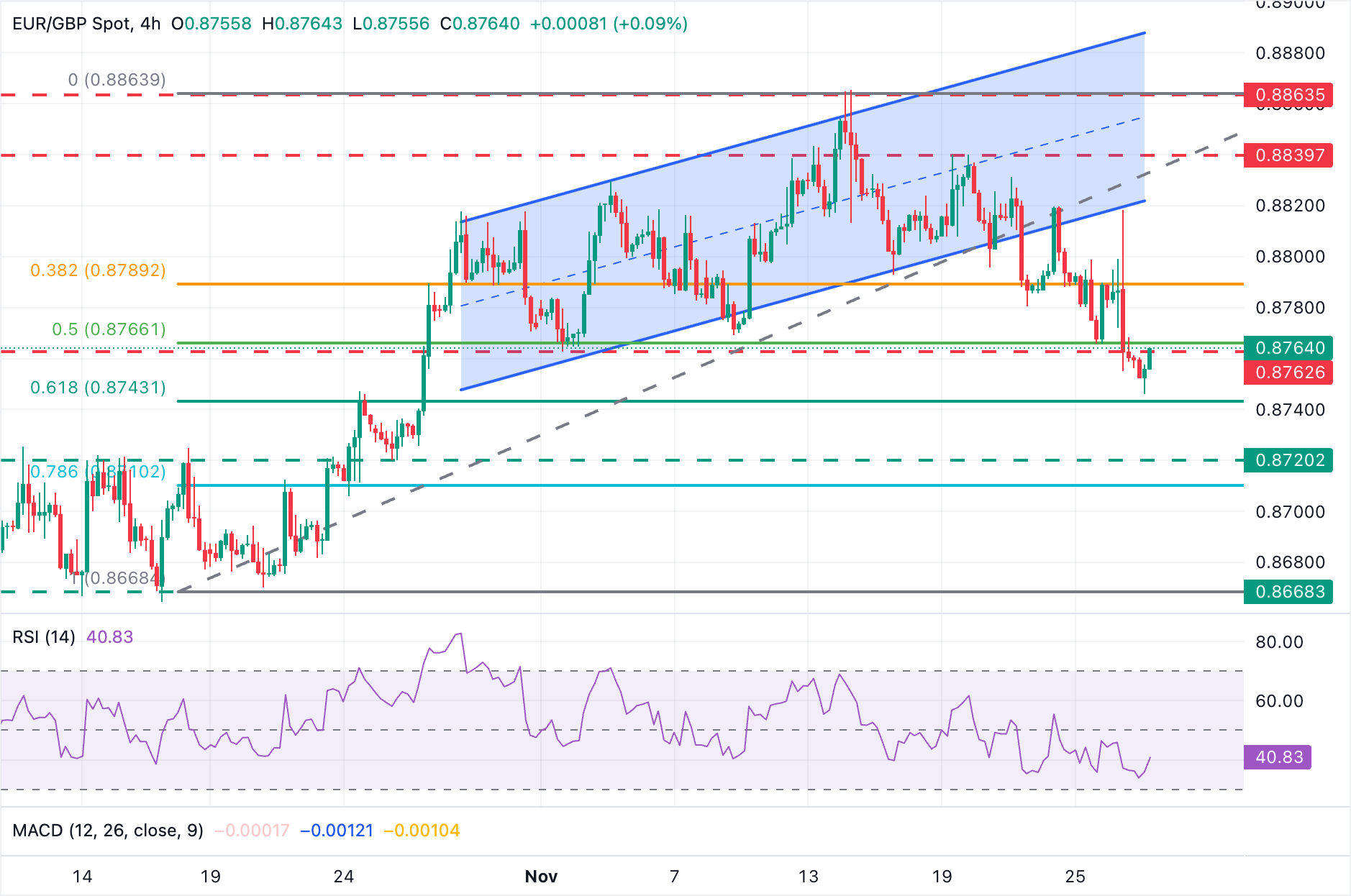
The technical picture is bearish, with the pair correcting lower from the mid-November highs above 0.8860. The rejection at a previous trendline support, near 0.8820 on Wednesday, printed an impulsive bearish candle on the daily chart, and confirmed the pair’s negative momentum.
The Euro is clinging to the 61.8% Fibonacci retracement of the late November rally, at 0.8743, but upside attempts remain limited, with the October 27 low, at 0.8720, on the bears’ focus. Further down, the 78.6% Fibonacci retracement of the mentioned cycle is at 0.8710.
On the upside, previous support at 0.8760 is now acting as resistance. Above here, the next targets are the mentioned reverse trendline, at 0.8820, and the November 19 and 20 highs, at 0.8760.
Pound Sterling FAQs
The Pound Sterling (GBP) is the oldest currency in the world (886 AD) and the official currency of the United Kingdom. It is the fourth most traded unit for foreign exchange (FX) in the world, accounting for 12% of all transactions, averaging $630 billion a day, according to 2022 data. Its key trading pairs are GBP/USD, also known as ‘Cable’, which accounts for 11% of FX, GBP/JPY, or the ‘Dragon’ as it is known by traders (3%), and EUR/GBP (2%). The Pound Sterling is issued by the Bank of England (BoE).
The single most important factor influencing the value of the Pound Sterling is monetary policy decided by the Bank of England. The BoE bases its decisions on whether it has achieved its primary goal of “price stability” – a steady inflation rate of around 2%. Its primary tool for achieving this is the adjustment of interest rates. When inflation is too high, the BoE will try to rein it in by raising interest rates, making it more expensive for people and businesses to access credit. This is generally positive for GBP, as higher interest rates make the UK a more attractive place for global investors to park their money. When inflation falls too low it is a sign economic growth is slowing. In this scenario, the BoE will consider lowering interest rates to cheapen credit so businesses will borrow more to invest in growth-generating projects.
Data releases gauge the health of the economy and can impact the value of the Pound Sterling. Indicators such as GDP, Manufacturing and Services PMIs, and employment can all influence the direction of the GBP. A strong economy is good for Sterling. Not only does it attract more foreign investment but it may encourage the BoE to put up interest rates, which will directly strengthen GBP. Otherwise, if economic data is weak, the Pound Sterling is likely to fall.
Another significant data release for the Pound Sterling is the Trade Balance. This indicator measures the difference between what a country earns from its exports and what it spends on imports over a given period. If a country produces highly sought-after exports, its currency will benefit purely from the extra demand created from foreign buyers seeking to purchase these goods. Therefore, a positive net Trade Balance strengthens a currency and vice versa for a negative balance.

FXStreet
100만 명이 넘는 사용자가 FXStreet를 통해 실시간 시장 데이터, 차트 도구, 전문가 인사이트, 포렉스 뉴스를 이용합니다. 포괄적인 경제 캘린더와 교육 웨비나는 트레이더가 정보를 유지하고 신중한 결정을 내리도록 돕습니다. FXStreet는 바르셀로나 본사와 전 세계 지역에 걸쳐 약 60명의 팀으로 구성되어 있습니다.
Read More








