

EUR/USD holds losses with US manufacturing data, Fed speakers on tap
작성자 Guillermo Alcala
게시일: 15 Jan 2026 | 수정일: 15 Jan 2026


인기 기사

EUR/USD remains capped below 1.1640 on Thursday, trading at 1.1635 at the time of writing, and dangerously close to one-month lows, at 1.1618, despite the stronger-than-expected Eurozone Industrial Production figures seen earlier on the day.
- EUR/USD remains capped below 1.1640 on Thursday, close to one-month lows at 1.1618.
- Eurozone data showed that Industrial Production grew beyond expectations in November.
- US manufacturing reports and more Fed speakers will grab the focus on Thursday.
EUR/USD remains capped below 1.1640 on Thursday, trading at 1.1635 at the time of writing, and dangerously close to one-month lows, at 1.1618, despite the stronger-than-expected Eurozone Industrial Production figures seen earlier on the day.
Data released by Eurostat on Thursday revealed that the Eurozone's Industrial Production advanced at a steady 0.7% pace in November, against market expectations of a moderate slowdown to 0.5%. Year-on-year, production growth accelerated to 2.5%, from 2% in October and beyond the 2% increase anticipated by the market's consensus.
Looking in perspective, however, the Euro maintains its bearish trend from late- December highs intact as a slate of fairly strong US macroeconomic figures and easing concerns about the US Federal Reserve’s (Fed) autonomy keep underpinning demand for the US Dollar.
US data released on Wednesday showed a larger-than-expected acceleration in producer prices and a strong rebound in retail consumption in November, providing further reasons for the Fed to keep interest rates unchanged in the coming months.
Beyond that, US President Donald Trump calmed markets, stating that he has no plan to oust Fed Chairman Jerome Powell despite the criminal investigation against him. Investors’ concerns about the Fed’s independence sent the US Dollar tumbling earlier in the week and prompted most of the world's central bankers to sign a statement defending Powell.
Investors are now looking to the NY Empire State and the Philadelphia Fed manufacturing reports to confirm the improvement of the US economic outlook in the fourth quarter of 2025. These figures will frame the speeches from Fed policymakers later on the day.
Euro Price Today
The table below shows the percentage change of Euro (EUR) against listed major currencies today. Euro was the strongest against the Canadian Dollar.
| USD | EUR | GBP | JPY | CAD | AUD | NZD | CHF | |
|---|---|---|---|---|---|---|---|---|
| USD | 0.04% | 0.02% | -0.11% | 0.16% | -0.20% | -0.07% | 0.02% | |
| EUR | -0.04% | -0.03% | -0.13% | 0.12% | -0.24% | -0.11% | -0.02% | |
| GBP | -0.02% | 0.03% | -0.11% | 0.15% | -0.21% | -0.09% | 0.00% | |
| JPY | 0.11% | 0.13% | 0.11% | 0.25% | -0.10% | -0.01% | 0.12% | |
| CAD | -0.16% | -0.12% | -0.15% | -0.25% | -0.35% | -0.24% | -0.13% | |
| AUD | 0.20% | 0.24% | 0.21% | 0.10% | 0.35% | 0.13% | 0.22% | |
| NZD | 0.07% | 0.11% | 0.09% | 0.00% | 0.24% | -0.13% | 0.09% | |
| CHF | -0.02% | 0.02% | -0.01% | -0.12% | 0.13% | -0.22% | -0.09% |
The heat map shows percentage changes of major currencies against each other. The base currency is picked from the left column, while the quote currency is picked from the top row. For example, if you pick the Euro from the left column and move along the horizontal line to the US Dollar, the percentage change displayed in the box will represent EUR (base)/USD (quote).
Daily Digest Market Movers: US PPI and Retail Sales data support the US Dollar
- The US Dollar keeps heading higher against most of its peers, as US macroeconomic data endorses the view that the Fed is likely to keep its monetary policy unchanged in the coming months.
- On Wednesday, November's US Producer Price Index (PPI) report showed inflation accelerated to a 3% year-on-year pace from 2.8% in the previous month, compared to expectations of a slowdown to 2.7%. Likewise, the core PPI rose 3% in the year to November, from 2.9%, also against the market consensus of 2.7%.
- These figures come after Tuesday's Consumer Prices Index (CPI), which showed steady readings in December and revealed that price pressures remain high in the US.
- Also on Wednesday, data from the US Census Bureau showed that Retail Sales grew at a 0.6% pace in November, following a 0.1% decline in October, and beating market expectations of a 0.4% increase. The strong consumption figures add to the case of a strong US economic performance in the last quarter of the year and ease pressure on the Fed to lower borrowing costs further.
- Geopolitical tensions have eased somewhat, as President Trump affirmed that he believes the killings of protesters in Iran have subsided, as US experts warned about the risks of a military intervention against the Islamic Republic. Oil and safe havens like precious metals have pulled back following the comments, which are also likely to weigh on the US Dollar's rally.
- In Europe, later on Thursday, Eurostat will release the Eurozone's Industrial Production data. Factory output is expected to have increased 0.5% in November, following a 0.8% increase in October. Year-on-Year, production is seen growing at a steady 2% pace.
- In the US, the NY Empire State Manufacturing Index and the Philadelphia Fed Manufacturing Survey will provide some insight into the sector's activity ahead of speeches from Atlanta Fed President Raphael Bostic, Governor Michael Barr, Richmond Fed President Thomas Barkin, and Kansas City Fed President Jeffrey Schmid.
Technical Analysis: EUR/USD remains close to 1.1618 lows
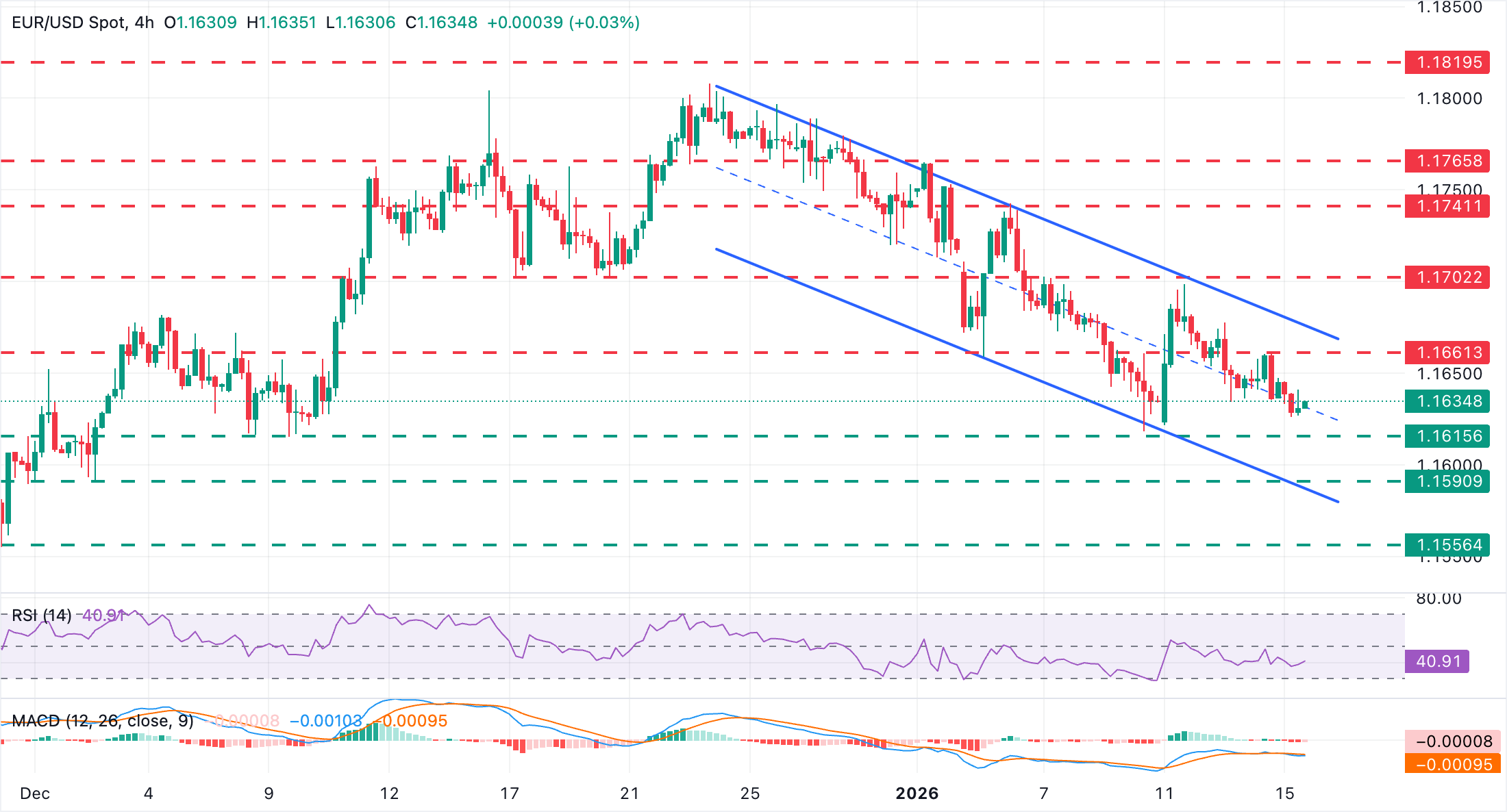
The EUR/USD trades near 1.1635 at the time of writing, extending its reversal from weekly highs near 1.1700 with price action contained within a descending channel since late December. The Moving Average Convergence Divergence (MACD) indicator holds around the zero line on the 4-hour chart, highlighting a neutral tone, while the Relative Strength Index (RSI) is pointing downwards at 38, suggesting increasing bearish momentum.
Bears are aiming for the January 9 low, in the vicinity of 1.1615. Further down, the area between the channel bottom, now around 1.1600, and the December 2 low, at 1.1590, is likely to be targeted. To the upside, Wednesday's high, at 1.1660, might pose some resistance ahead of the channel top, at 1.1690, and the January 12 high, near 1.1700.
(The technical analysis of this story was written with the help of an AI tool.)

100만 명이 넘는 사용자가 FXStreet를 통해 실시간 시장 데이터, 차트 도구, 전문가 인사이트, 포렉스 뉴스를 이용합니다. 포괄적인 경제 캘린더와 교육 웨비나는 트레이더가 정보를 유지하고 신중한 결정을 내리도록 돕습니다. FXStreet는 바르셀로나 본사와 전 세계 지역에 걸쳐 약 60명의 팀으로 구성되어 있습니다.
더 읽기








