

Trade The World
GBP/USD resumes bearish ways as Fed rate cut bolsters Greenback
작성자 Joshua Gibson
게시일: 30 Oct 2025 | 수정일: 30 Oct 2025


POPULAR ARTICLES

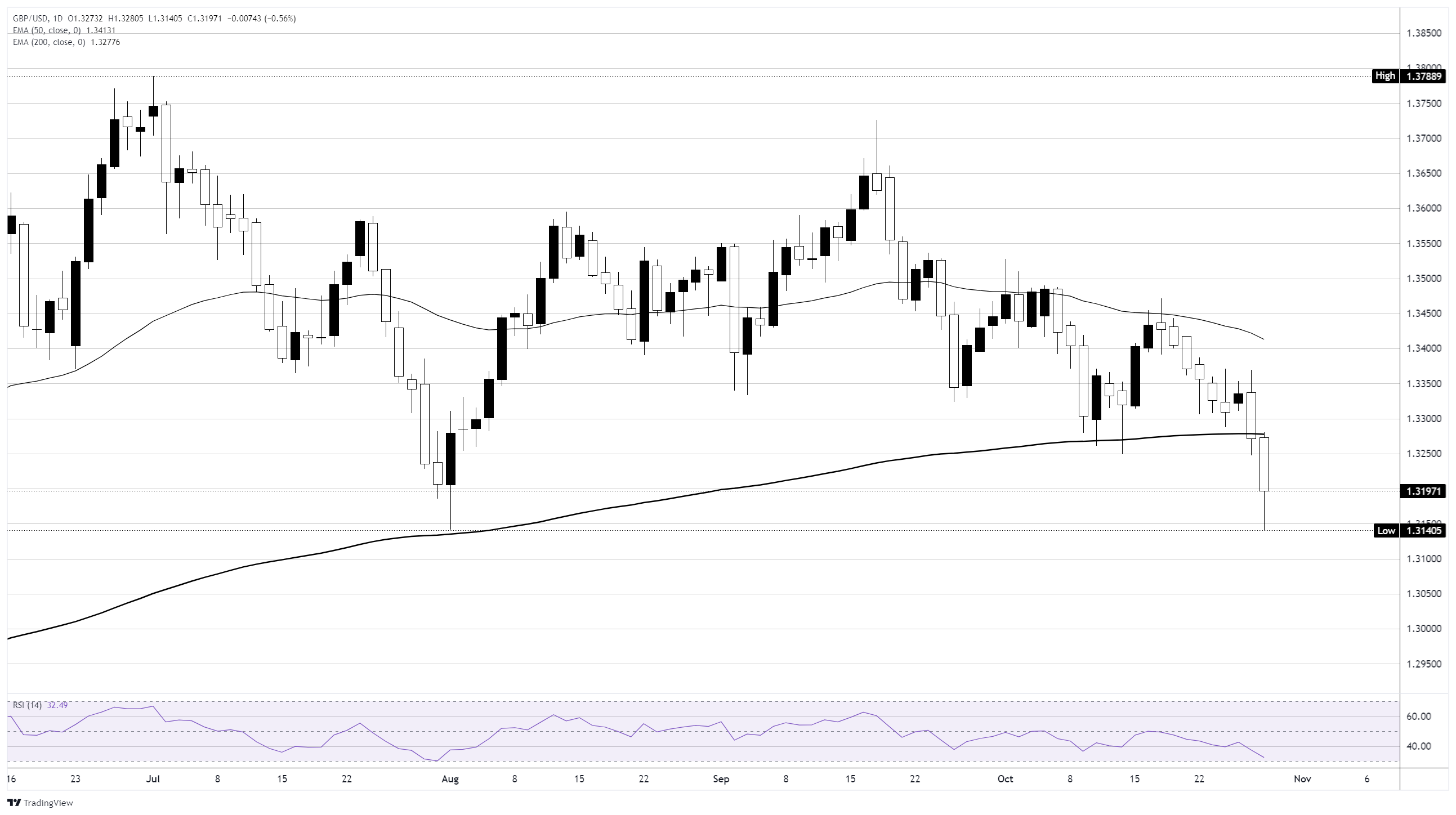
GBP/USD fell steeply during Wednesday’s American market session, extending a decline through the 200-day Exponential Moving Average (EMA) and pushing Cable positioning even further into bear country.
- GBP/USD fell another 0.6% on Wednesday as USD demand continues to climb.
- The Fed may not be as eager to deliver three straight rate cuts as many initially expected.
- With official data sources running dry amid the US government shutdown, Fed caution is on the rise.
GBP/USD fell steeply during Wednesday’s American market session, extending a decline through the 200-day Exponential Moving Average (EMA) and pushing Cable positioning even further into bear country. GBP/USD has closed in the red for eight of the last nine consecutive trading days, pushing the Pound Sterling (GBP) into a -2.46% swing against the US Dollar (USD) top-to-bottom.
The Federal Reserve (Fed) cut its main reference rate by another 25 basis points on Wednesday, as many market participants expected. What caught investors off guard, however, was Fed Chair Jerome Powell's press conference that struck an even more cautious note than usual. Before this week’s Fed interest rate decision, investors were confident that an October rate cut would be followed up by a third straight rate cut in December. Now, interest rate cuts through the second half of 2025 may very well be a two-and-done.
Citing a general lack of official datasets, thanks to the ongoing US government shutdown, Fed head Powell cautioned that the Fed may be forced to adopt a wait-and-see approach once again. With the potential for another data cycle with no meaningful decision on rate cuts from the Fed, investors have pulled back sharply from their hopes for a third rate cut in December. At the time of writing, rate traders are pricing in odds of a third rate trim on December 10 at less than 33%, with hopes for another rate cut pushed out to January of 2026.
GBP/USD daily chart
Pound Sterling FAQs
The Pound Sterling (GBP) is the oldest currency in the world (886 AD) and the official currency of the United Kingdom. It is the fourth most traded unit for foreign exchange (FX) in the world, accounting for 12% of all transactions, averaging $630 billion a day, according to 2022 data. Its key trading pairs are GBP/USD, also known as ‘Cable’, which accounts for 11% of FX, GBP/JPY, or the ‘Dragon’ as it is known by traders (3%), and EUR/GBP (2%). The Pound Sterling is issued by the Bank of England (BoE).
The single most important factor influencing the value of the Pound Sterling is monetary policy decided by the Bank of England. The BoE bases its decisions on whether it has achieved its primary goal of “price stability” – a steady inflation rate of around 2%. Its primary tool for achieving this is the adjustment of interest rates. When inflation is too high, the BoE will try to rein it in by raising interest rates, making it more expensive for people and businesses to access credit. This is generally positive for GBP, as higher interest rates make the UK a more attractive place for global investors to park their money. When inflation falls too low it is a sign economic growth is slowing. In this scenario, the BoE will consider lowering interest rates to cheapen credit so businesses will borrow more to invest in growth-generating projects.
Data releases gauge the health of the economy and can impact the value of the Pound Sterling. Indicators such as GDP, Manufacturing and Services PMIs, and employment can all influence the direction of the GBP. A strong economy is good for Sterling. Not only does it attract more foreign investment but it may encourage the BoE to put up interest rates, which will directly strengthen GBP. Otherwise, if economic data is weak, the Pound Sterling is likely to fall.
Another significant data release for the Pound Sterling is the Trade Balance. This indicator measures the difference between what a country earns from its exports and what it spends on imports over a given period. If a country produces highly sought-after exports, its currency will benefit purely from the extra demand created from foreign buyers seeking to purchase these goods. Therefore, a positive net Trade Balance strengthens a currency and vice versa for a negative balance.

FXStreet
100만 명이 넘는 사용자가 FXStreet를 통해 실시간 시장 데이터, 차트 도구, 전문가 인사이트, 포렉스 뉴스를 이용합니다. 포괄적인 경제 캘린더와 교육 웨비나는 트레이더가 정보를 유지하고 신중한 결정을 내리도록 돕습니다. FXStreet는 바르셀로나 본사와 전 세계 지역에 걸쳐 약 60명의 팀으로 구성되어 있습니다.
Read More








