

Gold Price Forecast: XAU/USD faces selling pressure above $4,200 as US Dollar rebounds
작성자 Sagar Dua
게시일: 2 Dec 2025 | 수정일: 2 Dec 2025


인기 기사

Gold price (XAU/USD) is down 1% to near $4,180.00 during the European trading session on Tuesday. The yellow metal slumps after failing to hold above $4,200 as the US Dollar (USD) bounces back despite weak United States (US) ISM manufacturing Purchasing Managers’ Index (PMI) data for November.
- Gold price tumbles to near $4,180 as the US Dollar extends Monday’s recovery move.
- The US Dollar gains despite weak US ISM Manufacturing PMI data for November.
- Firm dovish Fed expectations keep the Gold price broadly on the front foot.
Gold price (XAU/USD) is down 1% to near $4,180.00 during the European trading session on Tuesday. The yellow metal slumps after failing to hold above $4,200 as the US Dollar (USD) bounces back despite weak United States (US) ISM manufacturing Purchasing Managers’ Index (PMI) data for November.
At the press time, the US Dollar Index (DXY), which tracks the Greenback’s value against six major currencies, trades 0.1% higher to near 99.55. The USD Index recovered on Monday after revisiting the monthly low around 99.00.
Technically, a higher US Dollar makes the Gold price an expensive bet for investors.
On Monday, the US ISM reported that the Manufacturing PMI came in lower at 48.2 from estimates of 48.6 and the prior release of 48.7, signaling contraction in the manufacturing sector activity at a faster pace. A figure below the 50.0 threshold is considered a contraction in the business activity. Also, sub-components of the Manufacturing PMI, such as Employment and New Orders Index, declined at a faster pace.
Broadly, the outlook of the Gold price remains firm as traders seem confident that the Federal Reserve (Fed) will cut interest rates in its monetary policy announcement next week.
According to the CME FedWatch tool, the probability of the Fed cutting interest rates by 25 basis points (bps) to 3.50%-3.75% in December is 86.5%.
This week, investors will pay close attention to the US ADP Employment Change for November and the Personal Consumption Expenditure Price Index (PCE) data for September on Wednesday and Friday, respectively.
Gold technical Analysis
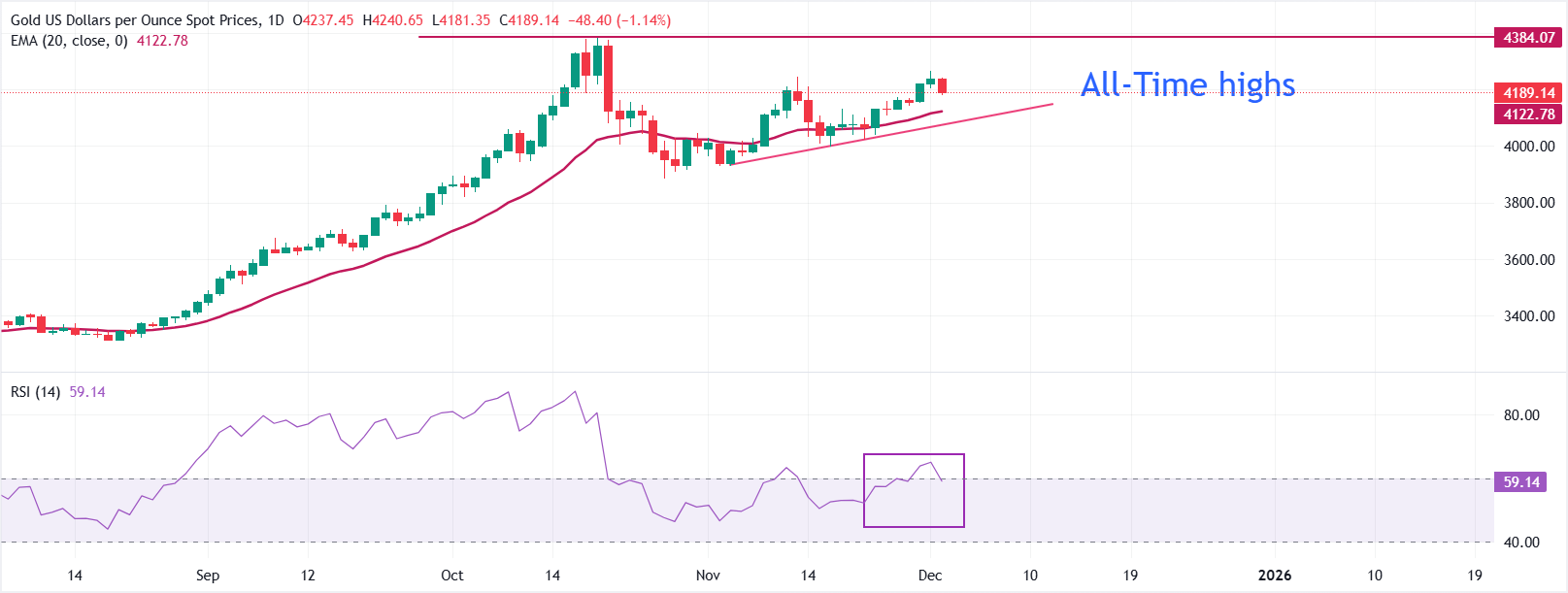
In the daily chart, XAU/USD trades around $4,190 during Tuesday’s European trading hours. The 20-day Exponential Moving Average (EMA) at $4,122.78 rises, with price holding above it to maintain a positive bias. Pullbacks toward the average would find support while its slope stays higher. RSI at 59, above 50, keeps bullish momentum intact despite easing from recent highs.
The 14-day Relative Strength Index (RSI) bends to near 60.00, while the momentum will remain in play until it holds that level.
The 20-day EMA remains positively aligned, keeping dip-buying interest in play. The rising trend line from $3,933.90 underpins the bias, offering support near $4,093.03. A daily close below that line would flag a deeper pullback, while holding above it would leave scope for an extension of the advance.
(The technical analysis of this story was written with the help of an AI tool)
Gold FAQs
Gold has played a key role in human’s history as it has been widely used as a store of value and medium of exchange. Currently, apart from its shine and usage for jewelry, the precious metal is widely seen as a safe-haven asset, meaning that it is considered a good investment during turbulent times. Gold is also widely seen as a hedge against inflation and against depreciating currencies as it doesn’t rely on any specific issuer or government.
Central banks are the biggest Gold holders. In their aim to support their currencies in turbulent times, central banks tend to diversify their reserves and buy Gold to improve the perceived strength of the economy and the currency. High Gold reserves can be a source of trust for a country’s solvency. Central banks added 1,136 tonnes of Gold worth around $70 billion to their reserves in 2022, according to data from the World Gold Council. This is the highest yearly purchase since records began. Central banks from emerging economies such as China, India and Turkey are quickly increasing their Gold reserves.
Gold has an inverse correlation with the US Dollar and US Treasuries, which are both major reserve and safe-haven assets. When the Dollar depreciates, Gold tends to rise, enabling investors and central banks to diversify their assets in turbulent times. Gold is also inversely correlated with risk assets. A rally in the stock market tends to weaken Gold price, while sell-offs in riskier markets tend to favor the precious metal.
The price can move due to a wide range of factors. Geopolitical instability or fears of a deep recession can quickly make Gold price escalate due to its safe-haven status. As a yield-less asset, Gold tends to rise with lower interest rates, while higher cost of money usually weighs down on the yellow metal. Still, most moves depend on how the US Dollar (USD) behaves as the asset is priced in dollars (XAU/USD). A strong Dollar tends to keep the price of Gold controlled, whereas a weaker Dollar is likely to push Gold prices up.

100만 명이 넘는 사용자가 FXStreet를 통해 실시간 시장 데이터, 차트 도구, 전문가 인사이트, 포렉스 뉴스를 이용합니다. 포괄적인 경제 캘린더와 교육 웨비나는 트레이더가 정보를 유지하고 신중한 결정을 내리도록 돕습니다. FXStreet는 바르셀로나 본사와 전 세계 지역에 걸쳐 약 60명의 팀으로 구성되어 있습니다.
더 읽기








