

Trade The World
Silver Price Forecast: XAG/USD consolidates below $41.50 with bearish RSI divergence
작성자 Vishal Chaturvedi
게시일: 10 Sep 2025 | 수정일: 10 Sep 2025


POPULAR ARTICLES
Silver (XAG/USD) trades under pressure on Tuesday, retreating from recent highs as a modest rebound in the US Dollar (USD) and Treasury yields weighs on the metal. At the time of writing, spot prices are trading near $40.85, down over 1% on the day.
- Silver retreats as a modest rebound in the US Dollar and Treasury yields caps upside momentum.
- Fed rate-cut expectations keep the broader bullish tone intact despite profit-taking.
- Technicals show RSI bearish divergence; key support at $40.50, resistance at $41.70-42.00.
Silver (XAG/USD) trades under pressure on Tuesday, retreating from recent highs as a modest rebound in the US Dollar (USD) and Treasury yields weighs on the metal. At the time of writing, spot prices are trading near $40.85, down over 1% on the day.
The white metal has been trapped in a tight band between $41.50 and $40.50 since last week, after hitting a fresh 14-year peak around $41.67 on Monday. While the pullback reflects profit-taking and short-term USD strength, the downside remains limited as markets are almost fully convinced that the Federal Reserve (Fed) will lower interest rates at its September 17 monetary policy meeting. Lower borrowing costs reduce the opportunity cost of holding non-yielding assets such as Silver, keeping the broader bullish tone intact.
The uptick in the Greenback comes despite the recent downward revision to US Nonfarm Payrolls (NFP), which confirmed that the labor market is losing momentum. Economists highlighted that the slowdown reflects businesses turning cautious, with some warning that the economy is edging closer to recessionary conditions. The US Dollar Index (DXY), which tracks the currency against a basket of six peers, is trading around 97.70 after staging a technical rebound from seven-week lows touched earlier in the day.
Attention now turns to this week's key inflation releases. The US Producer Price Index (PPI) will be published on Wednesday, followed by the Consumer Price Index (CPI) on Thursday, both of which are expected to shape expectations for the Fed’s policy outlook.
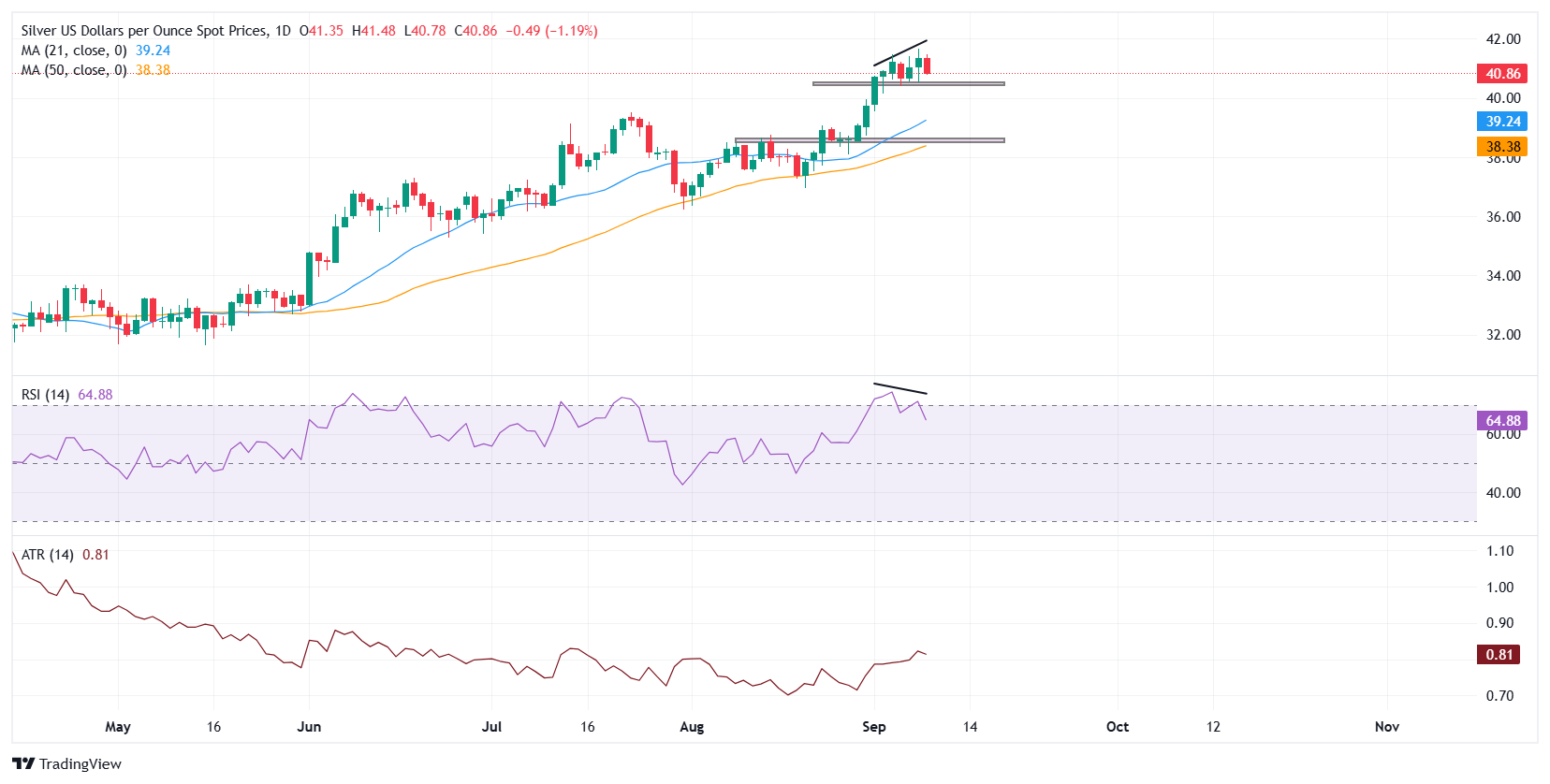
Technically, XAG/USD is struggling to extend its rally, with momentum indicators flashing caution. On the daily chart, the Relative Strength Index (RSI) is easing from overbought territory and showing bearish divergence, as price carved out higher highs while the oscillator printed lower highs. This divergence often precedes corrective pullbacks, highlighting fading upside momentum. The Average True Range (ATR) remains muted near 0.81, suggesting limited volatility in the short term, though a break outside the $41.50-$40.50 band could trigger a sharper move.
The first line of defense sits at $40.50, followed by the 21-day Simple Moving Average (SMA) at $39.24. Deeper losses could target the 50-day SMA near $38.40. On the upside, a sustained move above $41.70 would reduce the significance of the divergence and open the door toward the $42.00 psychological barrier.
Silver FAQs
Silver is a precious metal highly traded among investors. It has been historically used as a store of value and a medium of exchange. Although less popular than Gold, traders may turn to Silver to diversify their investment portfolio, for its intrinsic value or as a potential hedge during high-inflation periods. Investors can buy physical Silver, in coins or in bars, or trade it through vehicles such as Exchange Traded Funds, which track its price on international markets.
Silver prices can move due to a wide range of factors. Geopolitical instability or fears of a deep recession can make Silver price escalate due to its safe-haven status, although to a lesser extent than Gold's. As a yieldless asset, Silver tends to rise with lower interest rates. Its moves also depend on how the US Dollar (USD) behaves as the asset is priced in dollars (XAG/USD). A strong Dollar tends to keep the price of Silver at bay, whereas a weaker Dollar is likely to propel prices up. Other factors such as investment demand, mining supply – Silver is much more abundant than Gold – and recycling rates can also affect prices.
Silver is widely used in industry, particularly in sectors such as electronics or solar energy, as it has one of the highest electric conductivity of all metals – more than Copper and Gold. A surge in demand can increase prices, while a decline tends to lower them. Dynamics in the US, Chinese and Indian economies can also contribute to price swings: for the US and particularly China, their big industrial sectors use Silver in various processes; in India, consumers’ demand for the precious metal for jewellery also plays a key role in setting prices.
Silver prices tend to follow Gold's moves. When Gold prices rise, Silver typically follows suit, as their status as safe-haven assets is similar. The Gold/Silver ratio, which shows the number of ounces of Silver needed to equal the value of one ounce of Gold, may help to determine the relative valuation between both metals. Some investors may consider a high ratio as an indicator that Silver is undervalued, or Gold is overvalued. On the contrary, a low ratio might suggest that Gold is undervalued relative to Silver.

FXStreet
100만 명이 넘는 사용자가 FXStreet를 통해 실시간 시장 데이터, 차트 도구, 전문가 인사이트, 포렉스 뉴스를 이용합니다. 포괄적인 경제 캘린더와 교육 웨비나는 트레이더가 정보를 유지하고 신중한 결정을 내리도록 돕습니다. FXStreet는 바르셀로나 본사와 전 세계 지역에 걸쳐 약 60명의 팀으로 구성되어 있습니다.
Read More








