

Trade The World
USD/JPY Price Forecast: Steadies below 147.50 as traders await fresh catalyst
작성자 Christian Borjon Valencia
게시일: 9 Sep 2025 | 수정일: 9 Sep 2025


POPULAR ARTICLES

The USD/JPY holds steady below the 147.50 figure yet posts a minuscule loss of 0.02% as traders market participants priced in a Fed rate cut at the September meeting.
- USD/JPY posts marginal 0.02% loss, holding between key 20-day and 50-day SMA support levels.
- RSI flattens near neutral 50, signaling indecision as traders await catalyst to break consolidation range.
- Upside targets sit at 148.71 and 149.00, while downside risks loom toward 145.92 100-day SMA support.
The USD/JPY holds steady below the 147.50 figure yet posts a minuscule loss of 0.02% as traders market participants priced in a Fed rate cut at the September meeting.
Despite this, the resignation of the Japanese Prime Minister Shigeru Ishiba, might prevent the Japanese Yen (JPY) advance as political turmoil can prompt investors to buy the Dollar as haven.
USD/JPY Price Forecast: Technical outlook
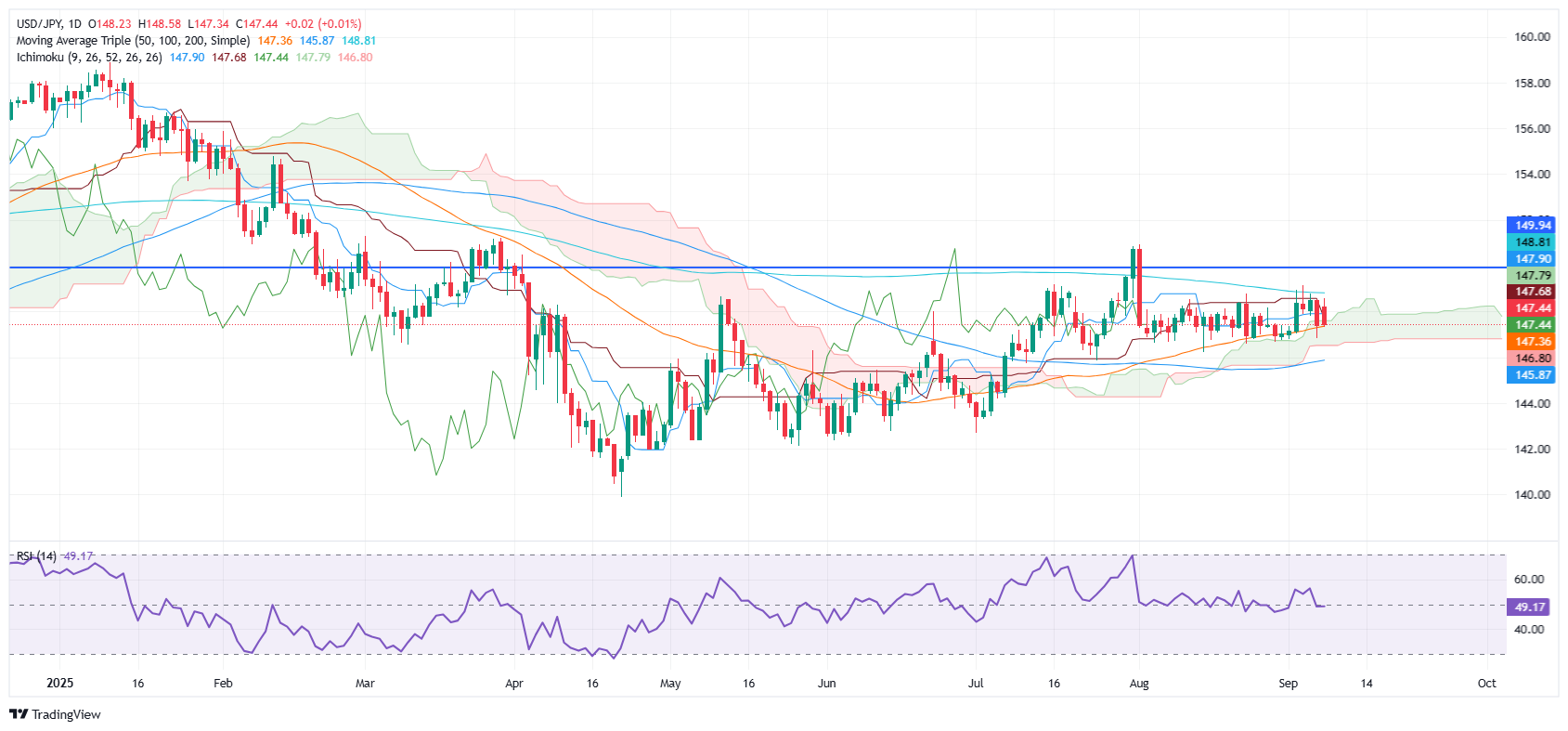
From a price action standpoint, the USD/JPY remains consolidated, with the first support level seen at the 20-day SMA at 147.55, slightly above the 50-day SMA at 147.42.
The Relative Strength Index (RSI) turned flat at around its 50 neutral level. Hence, USD/JPY traders are waiting for a fresh catalyst, before opening fresh bets in the pair.
If USD/JPY climbs past 148.00, the next resistance would be the 200-day SMA at 148.71. A breach of the latter will expose the 149.00 figure, ahead of 150.00.
On the flipside, the USD/JPY first support would be the above-mentioned daily SMAs. If sellers drive prices below 147.55 and 147.42, the next support would be the 100-day SMA at 145.92
USD/JPY Price Chart – Daily
Japanese Yen FAQs
The Japanese Yen (JPY) is one of the world’s most traded currencies. Its value is broadly determined by the performance of the Japanese economy, but more specifically by the Bank of Japan’s policy, the differential between Japanese and US bond yields, or risk sentiment among traders, among other factors.
One of the Bank of Japan’s mandates is currency control, so its moves are key for the Yen. The BoJ has directly intervened in currency markets sometimes, generally to lower the value of the Yen, although it refrains from doing it often due to political concerns of its main trading partners. The BoJ ultra-loose monetary policy between 2013 and 2024 caused the Yen to depreciate against its main currency peers due to an increasing policy divergence between the Bank of Japan and other main central banks. More recently, the gradually unwinding of this ultra-loose policy has given some support to the Yen.
Over the last decade, the BoJ’s stance of sticking to ultra-loose monetary policy has led to a widening policy divergence with other central banks, particularly with the US Federal Reserve. This supported a widening of the differential between the 10-year US and Japanese bonds, which favored the US Dollar against the Japanese Yen. The BoJ decision in 2024 to gradually abandon the ultra-loose policy, coupled with interest-rate cuts in other major central banks, is narrowing this differential.
The Japanese Yen is often seen as a safe-haven investment. This means that in times of market stress, investors are more likely to put their money in the Japanese currency due to its supposed reliability and stability. Turbulent times are likely to strengthen the Yen’s value against other currencies seen as more risky to invest in.

FXStreet
100만 명이 넘는 사용자가 FXStreet를 통해 실시간 시장 데이터, 차트 도구, 전문가 인사이트, 포렉스 뉴스를 이용합니다. 포괄적인 경제 캘린더와 교육 웨비나는 트레이더가 정보를 유지하고 신중한 결정을 내리도록 돕습니다. FXStreet는 바르셀로나 본사와 전 세계 지역에 걸쳐 약 60명의 팀으로 구성되어 있습니다.
Read More








