

Trade The World
WTI Price Forecast: Languishes near $61.50 support zone; seems vulnerable
작성자 Haresh Menghani
게시일: 1 Oct 2025 | 수정일: 1 Oct 2025


POPULAR ARTICLES

West Texas Intermediate (WTI) US Crude Oil prices extend last week's retracement slide from the $66.20 region, or the highest level since August 4, and drift lower for the fourth successive day on Wednesday.
- WTI retains negative bias for the third straight day amid US shutdown-led fuel demand concerns.
- The OPEC+ denies speculation of increasing Oil production, though it does little to lend any support.
- The technical setup favors bearish traders and backs the case for a further depreciating move.
West Texas Intermediate (WTI) US Crude Oil prices extend last week's retracement slide from the $66.20 region, or the highest level since August 4, and drift lower for the fourth successive day on Wednesday. The commodity slides to an over one-week low, around the $61.85-$61.80 region during the first half of the European session, though it lacks follow-through selling.
Concerns that a prolonged US government shutdown could have an adverse effect on the economy and dent fuel demand, which turns out to be a key factor weighing on Crude Oil prices. Meanwhile, the OPEC+ denied speculation regarding a hike in Oil production in its upcoming meeting on Sunday, which, in turn, could offers support to the black liquid and help limit any further losses.
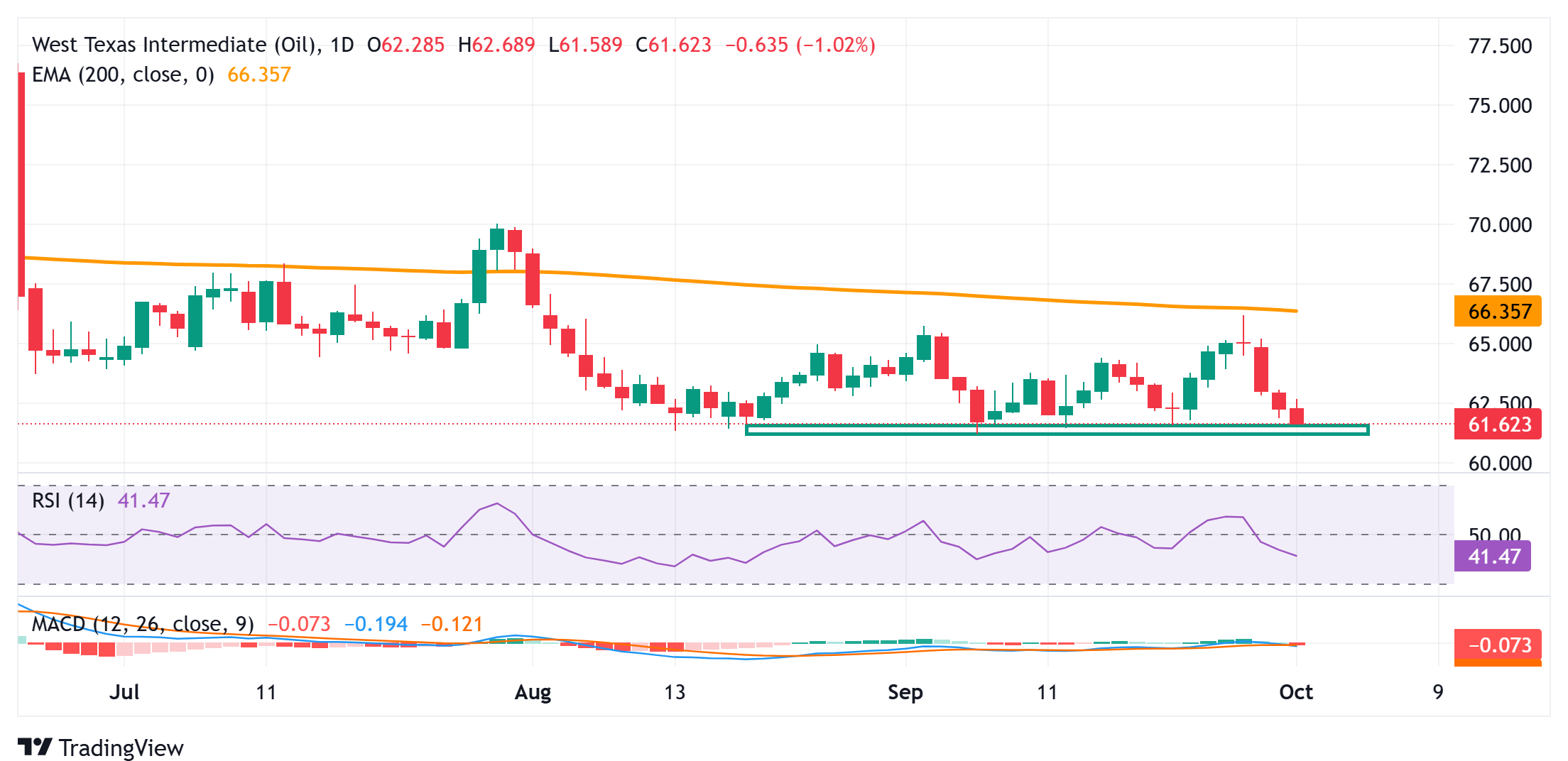
From a technical perspective, last week's failure near the 200-day Exponential Moving Average (EMA) and the subsequent fall could be seen as a key trigger for bearish traders. Moreover, oscillators on the daily chart have again started gaining negative traction and validate the negative outlook, suggesting that the path of least resistance for Crude Oil prices is to the downside.
Some follow-through selling below the $61.50-$61.30 area, or a multi-month low touched in September, should pave the way for deeper losses. Crude Oil prices might then accelerate the fall below the $61.00 mark, towards testing an intermediate support near the $60.40-$60.30 intermediate support en route to the late May swing low, around the $60.00 psychological mark.
On the flip side, any meaningful recovery attempt beyond the $62.00 mark now seems to confront an immediate hurdle near the daily top, around the $62.65-$62.70 region. A sustained strength beyond could trigger a short-covering move and lift Crude Oil prices beyond the $63.00 round figure, towards the $63.60-$63.65 hurdle en route to the $64.00 mark and the $64.25 region.
WTI daily chart
WTI Oil FAQs
WTI Oil is a type of Crude Oil sold on international markets. The WTI stands for West Texas Intermediate, one of three major types including Brent and Dubai Crude. WTI is also referred to as “light” and “sweet” because of its relatively low gravity and sulfur content respectively. It is considered a high quality Oil that is easily refined. It is sourced in the United States and distributed via the Cushing hub, which is considered “The Pipeline Crossroads of the World”. It is a benchmark for the Oil market and WTI price is frequently quoted in the media.
Like all assets, supply and demand are the key drivers of WTI Oil price. As such, global growth can be a driver of increased demand and vice versa for weak global growth. Political instability, wars, and sanctions can disrupt supply and impact prices. The decisions of OPEC, a group of major Oil-producing countries, is another key driver of price. The value of the US Dollar influences the price of WTI Crude Oil, since Oil is predominantly traded in US Dollars, thus a weaker US Dollar can make Oil more affordable and vice versa.
The weekly Oil inventory reports published by the American Petroleum Institute (API) and the Energy Information Agency (EIA) impact the price of WTI Oil. Changes in inventories reflect fluctuating supply and demand. If the data shows a drop in inventories it can indicate increased demand, pushing up Oil price. Higher inventories can reflect increased supply, pushing down prices. API’s report is published every Tuesday and EIA’s the day after. Their results are usually similar, falling within 1% of each other 75% of the time. The EIA data is considered more reliable, since it is a government agency.
OPEC (Organization of the Petroleum Exporting Countries) is a group of 12 Oil-producing nations who collectively decide production quotas for member countries at twice-yearly meetings. Their decisions often impact WTI Oil prices. When OPEC decides to lower quotas, it can tighten supply, pushing up Oil prices. When OPEC increases production, it has the opposite effect. OPEC+ refers to an expanded group that includes ten extra non-OPEC members, the most notable of which is Russia.

FXStreet
100만 명이 넘는 사용자가 FXStreet를 통해 실시간 시장 데이터, 차트 도구, 전문가 인사이트, 포렉스 뉴스를 이용합니다. 포괄적인 경제 캘린더와 교육 웨비나는 트레이더가 정보를 유지하고 신중한 결정을 내리도록 돕습니다. FXStreet는 바르셀로나 본사와 전 세계 지역에 걸쳐 약 60명의 팀으로 구성되어 있습니다.
Read More








